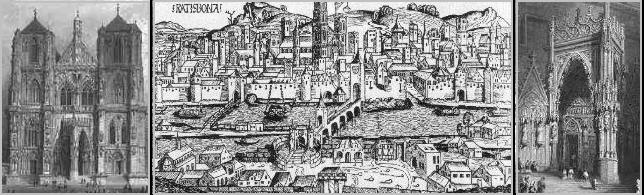
| Regensburg |
| A city important to Protestant history is Regensburg, also known as Ratisbon. It is one of the oldest German cities and a cultural center with historic monuments dating back to Celtic times. It was an important Roman outpost known as Castra Regina. An abbey was founded there in the mid 7th century, and St. Boniface established an Episcopal See in 739. Regensburg has a long history of negotiation and arbitration. For example, it was at the Council of Ratisbon in the year 742 that the first officially authorized the use of chaplains for armies was granted, but it prohibited the "servants of God" from bearing arms and fighting. The word chaplain itself dates from this period. Regensburg was captured by Charlemagne in 788 when he subjugated Bavaria. One of the most prosperous commercial centers of medieval Germany, Regenburg traded as far as India and the Middle East. The city proper of Regensburg was made a free imperial city in 1245, and accepted the Reformation in the 16th century, but was influenced by the Counter Reformation in the late 16th century. In the Thirty Years War Regensburg was garrisoned by Bavarian troops and was bombarded and captured by the Protestant general Bernhard of Saxe-Weimar in 1633, then recovered by imperial forces under Ferdinand III. From 1532, Regensburg was often the meeting place of the Imperial Diet, and it became the permanent seat of the Perpetual Diet or Immerwährender Reichstag, around 1663, around the time its commerce had declined. Under the influence of Napoleon, the diet was completely reorganized from the Holy Roman Empire from 1801 to 1803. In April of 1809, Napoleon Bonaparte was wounded scaling the town walls with ladders during a battle. The Bishopric of Regensburg and the city along with Aschaffenburg were given to K. T. von Dalberg, and Regensburg and became the capital of the Upper Palatinate in 1810 under Bavarian rule. Many people went to Regensburg to plead assorted legal cases. Astronomer Johannes Kepler died in the Golden Cross Lodging House in the city after having gone there to collect a debt in 1630. Another momentous event occurred at the Golden Cross when Holy Roman Emperor Karl V (King Carlos I of Spain) spent the summer of 1546 there and met a beautiful young girl named Barbara Blomberg, the daughter of a local craftsman. It developed into a passionate but short romance. An illegitimate son of this union was born in Regensburg under complete secrecy in 1547, and was separated from the mother and taken to Spain to be reared. The bastard Juan had an exciting life. He was raised as "Gerónimo" in Spain, and in respect of his father's will he was recognized by his legitimate half brother, Philip II of Spain, and given an income and the title of Don Juan of Austria. Philip hoped Juan would enter the Church, but Juan wanted the military career at which he later succeeded rather brilliantly. He fought pirates, various rebels and the Ottomans, defeating the Turks at in the Battle of Lepanto in 1571. At one point, Juan had even planned to liberate Mary Queen of Scots from her English captivity and marry her. He died of typhus. Unlike the other medieval German cities completely flattened by World War Two Allied bombing, many of Regensburg's ancient buildings amazingly survived, including the famous cathedral. However, the 9th century Romanesque church of Obermünster, top of page left, was completely destroyed at the tail end of the War by a totally meaningless bombing in March of 1945. Only the belfry still stood. The church could not be rebuilt. |