| Genius and scholar Johann Michael Friedrich Rückert spoke thirty languages, wrote complex books and created poetry, both strong and delicate, that served as an inspiration to the Lieder compositions of Brahms, Schubert, the Schumanns and countless others. J.M. Friedrich Rückert was born on May 16,1788 at Schweinfurt and educated at the universities of Wurzburg and Heidelberg. At the same time anti-Napoleon sentiment in Germany was bubbling over, he published his first book in 1814, echoing the feelings of his countrymen under the pseudonym Freimund Raimar. In 1815, he published 'Napoleon, eine politische Komödie in drei Stücken' ('Napolean, a Political Comedy in Three Parts') and in 1817, 'Der Kranz der Zeit' ('The Wreath of the Times'). For a time, he worked for a newspaper in Stuttgart and travelled to Rome in 1818. Upon his return, he lived Coburg for several years. In 1822, he published a collection of poems, Östliche Rosen ('Eastern Roses'), and in 1834-38, the six volume Gesammelte Gedichte ('Collected Poems'). He was inspired by August Wilhelm von Schlegel. By 1826, Ruckert was a master of thirty languages and was appointed professor of Oriental languages at the University of Erlangen, and then in Berlin in 1841. In 1849, he resigned in Berlin, and retired to his estate near Coburg. He died January 31,1866. Once famous world-wide, few people outside of Germany would recognize the name today. He was a prolific author and scholar, but also widely acclaimed as a translator of Oriental poetry and for his poetry, some of which was created in the spirit of Oriental masters and included love songs and dramas. His impressive works Die Weisheit des Brahmanen ('The Wisdom of the Brahmens') was published in six volumes in 1836, but he is probably most famous for his 1844 cycle of love songs, Liebesfrühling ('Spring of Love'). Several collections of his numerous poetical translations and original poems were found after his death and published. Among his Indian translations are complex works such as Nalopakhyana, the Amarusataka, the Raghuvamsa, and the Gita Govinda. Ruckert's translations of the Gitagovinda and Brahmanische Erzaehlungen are prized as works of art. Friedrich Rückert was also known for his contribution to the art of Lieder, and he influenced most of the musicians of his day, including the Schumanns, Brahms and Schubert, all of whom composed the melodies to his poems. But Rückert was in terrible anguish when he wrote the 425 'Kindertotenlieder'. Rückert had married Luise Fischer in 1820, and they had altogether ten children, of whom only seven outlived their parents. In December of 1833, his only daughter died of scarlet fever at the age of three, followed sixteen days later by his second youngest child, a son. Rückert wrote Kindertotenlieder in the six months after their deaths. In Ruckert's poem "Chidher", above, an eternally youthful wanderer returns every half millennium to the same place, each time encountering a completely transformed landscape. A town turns into to a pasture and then to a lake, the lake to a forest and then to a city. Yet, whenever Chidher asks one of the local inhabitants what has happened to the past environment, he always receives the same answer: "What's here has always been here and will always remain.'' It would be proved wrong. |
| "What is here has always been here and will always remain'' |
| Chidher, the ever youthful, told: I passed a city, bright to see; A man was culling fruits of gold, I asked him how old this town might be. He answered, culling as before “This town stood ever in days of yore, And will stand on forevermore!” Five hundred years from yonder day I passed again the selfsame way. I found a forest settlement, And o’er his axe, a tree to fell, I saw a man in labor bent. How old this wood I bade him tell. “’Tis everlasting, long before I lived it stood in days of yore,” He quoth; “and shall grow evermore.” Five hundred years from yonder day I passed again the selfsame way, And of the town I found no trace; A shepherd blew on a reed instead; His herd was grazing on the place. “How long,” I asked, “is the city dead?” He answered, blowing as before “The new crop grows the old one o’er, This was my pasture evermore!” |
| Five hundred years from yonder day I passed again the selfsame way. I saw a town; the market-square Was swarming with a noisy throng. “How long,” I asked, “has this town been there? Where are wood and sea and shepherds song?” Five hundred years from yonder day I passed again the selfsame way. A sea I found, the tide was full, A sailor emptied nets with cheer; And when he rested from his pull, I asked how long that sea was here. Then laughed he with a hearty roar “As long as waves have washed this shore They fished here ever in days of yore.” They cried, nor heard among the roar “This town was ever so before, And so will live forevermore!” “Five hundred years from yonder day I want to pass the selfsame way.” |
| Schweinfurt was first mentioned documents in the year 792. By the 10th century, it was the seat of a Margrave. It was expanded to a city with walls, towers and city gates by the 13th century when a mint was founded and a new church was built. Destroyed in 1250, then rebuilt, it was a free city and part of the Holy Roman Empire by 1282. In the mid-14th century, Schweinfurt joined the Swabian-Franconian Confederation and gained river rights to the Main. In 1514, a constitution was allowed and by 1542 the city joined the Reformation. It was destroyed in 1554, became part of the Protestant Union in 1609, and was rebuilt in 1615. Gustavus Adophus occupied it in the Thirty Years War. During the Napoleonic wars, Schweinfurt suffered heavy casualties. It remained a free imperial city until 1802, when it passed to Bavaria. After the railroad opened in 1852, it began to produce ball bearings and this would one day spell its doom. A significant portion of Germany's ball bearings were imported from Sweden in World War Two, and when the Allies had failed to make the neutral Swedes limit the export of the ball-bearings, they decided to attack bearing factories within Germany. Other than ball bearing factories, there was nothing of military significance in Schweinfurt. Unfortunately, Schweinfurt's factories were very close to these residential areas because of the ancient lay of the town. Schweinfurt was attacked first on August 17,1943. The Allies sent 230 bombers to attack the town, and they lost 36 planes and 341 men. They had just lost 24 bombers and 200 men from an attack on Regensburg the same day. Reconnaissance photographs showed that only 3 of the 12 attack groups had bombed anywhere near the factories, and Schweinfurt's production of ball-bearings was unaffected. The Allies attacked again on October 14, 1943, and lost 60 bombers and 639 men. While destructive, it was still not fatal to the ball bearing industry. For almost 1,000 Allied and hundreds of civilian lives lost so far in this one town, the Allies simply put a temporary slow down in Germany's supply of ball bearings. The Allied High Command termed the losses as "acceptable," glowingly reporting that the second mission, also resulting in tremendous loss of life, was a "huge success and utterly devastated the ball bearing manufacturing." In reality, there was again not much of an impact at all upon ball bearing production. By February 24-25, 1944, after the Allies had long-range escort fighters and German defenses were at minimum, 3,500 high explosive bombs and 33,000 incendiary bombs were dumped on the small city. In total, it was bombed 22 times by 2,285 British and American bombers during the war, with a final devastating attack on April 10, 1945, the day before the U.S. Army would take the city anyway. 7,933 tons of bombs were dropped on Schweinfurt in 592,598 individual bombs, or 65% of the total bombs dropped by the Allies on all bearing industry plants, and by the time this occurred, the ball bearing industry had been scattered anyway. By April 1945, after more than 20 bombing attacks in 18 months, Schweinfurt was left in ruins with half of the houses destroyed, the other half unlivable, four-fifths of the industrial buildings destroyed, and 1,079 civilians dead. The city's population dropped by 50 percent due to deaths and departing refugees. |

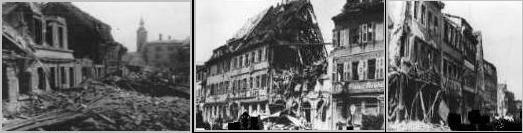
| The Destruction of Schweinfurt and Johann Michael Friedrich Rückert |