| Salzburg and Music |
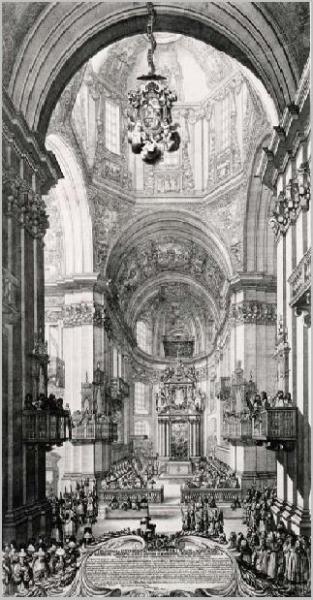
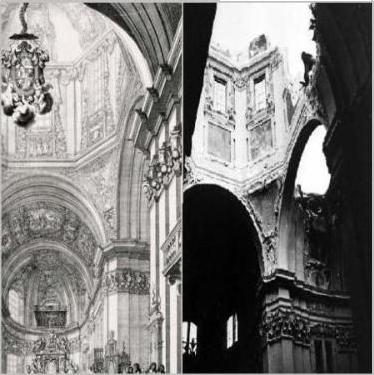
| On October 16, 1944 the US bombed the cathedral, hitting the dome which then collapsed. It also broke open a section of floor, opening up a previously unknown crypt. Above left is an 1682 engraving of the Salzburg Cathedral showing a mass in progress with numerous instrumentalists and vocalists in various locations around the building. On the right is the damage from US bombs. Thanks in part to area farmers who donated money, and the women of Salzburg who gave up their jewelry, the Dom was repaired and rebuilt over many years and at great effort. In May 1959, the cathedral was finally finished, with new bronze doors and a new pulpit. The ancient frescoes were replaced with modern ones as was the time honored plaster work, carving and gilding. St. Andräkirche was also destroyed by the air raids and reconstructed elsewhere. Mozart was not the only musical figure in Salzburg. The city has a musical history dating from long before the 1300s when Archbishop Pilgrim II from Puchheim became the first archbishop to actively sponsor music and composition. From the 15th century on, music at the fortress Hohensalzburg drifted down from on high and greeted everyone from the wealthy patrician to the beggar in rags. There were two high trumpet towers in the Hohensalzburg erected in 1465 and 1506 from which there was a spectacular view of the surrounding countryside. At night, a huge lantern was hung from the upper tower and during the day a flag. When people approached the fortress, they were spotted from the towers and announced with horns and trumpets which signalled the soldiers in the fortress as well as the townsfolk below of approaching friends or foe. Hence, visitors to Salzburg describe the deafening roar of gun salvos, trumpets and drums heralding their approach mixed with the heavenly sounds of concerts in progress. The royal trumpeters also played to entertain, not only from the trumpet towers, but at the court, in front of the Rathaus, at the church and the convent and in front of the houses of the elite, all for a reward of coins, while members of the Salzburg court orchestra played great music in the grand rooms and chambers of the Salzburg court and at festivals. St George's chapel at the fortress Hohensalzburg in Salzburg was built during the reign of Archbishop Leonard von Keutschach (1495 to 1519) and inaugurated on August 21, 1502. Although during the Middle ages, many towns, cities, monasteries and cloisters had mechanical organs built into their gates and towers, the only organ to have survived in its entirety until today is the so-called “castle horn” organ at Hohensalzburg, the organ which von Keutschach had built in order to communicate with the inhabitants of the town in a method akin to the use of alpine horns in the valleys. The “castle horn” woke the townsfolk up at 4AM and signaled their bedtime at 7PM. It also reminded everyone of the Archbishop's power over them. In 1672, Archbishop Max Gandolph had a chaplain's house built and attached to St Georg's Chapel in which there was additional space to house a music school and living quarters for the teacher. The Choirboys' Institute housed, fed, educated and clothed about sixteen choirboys who sang in the Cathedral, all at the court's full expense. Here they were taught by court musicians. Through most of the seventeenth century, there were at least seventy-five to eighty cathedral and court musicians and about fifty regularly performing vocal music. Salzburg employed a number of eminent composers through the centuries, among them Heinrich Finck, Paul Hofhaimer, Heinrich Biber, Georg Muffat, Johann Ernst Eberlin, Giuseppe Francesco Lolli and of course, Leopold Mozart and later his son Wolfgang. The composition and performance of cathedral music was the principal mission of court musicians. Positions included a Kapellmeister, a vice-Kapellmeister, composers and several instrumentalists (violinists, viola players, cellists, double bassists, keyboard players, oboists, flautists, bassoonists, horn players, trombonist and more). There were then the singers and the choir, all sometimes constituting over a hundred performers in total. |
| During the ravages of the Thirty Years War, foreign soldiers burned hundreds of cities, spreading death, destruction and disease throughout German lands. Salzburg was barely scathed because of the clever diplomacy of its Archbishop, Paris Lodron, who, even in the midst of the neighboring chaos, hosted a consecration of the newly rebuilt Salzburg Cathedral, the largest baroque building north of the Alps. |