| Ancient Trier and its Neighbors |
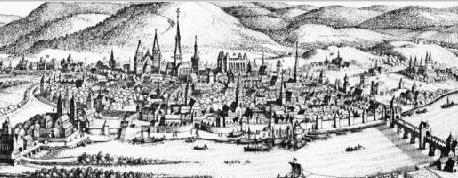
| Trier, shown below left in the 16th century, barely survived the War. On August 14, 1944, over 11,000 incendiary bombs fell into the oldest section of the city which held many historic architectural monuments of the Roman and medieval times. In December, 1944, there were three heavy air raids on Trier. On December 19, thirty British bombers let loose 136 tons of high explosive bombs and two days later, British and American bombers dropped 427 tons of bombs, including incendiaries. Two days later, another 700 tons of bombs plastered the city. 420 people were killed, but many had fortunately already fled the city. 1600 houses were completely destroyed, and numerous ancient buildings obliterated. Between December 16, 1944 and January 2, 1945, the U.S.A.F. and the R.A.F. dropped altogether 1,467 metric tons of bombs. The only undamaged structures left of ancient Trier were the old Roman ruins. The bombers had hit the ancient cathedral, the oldest Romanesque church in Germany, and with one direct hit, the bell had shaken loose and fallen through the tower. Liebfrauenkirche, left, an early Gothic structure dating from the 13th century was badly damaged, and the 18th century Paulinuskirche had a hole in its roof. In both structures, all the irreplaceable stained glass windows blew up and precious manuscripts were lost to the world forever. (click below) |
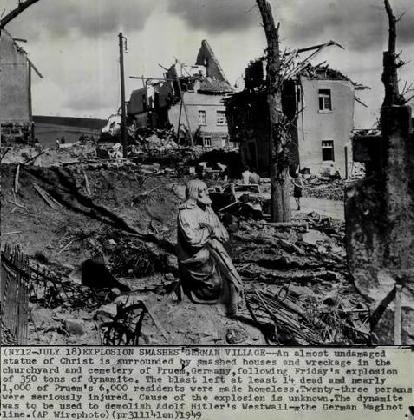
| Nearby Prüm is a small city in the nearby Westeifel. Formerly a district town, today it is in the joint municipality of Eifelkreis Bitburg-Prüm, a district bounded by Luxembourg, Belgium and the districts of Euskirchen, Vulkaneifel, Bernkastel-Wittlich and Trier-Saarburg. The abbey and the city of Prüm were subordinate directly to the Holy Roman Emperor in medieval times. Prüm Abbey is a former Benedictine abbey in Prüm/Lorraine, now in the Diocese of Trier, founded by a Frankish widow Bertrada and her son Charibert in 720. The eastern parts of the district and the town of Kyllburg, were property of the bishop of Trier. When Prussia gained these regions 1815, it established the three districts of Bitburg, Prüm and Trier. There were 25 Allied bomb attacks on Prüm, heavily damaging the town and Abbey, below left. On the right: Allied destruction continues in Prüm even after war's end (click). |
| Bitburg was settled over 2000 years ago and was first mentioned as “Vicus Beda”. Emperor Constantine I expanded the settlement to a castle around 330, the central part of which forms the town center to the present day. Bitburg is first documented around 715 as “castrum bedense”. It subsequently became part of Franconia. In 1262, the castle gained municipal rights and in the middle of the tenth century the city came under the county (later a duchy) of Luxembourg, and in 1443 under the county of Burgundy. After 1506, the place belonged first to the Spanish Netherlands, and from 1714 to the Austrian Netherlands. In 1794, the city came under French administration. In 1815, by the resolution of the Congress of Vienna, Bitburg was transferred to the Kingdom of Prussia, where until 1822 it belonged administratively as district town to the province of Niederrhein, and afterwards to the Rhine province. Bitburg was industrialized in the 20th century and this spelled its doom. On December 24, 1944, Bitburg was 85% destroyed by air raids, and later officially designated by the Americans as yet one more German “dead city”. The French did not withdraw their last occupying troops until the end of the 1980s. |
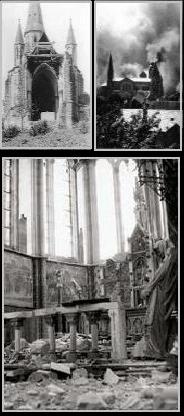
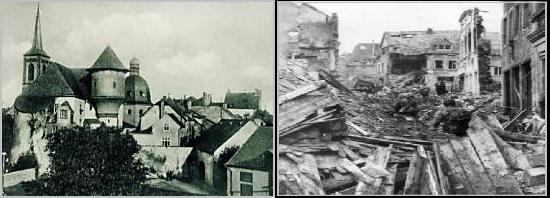
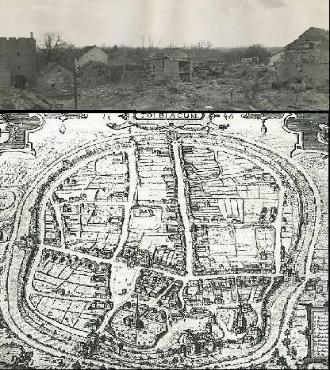
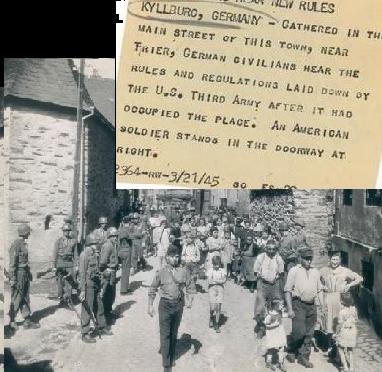
| Above: (left)Bitburg before and after. (Top right) Kyllburg residents being herded by US occupiers to hear their new rules. (Bottom right) Zülpich once and after (click) |
| Zülpich is another town in North Rhine-Westphalia between Aachen and Bonn (Latin name of Tolbiacum). It was famous for the Battle of Tolbiac fought between the Franks under Clovis I and the Alamanni around the year 496. On December 24, 1944 Zülpich was bombed by the Allies and large parts of the ancient central city were destroyed. Nearby Euskirchen has a history dating back over 700 years, having been granted town-status in 1302. In February of 1945, Allied bombs destroyed the town's significant church and several other buildings |