| Friedrich Wilhelm Nietzsche was born on October 15, 1844 on the 49th birthday of Prussian King, Friedrich Wilhelm IV, after whom Nietzsche was named. He was born in the Prussian town of Roecken between Leizpig and Weißenfels in today's German State of Sachsen-Anhalt. His father, Karl Ludwig Nietzsche died from a brain disease at age 36 when Nietzsche was 4 years old, and Nietzsche's two-year-old brother died six months later. The family moved to Naumburg, where Friedrich and his younger sister Elizabeth were raised by his mother, grandmother and two aunts. In 1864, Nietzsche entered the University of Bonn as a theology and philology student and was introduced to the work of Richard Wagner. He then transferred to the University of Leipzig where he was influenced by Schopenhauer's work. |
| Nietzsche entered mandatory military service at age 23 in an equestrian field artillery regiment and suffered a serious injury resulting in his dismissal. After returning to the University of Leipzig, Nietzsche met Richard Wagner who was older and they became close friends. He was hired to the chair of classical philology at the age of 24 at the University of Basel, and he taught there from 1869 to 1879 when he was forced to retire due to ill-health following health problems arising from Nietzsche's reenlistment in the army ambulance service in 1870 in the war against France. He stopped teaching in 1879 and traveled a lot throughout German, French, Swiss and Italian cities. He published in Germany between 1872 and 1888. A German philosopher and philologist, he wrote critical texts on religion, morality, philosophy, contemporary culture and science. |
| To the surprise of some, he also composed some music, one such piece being "Mein Platz vor der Thür". In 1889, while in Turin, Nietzsche had a mental breakdown, possibly due to the same brain disease which had affected his father, and until his death on August 25, 1900 Nietzsche was insane. |
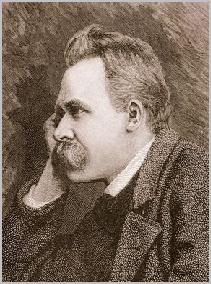
| Nietzsche |