| A Couple of Soldier Stories |
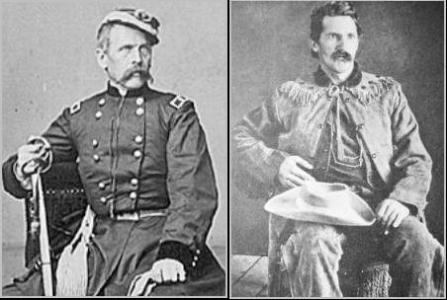
| Ludwig Blenker (1812-1863) is an example of why enthusiasm is not always enough to make a successful soldier. He was born in Worms, Germany. He enlisted in the Bavarian Legion in 1832 and served in the Greek Wars of Revolution with distinction. After he returned to Worms five years later, he became a vintner, but went bankrupt. He was one of the main leaders of the German revolutions of 1848, but had to flee when the revolutions failed. He first went to Switzerland, and in 1849 went to the United States where he went into business in New York City. Upon the outbreak of war, he volunteered and became prominent among the organizers of the German recruits. As a Colonel, he led the 8th New York to war, and by July 1861 he was given the command of a German brigade which repulsed a Confederate cavalry attack in a rearguard action at First Bull Run. He was appointed Brigadier General on August 9, 1861 and by October had gathered enough German regiments that the War Department organized "Blenker's Division". He was assigned to the Mountain Department in Virginia under Major General John C. Fremont in March, 1862. When Blenker and his division left for western Virginia on April 6, the men were ordered to leave their tents behind. Unfortunately, they ran into over a foot of snow and they were pelted by freezing rain, making many of the men ill. Blenker was severely injured in a fall from his horse at Warrenton, and confusion rose in the stressed troops, who were also suffering from insufficient rations. They began to raid farms, and this event gave birth to the term "Blenkered", or misappropriating goods to maintain an army in the field. Major General William S. Rosecrans was sent by the War Department to find the division and escort it to Fremont. Rosecrans resupplied the hungry, cold troops and rushed them to Major General Fremont at Petersburg on May 11. Fremont pushed the exhausted men to catch up with Stonewall Jackson in the Shenandoah Valley. On June 7, 1862 at Cross Keys, Virginia, Fremont met up with Jackson who repulsed the demoralized union division. They took heavy losses in an attempt to turn the Confederate left flank. Shortly after this action, all of the blame was put on Blenker and he was relieved. Although there were no charges against him, he saw no more action and was discharged on March 31, 1863. He died later that year at his farm in New York, from the injuries received in the fall from his horse. Albert Sieber's life took a different path. Sieber was born in 1844 near Heidelberg, the 13th of 14 children, and he came to America as a boy. He volunteered in the military in March of 1862, and was a private in Company B of the 1st. Infantry from Minnesota He participated in the Peninsular campaigns, fought at Antietam and Fredericksburg, and was severely wounded on the second day of the Battle of Gettysburg, when in the evening hours of July 2,1863 his regiment (which was 60 percent Germans) was to defend the "Cemetery Ridge". The First Minnesota Regiment was the only regiment in place. General Winfield Scott Hancock mounted a counter-attack on these 262 men with a force more than five times greater, killing 75 and wounding 174 men of the First Minnesota Regiment. This was the highest percentage of loss suffered by a regiment of the army. Albert Sieber was hit in the head by a shell fragment so hard that his skull was opened up on the right side. His right leg had shattered. He was sent to the Army Hospital for a six-month recovery. After he recovered his strength, he served as a security guard in a POW camp in Elmira, New York. In 1864, he was awarded the rank of corporal. After the war, Sieber was honorably discharged from the army and in 1866 went out west to explore the silver mines in Nevada and the gold fields of California. After he didn't strike it rich, he found a job as a foreman on a ranch in Arizona where there were only a few scattered settlers who were under constant attack by Apaches. Sieber organized a defense against the Apaches. General George Crook hired him to be Chief of Scouts in 1871 for much of the Apache Wars. This was the most dangerous time in the Old West, and Sieber was wounded in fighting 29 times by knives, bullets or arrows. On one occasion, a ball shattered his left leg, shortening it by a full five inches, and permanently crippling him. He was known among the Apaches as "bleached face that knows no fear." He acted as a negotiator between the tribes and the military, becoming a legendary figure and one of the most famous scouts in the frontier history of the territory of Arizona. George Crook described Al Sieber in 1844 as follows: "He is six feet tall, weighs 190 pounds and seems to exist in only bones and muscles. Eyes and hair are dark, his appearance is not unusual. He can move with his scouts sixty miles a day and back, also he is an incomparable rifle shooter. His fearlessness is famous." These were trying times, and there were long parades of exiled Indians heading to relocation and piles of massacred Indians alongside of scattered dead settlers, burned out frontier homes and wandering orphans. Sieber is credited with having prevented massacres of Indians on a couple of occasions and he was not happy with the later military treatment of the Apaches. He wanted to resume prospecting. He was formally discharge from military service in 1890, but Sieber still had adventures. He entered into a four-year dispute with an Indian agent that Sieber felt treated Indians poorly and even managed to solve a local murder. Albert Sieber had never married. Sieber began a struggle to receive a pension, and had to continue to work. In 1905, he found work with the construction of a road leading to Roosevelt Dam. Eight days before his 64th Birthday, on February 19, 1907, he was supervising an Apache work crew when he noticed a large outcropping of boulders teetering above ready to slide. He screamed a warning and while the others scrambled to safety, because of his lame leg he could not jump out of the way fast enough and was crushed by the boulders. He could not be saved, and died quietly and bravely, surrounded by Indians. Dozens of books and articles have been written about him. The movie 'Geronimo' tries to include a portrait of his life to some extent as does the film 'Apache'. |
| Blenker and Sieber |