| German Americans During the Civil War |
| The Civil War years were also a time of heavy German immigration to America. Some of these new immigrants were greeted at the docks upon their arrival and recruited with promises of instant income. Others responded to a recruitment campaign which appealed to their sense of brotherhood, justice and loyalty toward their new country. Their numbers would swell until Germans made up a full quarter of the fighting force of the American Civil War. While 216,000 German-born men were on the rolls of both the North and the South, 177,000 of them, the vast majority, fought in the Union Army, sixty seven later receiving the Medal of Honor. While there were at least 13 German generals and another 31 Germans in the highest ranks of the Union Army, only one German reached the rank of General in the Confederacy. Potential German recruits were often led to believe that slavery in America was similar to those conditions of servitude under aristocracy in their homeland which had caused many of them to flee. Union recruitment campaign exploited these strong sentiments. The earliest protest against slavery in American history had, after all, been drawn up by Germantown, Pennsylvania settlers in 1688 by their leader Francis Daniel Pastorius. The Georgia Salzburgers, the Germans of the Valley of Virginia and the Moravians of North Carolina mostly resisted the idea of slavery as well. Reflecting this sentiment against slavery, in an incident on January 1, 1861 at a slave sale at the St. Louis, Missouri courthouse, the mostly German crowd made such a fuss that the sale couldn't go above $8.00. This was the last slave auction in St. Louis. The average age of German soldiers who enlisted in 1861 was significantly older than their native- born counterparts and they were often in their thirties or forties. They also tended to have more military experience because of prior strict and rigorous military training in the armies of the German states. Most were at the very least literate, and many had a high degree of education. This is shown in the fact that at least 200 German nobleman fought in the American Civil War. While the majority of Germans served in ethnically mixed units, about a fifth of German enlistees served in units which were all German. Over 36,000 New York soldiers were of German descent (the 20th New York Infantry alone lost 120 men), and almost a third of them served in all-German units. The most notable were the 29th, 46th and 52nd New York. After New York came Missouri with 30,000 Germans serving and the 12th and 17th Missouri regiments being all German. Then came Ohio with 20,000 Germans serving and the 9th and 107th all German Ohio regiments. Other all German regiments included: the 24th, 43rd and 82nd Illinois, the 32nd Indiana, the 9th and 26th Wisconsin and the 74th and 75th Pennsylvania regiments. Michigan contributed thousands of Germans, as did Minnesota, Wisconsin, Kentucky, Kansas, Iowa and other states. One famous German in the Union was Carl Schurz who once had an academic career at the University of Bonn before becoming involved in the revolutionary movement of 1848. He joined the forces of the revolution, and was one of the defenders of the Fortress of Rastatt which fell in 1849. |

| Out of the German-born men who fought in the Union armies, an estimated five thousand of them served in the 1848 revolutionary armies and insurrections throughout Germany. The New Yorker 20th Regiment of Volunteers reportedly carried a German tri-color besides their National flag; and the first uniforms issued to Franz Sigel's 3rd Regiment of Missouri Union Volunteers were cut to the design of the blouses worn by Freischaren revolutionaries of 1849. Many German soldiers, regiments and companies wore the gold, red and black cockade as they marched off to the war. By 1860, an estimated 1.3 million German born immigrants lived in the United States; 200 German language magazines and newspapers were published in this country, there were dozens of German breweries and beer gardens, bands, singing and shooting clubs. The numbers swelled to an estimated 2.8 million German-born immigrants lived in the USA between 1860 and 1890, a majority of them located in the "German triangle," whose 3 points were Cincinnati, Milwaukee, and St. Louis. Aside from the more famous people mentioned here, other well-known figures include August Willich, Max Weber, Godfrey Weitzel, Adolph von Steinwehr, August Kautz and hundreds of German-born officers who both led and served in regiments during the war, including among others Col. Gustav Tafel, Col. Paul A. Frank, Maj. Jurgen Wilson, Lt. Theodore Schwan and German Capt. Hubert Dilger, one of the best Union artillerists Certain nativist elements in the Anglo-American press, both during and after the war, created an erroneously tainted image of the "lop-eared" or "cowardly Dutch" regarding the German Americans who served their new country in the Civil War, and this myth was especially resurrected and expanded upon during the days of Anti-German hysteria during World War One to such an intense degree that even today it remains unjustifiably intact. |
| Schurz escaped to freedom but later boldly rescued of the uprising's leader, his Professor Gottfried Kinkel who had been arrested and sentenced to life behind bars.Schurz left Germany a hero. After marriage and many more adventures, Schurz at last ended up in America, where he became a confidante of Abraham Lincoln and he served as minister to Spain and later as an officer of the line in the 11th Corps, which had a number of German regiments.Schurz was later promoted to major general and saw action at Nashville and Chattanooga. At the end of the war, he was chief of staff to General William Tecumseh Sherman. Schurz remained in public life until his death in 1906, serving the government in many capacities, including secretary of the interior. In the Confederacy, General Jeb Stuart's aide was a tall, handsome Prussian noble from a military family named Major Johann August Heinrich Heros von Borcke. Serving in the Second Brandenburg Regiment of Dragoons when the Civil War began, Heros departed for the Confederacy, landing in South Carolina in May of 1862. Becaming a close friend of Jeb Stuart, he stayed on with Stuart for a year and later documented his exploits. Much admired by his comrades, von Borcke later returned to Prussia to serve his native land in the war with Austria in 1866; and to his amusement, Prussian military genius Helmuth von Moltke ogreeted him with the words, "So, are you not the American?" Then there was Franz Sigel. Trained as a military officer in Germany in the regular army, he quickly sided with the revolutionaries in 1848, and became minister of war in the provisional republic declared in May 1849. With the total collapse of the Revolutionary movement, he became one of thousands of rebels forced into American exile. Sigel was a rabid Unionist and met his match with Radical Unionist General Nathaniel Lyon, who saw Sigel's potential. The two, despite the inevitable local conflict which would arise, formed five nearly all German regiments to keep Missouri in the Union. Eighty percent of Lyon's forces that rushed to Camp Jackson were Germans. It had disastrous results and it would damage Missouri Germans' reputations for decades. Friedrich Hecker was born in 1811 into a successful family in Baden. He studied at Mannheim, Heidelberg and Munich, receiving his doctorate in law. In 1838, he began his practice and married in 1839. Hecker won a seat in the Baden State Assembly in 1842 and soon received attention and popular support all over Germany in 1845 when he opposed the incorporation of German speaking Schleswig-Holstein into Denmark. In 1848, Hecker and Gustav Struve called an assembly of the people at Offenburg in March of 1848, seeking to eliminate the royal governments. Failing to obtain the support in the German Parliament at Frankfurt, Hecker and Struve called for a general armed uprising on behalf of a German Republic on April 12,1848. With a small force they marched from Constance through the Black Forest, being defeated by a force of Baden and Hessian troops commanded by General Friedrich von Gagern, who died in the battle. Hecker fled to Switzerland where he tried to foment another revolt, but failing, he left for America. He intended to buy a farm in southern Illinois, but in spring of 1849, an uprising in Baden prompted Hecker to return to Germany and join the revolution. The battle was lost by the time he reached Strasbourg and he returned to America where he reinvented himself as a farmer. He bought land in Illinois and began raising grapes using modern technology. He lived a rather apolitical life, although he was a member of the new Republican Party. With the advent of the Civil War, Hecker signed up as a soldier in the Missouri Volunteers organized by Sigel. In the spring of 1861, Hecker went on to lead a German regiment from the Chicago area, the 82nd Regiment, Illinois Volunteers. After his service, Colonel Hecker returned to his farm in 1863. He continued to be active as a speaker and columnist in the German press and he founded the American Turnverein.. In 1873, Hecker returned on a speaking tour to a new, unified Germany under Prussian leadership. Freidrich Hecker died on March 24,1881 on his Illinois farm. Pennsylvania alone contributed five exclusively "German Regiments", among them the 1st German Regiment also known as 74th PA Vol. Infantry regiment. It was also led by a 48'er, brilliant Prussian officer Alexander von Schimmelfennig of Philadelphia. He taught drill and techniques he had learned in the Prussian military. Schimmelfennig and Col. George Von Amsberg were also in charge of the 82D Illinois 45th, the 157th NewYork, the 61st Ohio and the 74th Pennsylvania Infantry. German 48'ers and their children enlisted in what they liked to call the "Zweiter Freiheitskampf", or their second fight for liberty. |
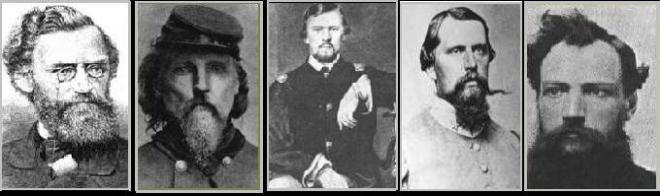
| Schurz, Hecker, Sigel, von Borcke, von Schimmelfennig |
| To: Before They Sprouted Horns and Fangs The pre-War Image of German Americans |