| Heros von Borcke and other Stepsons of the South |
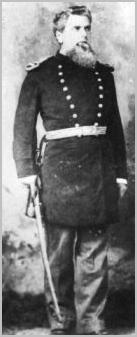
| Johann August Heinrich Heros von Borcke (1835 – 1895), known as the "giant in gray" was over six feet four in height and well over two hundred pounds, with curly blond hair and laughing eyes. Born to an aristocratic German family, his childhood was spent in Berlin and Halle before receiving a superb Prussian military education. Von Borcke was commissioned an ensign in 1853 and admitted to the Cuiraisser Regiment of Guards as a cadet. In 1860, he was posted as second lieutenant to the Second Brandenburg Regiment of Dragoons, but saw little action. After his release from the Prussian Army, he embarked upon the adventure of his life: he sailed for Bermuda intent on joining the Confederate Army. Speaking almost no English, he had managed to secure letters of introduction to Confederate authorities, and he slipped into South Carolina's Charleston Harbor on a blockade runner on May 24, 1862. He next traveled to Richmond where he met with Confederate Secretary of War George Randolph who presented him with a letter of introduction to Major General J.E.B. Stuart. A deep friendship developed between the two men immediately and von Borcke was made a captain in the Provisional Army of the Confederate States and soon promoted to the rank of major. Von Bourcke could be entertaining and told wonderful stories with his think accent, but he could also be a bit vain and difficult to get along with at times, especially for his servants. His horses were as big as his extra long sword, a huge of a blade forged in Solingen of Damascus steel. He rode with Stuart, who affectionately called him "Von", during the Northern Virginia Campaign and the Maryland Campaign, acquiring a reputation for bravery, and he served with Stuart the Battle of Middleburg on June 19, 1863, where he suffered a severe wound. The examining doctor thought the wound, which pierced the lung, mortal, but von Borcke woke up the next morning determined to live. He did, although he was incapacitated for the rest of the year. He resume his duties in the spring of 1864, and was present at the Battle of Yellow Tavern in which J.E.B. Stuart was killed, and he sat by Stuart's side at his deathbed. He was promoted to lieutenant colonel in December of that year, and was voted the official thanks of the Confederate Congress and sent on a diplomatic mission to England by President Jefferson Davis. When the Confederacy collapsed in 1865, von Borcke returned to his native Prussia and resumed his military career. He fought in the 1866 Austro-Prussian War, receiving the coveted Order of the Red Eagle for his gallantry, but his old wounds always plagued him, and he retired from the Prussian Army as Captain in 1867, settling in Neumarkt, East Prussia. While in London, he had written articles for the pro-Confederate 'Blackwood's Edinburgh Magazine' and he published them in book form as "Memoirs of the Confederate War for Independence" in 1877. He inherited a castle at Geisenbrugge in Pomerania, and he proudly flew the Confederate flag alongside the Prussian flag from its battlements. He and his wife Magdalene Honig had three sons and, when she died in 1883, he married her sister and they had a daughter named Karoline Virginia, in honor of his adopted and beloved southern state back in America. In 1884, he sailed back to the United States for a reunion with many former friends and comrades. Here he was welcomed with enthusiasm at many events where the legacy of the Confederacy was celebrated. He presented his famous sword to the State of Virginia, who later placed in the Museum of the Confederacy. Von Borcke returned to Germany and moved to Berlin, but he died on May 10, 1895, just a few months after his trip to America, proud to the end of his service for the South. He died from blood poisoning most likely due to the after-affects of the injuries received at Middleburg, |
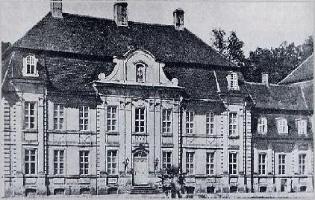

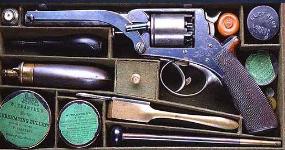
| Von Borcke as a US soldier. He gave this revolver to Stuart the same month von Borcke was wounded at Middleburg, Virginia, in June 1863, the expectation in which Stuart would have attained the rank of lieutenant general. Unfortunately, Stuart died first, but the inscription on the cover of the cased revolver is inscribed to Lt. Gen. J.E.B. Stuart C.S.A. Culpepper, Va. June 1863 from Heros von Borcke. Von Borcke's estate "Stargordt" in Pommern was built between 1717 and 1720. Heinrich von Borcke added additions in 1743. The stately manor house contained valuable collection of 18th century art. When the Russians invaded Germany in 1945, they looted it thoroughly before burning it down. Von Borcke's descendants were forced to flee in a hunting wagon, leaving their ancestral lands and all of their possessions behind forever. His original gravestone was smashed. (click) |
| August Büchel of Texas As German settlers in Texas were numerous, their proportion sent to war was relatively high and they were recruited in about 70 regiments. Company B, the Lone Star Rifles of the 6th Texas Infantry Regiment consisted almost exclusively of Germans. Among the Texas Germans who served their country was an unassuming adventurer and professional soldier named Carl August Büchel, who reportedly moved to Texas after killing a man in a duel back in Germany. Büchel was born in 1813 near Mainz. At the age of 14, he went to the Military Academy in Darmstadt and remained there until 1835. He was commissioned a second lieutenant of volunteers in the First Infantry Regiment of Hesse-Darmstadt before having more advanced training at L'École Militaire in Paris, after which he served in the Foreign Legion as a lieutenant. This took him to Spain where he participated gallantly in the Carlist War. For his bravery at the battle of Huesca, he was decorated and knighted by Queen Maria Christina in 1838. For the next several years, he was an instructor in the Turkish army, attaining the highest rank allowed a Christian, that of colonel. In 1845, Büchel arrived at Carlshafen, later Indianola, Texas and took up residence. During the Mexican War, he raised a company in the First Regiment of Texas Foot Rifles and served as its captain in 1846. He served as aide-de-camp on the staff of Gen. Zachary Taylor and was present at the battle of Buena Vista. He was made customs collector at Port Lavaca after the war and temporarily gave up military life, keeping the job for a few years, and even running a side business selling lumber and building materials in Corpus Christi. Buchel never married. He was surprisingly small in stature, and had a reputation as a very quiet, polite, intelligent man who spoke seven languages. In 1859, however, he decided to use his military experience and organize the Indianola Volunteers to fight the depredations of Mexican bandits under Cortina. When civil war broke out, Buchel joined the Texas militia as lieutenant colonel of the Third Texas Infantry in 1861 and he served in South Texas. He became colonel of the First Texas Cavalry in 1863 and saw extensive service on the Texas Gulf Coast before being transferred to Louisiana to thwart invasions of Texas by Union troops. Early in 1864, Buchel was appointed a brigadier general, but the appointment would sadly never be confirmed. He was hit by at least seven balls and mortally wounded as he led his troops in a dismounted charge at Pleasant Hill, Louisiana on April 9, 1864. He was taken to Mansfield, where he died two days later. His body was later taken by his cavalry detachment to Austin, and he was reburied in the State Cemetery. Baron August Valentin Albert Massow, Virginia Baron August Valentin Albert Massow was born in 1839 in Prussia to an aristocratic family with a pedigree dating back to 1259. He served in the Prussian military before coming to New York in 1863. He took various detours until he arrived in the South where he joined here 43rd Virginia Battalion under Colonel John S. Mosby. Von Massow preferred fighting with his sword over the gun, and in a raid on February 22, 1864, after accepting the surrender of a Union cavalry officer on the battlefield, Von Massow rode past the fellow without disarming him and was shot in the back for his chivalry. Another Confederate, seeing the horrible, dishonorable deed, shot the shooter. Von Massow needed 6 months to recuperate. In the spring of 1865, he traveled back to Germany and reenlisted in the 11th Pomeranian Dragoon Regiment in 1866 and he was awarded the Iron Cross for his service in battle. After the war, he settled first in Oldenburg, and later in Berlin. By 1890, he had the supreme command of the Prussian cavalry. In 1899, he was appointed General of the Army. In 1906, after almost 54 years of military service, he retired. He died in 1927 in Germany. Leonhard von Zinken Louisiana The 20th Louisiana Infantry, established in February, 1862, was to a great extent made up of German immigrants and commanded by another former Prussian officer, Leonhard von Zinken. At the outbreak of war, von Zinken joined the Confederate Army and fought in major battles across the Western Theater including Shiloh, after which he served as Inspector General of the General Staff Breckenridge. In 1863 he took command over the 19th and 20 Louisiana Infantry Regiment and led the units at Chickamauga. He also fought at Kennesaw Mountain and Atlanta. He was wounded in every single battle in which he fought, including the battle at Ezra Church west of Atlanta where he lost the use of one of his arms. He was a strict military disciplinarian and not without controversy. In one incident, while garrison commander at Columbus, one of his guards shot and killed a soldier home on leave for failing to produce his leave papers. Town citizens were furious and demanded that the guard be charged with murder, but Von Zinken stepped in and said he should be the one charged, since the guard was operating under his command. Indeed, he was charged, but cleared of any wrong-doing in his court martial. After the war, Von Zinken returned home to Louisiana, and he died in 1871 in New Orleans. Wilhelm K. Bachmann and Johann Andreas Wagener, South Carolina The 3rd Cavalry Regiment, Division G South Carolina was called the German Hussars. At least 3 Artillery batteries were commanded by German born officers gunners, one of them being Wilhelm K. Bachmann, Commander of the Charleston Artillery. However, the German name in South Carolina most associated with the war belonged to one of its most important and respected German immigrants, Johann Andreas Wagener. Wagener was born in 1816 in Hanover, the eldest child of 12 siblings born to an inn-keeper/farmer. In 1831, he was the first of his family to immigrate to America. He found work in New York as a servant, and moved to South Carolina where he settled in Charleston and found a bookkeeping job. In 1835, he joined the local militia called the "German Füseliers". He also married, became a citizen, and, always hard working and ambitious, founded a German Fire Engine Company in 1838. Then in 1840, he was one of the founders of the German Evangelical St. Matthews Church in Charleston. In 1844, Wagener took over the editorial staff of the German newspaper "Teutones", and in 1846, he and some friends founded the Turnverein of Charleston. Always popular, Wagener was a prominent member of numerous lodges in Charleston and in 1857 was Master of three lodges simultaneously. On his own initiative in 1849, he founded the German settlement of Walhalla, a haven for German expatriates. The idea for a German settlement had been suggested as early as 1844 for immigrants coming to Charleston, South Carolina. Eventually, the German Colonization Society was organized on October 6, 1848 in Charleston with a primary focus on establishing such a German settlement. Under Wagener's leadership, the Society bought 17,859 acres in 1849. The town and the surrounding areas were all planned and the members of the Society met in 1850 to draw for the first lots and surrounding farms. They named the new town "Walhalla". The German Evangelical Lutheran Congregation there was officially organized on November 20, 1853 and the St. John's Evangelical Lutheran Church was built and dedicated on March 17, 1861. Services were held in German and English (after World War One anti-German hysteria, services would later be held only in English). The town of Walhalla was incorporated on December 19, 1855. On March 31, 1860, Wagener was appointed Major and commander of the 2nd Battalion of the 1st Artillery Regiment of the South Carolina militia. After the Ordinance of Secession was signed on December 20, 1860, Wagener's German Regiment occupied the abandoned Fort Moultrie and participated in the bombardment of Fort Sumter. By July, 1861, Wagener was a Lieutenant Colonel in the Confederate Army. His troops built Fort Walker on Hilton Head, after which he was made Brigadier General and Commandant of Charleston. He held this post throughout the war. Between 1863 and 1864, he acted as commander of all militia organizations of Charleston. In 1866, he received the rank of Brigadier-General of the 4th Brigade of the Militia of South Carolina. After the war, Wagener was appointed as "Commisair of Immigration". In this capacity, he argued the cause for attracting more German immigrants to compensate for the collapsed slaves market. He was one of the co-founders of the German Society of South Carolina, and was also Mayor of Charleston. He was a delegate to the Democratic Party in St. Louis in 1876 . Shortly afterwards, on August 27, 1876, he died. He had arranged for his siblings to immigrate, and his bothers were also important figures during the War. Wilhelm Heinrich von Eberstein, North Carolina Baron Wilhelm Heinrich von Eberstein rose to Sergeant Major (NCO rank) in the 7th North Carolina Infantry. Von Eberstein left behind his memoirs. The first portion of "William Henry" von Eberstein's memoir concerns the history of his illustrious noble family. Wilhelm Heinrich (William Henry) von Eberstein was born in St. Servan, France in 1821, the fifth of eight children. He also lived as a child on the Isle of Guernsey where the family moved after the death of his father. The sea was already in his blood. At the age of fourteen signed on as a midshipman aboard a British East India Company merchant ship. Later he served as second officer on a brig which travelled the world. As first officer of one bark in 1841, von Eberstein relates the transportation of prisoners to the penal colony at Australia among other things. In the same year, while still a youth, von Eberstein ran African slaves from the Congo to Brazil as captain of a Spanish brig. His other positions included that of third lieutenant on a Brazilian navy frigate and master of a merchant vessel in 1843. He later served as first officer of an American schooner out of New Bedford, Massachusetts. Von Eberstein reports on everything from hunting seals at Cape Horn, to trading and fighting with the South American Indians and being shipwrecked off the coast of Argentina. As he tells of whaling and fishing as chief mate on board various ships, he relates how he became familiar with North Carolina as mate on another American schooner and even fighting a hurricane. In 1850, von Eberstein and his brother visited their family in Europe. While he was visiting with his mother in Dresden, he joined the forces of the King of Saxony to help quell a socialist revolution. Soon enough, however, he decided it was time to settle down a bit, and he moved to Chocowinity, N.C., in July 1851, where he established himself as an engineer and merchant, and he married in 1852. After bringing four children into the world, he became a farmer, harness maker and lastly, a school teacher! But, alas, he soon grew restless and briefly returned to the sea where he captained a few more ships and encountered more adventures, including defeating coastal pirates. At the start of the Civil War, 40-year-old von Eberstein enlisted on April 22, 1861 in Company K, 10th Regiment N.C.S.T. (1st Regiment N.C. Artillery), also known as the Washington Grays, and mustered in as 5th (Orderly) Sergeant. He later transferred to the Field and Staff of the N.C. 61st Regiment on July 3, 1863 and was promoted to the rank of Sergeant-Major. He was wounded in the hip in the Defense of Charleston, S.C. on August 26, 1863 and hospitalized. He returned to duty on October 5th. While at Drewy's Bluff, Virginia, he was again wounded in the hip on or about May 16, 1864 and was again hospitalized. He received a sixty day furlough on May 31, 1864, during which he served as acting adjutant of the 61st N.C.T. for a short period, but due to his age and being unfit for field duty, he received a discharge on October 4, 1864. He went home to his family in Chocowinity, and after recovering from exhaustion, he and his family moved to Pitt County, N.C., where he was living when the war ended. Before his death, Mr. von Eberstein wrote his life's memoirs. He was buried at Trinity Cemetery, Chocowinity, North Carolina on October 26, 1890. Johann P. Emrich, Alabama Alabama sent some 40,000 troops against the Union during the war, including the primarily German men of Company H of the 8th Infantry, named the "Germans fusiliers". It was raised in 1848 and mustered into Confederate service on June 9th, 1861. As Company H, Eighth Alabama, Pryor's Brigade, it defeated its enemy at Williamsburg and at Seven Pines, May 5, 1862. They fought again in Wilcox's Brigade at Mechanicsville, Gaines' Mill, June 27, 1862, at Frasier's Farm, June 29, where they were face to face with the Irish Brigade; Again, at Second Manassas, Harper's Ferry, Sharpsburg and Fredericksburg, December 13, 1862. Next at Salem's Church, Gettysburg, the Wilderness, Spottsylvania, Richmond and Cold Harbor, where on June 3, 1864, 6000 Yankees were slaughtered in less than one hour, Wilcox's Brigade withstanding their rushing charge. It fought cavalry on the Weldon Road, again at Deep Bottom; Boydston Plank Road, in the trenches at Petersburg, and last at Appomattox, where they divided the regimental flag. German born Captain Johann P. Emrich, the last regimental colonel, was wounded 5 times during the war, including once at Chancellorsville, and he rose to the rank of lieutenant colonel. Company C of the 12th Alabama Infantry also recruited from Germans from the Richmond area. The Mobile German Fusileers fought shoulder-to-shoulder with their Irish immigrant comrades of the 8th Alabama Infantry, Company I, the Emerald Guard. A good many of the regimental bands of the Civil War were comprised of Germans. One of the best known in the South was the 26th North Carolina Regiment Band, which was made up wholly of German speaking Moravians. The 26th North Carolina Regiment was organized from companies raised from the Piedmont and western North Carolina. The regiment first engaged in battles at Malvern Hill, Gettysburg (where its band gave an improvised concert in the midst of the action on the battlefield), the Wilderness, and the defense of Petersburg, Virginia (for nearly one and a half years). The regiment continued its service with the Army of Northern Virginia and surrendered with General Robert E. Lee at Appomattox Courthouse on April 9, 1865. The band, said to have been one of General Robert E. Lee's favorite bands, became separated from the body of the regiment and were captured near Amelia Courthouse after the evacuation of Petersburg in the closing week of the war in Virginia. They were imprisoned at Point Lookout, Maryland for three months. They returned to Salem after their release on July 2, 1865, and two days later, they were playing for the townspeople. There were three bands from Moravian settlements in North Carolina. They served with the 26th Regiment, N.C. Infantry, the 21st Regiment, N.C. Infantry (1st Battalion, N.C. Sharpshooters), and the 33rd Regiment, N.C. Infantry. In the course of the War, the three Moravian bands from Wachovia were represented in almost every major campaign in North Carolina, the Shenandoah Valley, and Northern Virginia. All three bands were captured in the final battles leading up to the Confederate surrender at Appomattox. |
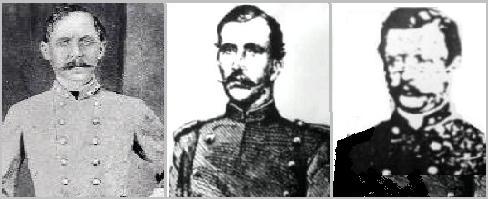
| Above: Büchel, Massow, von Zinken, Wagener |
| Other German Confederates |