| Across the Wide Atlantic in Mid-Century: German Immigrants To America |
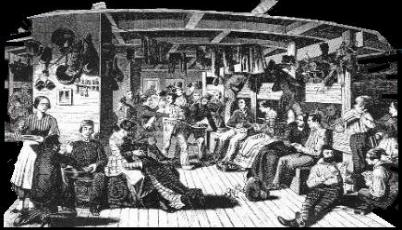
| Immigrants from Germany soared to 1,275,000 from 1845 to 1860 as people fled the rocky mid-19th century revolutionary years in Germany. Coming to America was more than simply a voyage, it was a whole set of adventures which could prove dangerous, even lethal. For most German emigrants going to America during these years, Bremerhaven was the major port of departure. It would become port to 7 million emigrants leaving Europe between 1832 and 1874. The first leg of an emigrant's journey would have been the trip to Bremen itself by train or in a coach. Some poorer emigrants had to reach Bremen by foot. Many had never even set foot out of their small villages before, and just making this step was in itself a life-changing experience. Once in Bremen, most would stay at an inn and take in the sights, such as the famous tall statue of Roland the Giant. Created in 1404, the Roland statue in the Bremen market place symbolizes freedom and justice. It commemorates the death of Roland who was killed by Muslim and Basque forces attacking the rear-guard of Charlemagne's army. Bremen, on the banks of the river Weser that flows into the North Sea, was founded in the 9th century and was an important and lovely member of the Hanseatic League. When silt on the Weser began to reduce access to Bremen's docks, Bremen's mayor purchased land 30 miles away near the mouth of the river from Hannover in 1825 for use as a new port. The new harbor of Bremerhaven received its first customer in 1830, the American schooner Draper. When Bremerhaven first opened, passengers would have to travel for miles down the Weser River from Bremen to Bremerhaven on crowded river barges, a journey taking three days, until they were brought to the side of their large sailing ship. The final stretch to the ship could only be taken during ebb tide, when water from the arm of the Weser flowed toward the North Sea. In the 1840s, a steam-powered tugboat towed barges to the mouth of the river, shortening the journey to a day. Although a massive re-routing of the Weser above Bremerhaven eventually solved the problem of accumulating silt, Bremerhaven remained the busiest emigrant port in Germany and soon became the embarkation point for most emigrants leaving Germany through Bremen. The city council of Bremen passed ordinances in 1832 that required companies transporting emigrants to file passenger lists containing emigrants' names, ages, occupations, and places of origin. It was not until 1862 that a rail connection between Bremen and Bremerhaven was completed to make the trip easier. Once in Bremerhaven, many emigrants prayed for their safety in the port city's beautiful old churches until they set sail. Their passage was often paid for with their life savings, and there was no turning back at this point. In 1847, crowded passage in 'steerage' from Bremen to America started at $16.00, a hefty sum to many. It is said that as they departed, most emigrants stood in eerie silence on the deck of the ship watching their Fatherland slowly disappear. With differing degrees of sadness, joy, fear and optimism, they faced several weeks at sea from Bremen to America, barring any emergencies or accidents. Once they left land, they sailed into the North Sea and on to the English Channel, then out into the Ocean. Finally, many long weeks after the Bremen departure and halfway around the world, America would be before their eyes. Despite this grueling adventure, more and more people made the trip. Between 1847 and 1853, at least 49 emigrants' ships, each carrying between 600 to 1,000 passengers, were lost. As new ships were being hired to accommodate the swell of emigrants, many exceeded the legal load limits and this led to tragedy. The ports of Europe were already strained and the immigrant ships of the 1840s could barely handle the sheer numbers of people seeking refuge on foreign shores, the approximate size of an immigrant ship being only 124 x 20 x 15 feet. Some sailed on a "bark", a three-masted vessel with foremast and mainmast square rigged and the third mast fore and aft rigged. Others took a "brig" having two square-rigged masts, fore and main.There were very few laws governing safety, feeding, or cleanliness, and storms were frequent and often fatal. Ship fires were common, as were other accidents and collisions, and passengers, some with many children, were crammed into steerage, often sharing an uncomfortable wooden bunk with two or three other passengers for weeks. If there were toilets, they were usually up on deck and hard to reach for the young, old, ill and everyone else in stormy weather. The usual facility in steerage consisted of a few buckets with privacy screens. Cooking grates were set up on deck for steerage passengers who had to take turns using them in order to prepare a meal and they had to provide their own food. Diseases and illnesses spread quickly. The legislation governing slave ships from Africa was often more humane that the legislation governing these emigration ships. The same ships carrying in excess of 700 emigrants would only have been allowed by law to carry 500 slaves. Appalling Calamities For those who could afford to travel first or even second class, an emigrant ship was not too bad, but steerage was horrible, with some ships taking 750 or more passengers. A child under eight was counted as half an adult, with half rations, and infants were not counted at all. The ships would be so crowded that people sometimes had to sleep in the gangways, and when this space filled, shacks were thrown up on the top deck where they were exposed to the elements. The ship's quarters below the upper deck was made of rough sawn lumber fastened together forming compartments, each one holding four people. One couldn't sit upright in the upper compartment, or berth, which was located at the sides, with trunks and baggage filling the center of the dark, windowless hold. One reached the upper deck by a steep ship's ladder. Many of the vessels were "plague" ships, quarantined because of cholera or yellow fever, and up to one in six Germans on such a ship died from the long voyage. It was not uncommon for immigrant ships to arrive with an entire ship full of ill, dying or dead passengers, or for the passengers to die while anchored in the harbor in quarantine. The odors aboard these immigrant ships were so foul that people on land claimed they could smell them coming. Bremen was one of the better ports to ship from. As early as 1832, Bremen tried to improve the quality of life for emigrants and established a reputation as the most favorable place from which to emigrate. The Bremen Senate set up rules regarding sea-worthiness of the ships departing from her harbors, minimum space requirements and enough adequate provisions for three months at sea. They required that a doctor be on board each voyage and mandated sanitary inspections. They further required passenger lists be supplied to Bremen authorities by the ship owners for each voyage and that any emigrant not admitted into the United States by American authorities would be transported back to Germany at the ship owner's expense. This made Bremen a leader in the emigration trade for all of central Europe, and the Bremen shipping industry was prospering by consequently importing American goods to Germany, tobacco and flour from Baltimore and tobacco, cotton and sugar from New Orleans. The port of Hamburg didn't begin to improve conditions for emigrants until 1851. Some immigrants had been tempted by misleading recruitment ads and dishonest speculators, only to find out once they arrived that they had been duped and were now penniless, homeless and at the mercy of the elements and of strangers. The Texas Germans Heinrich Hoffmann v. Fallersleben For those landing in New York City before 1855, there was no immigrant processing center as of yet. The shipping company presented its passenger list to Customs, and the immigrants made a Customs declaration and simply went on their way. They were suddenly confronted with an alien civilization, crowds of people they could not understand and, if they did not have family or connections ready to receive and assist them, they were quickly overwhelmed by culture shock, fatigue and were again at the mercy of robbers and the unscrupulous. For those headed for the Port of Baltimore, some hoping to stay in Pennsylvania or the mid-Atlantic states before heading farther west, another voyage awaited them on the Chesapeake Bay until they could stand on dry ground. Then, anchoring overnight, the next day would still be spent on water until they arrived near the port toward evening and anchored again. There, they were assayed any taxes or duties on items they brought into the country, and quarantined until a doctor's examination. Finally off ship, some booked into one of the many Gasthoffs catering to newly arrived Germans, and many spent lengthy periods in them until they found permanent lodging or moved on. Others who had made prior arrangements continued on their way. And what a way it was! A German immigrant landing in Baltimore in the 1840s would likely have gone from there to Columbia, Pennsylvania and taken a horse drawn canal boat until he arrived in Harrisburg if he were going west. From there, the boat was put on a train, lifted over mountains by cables, dragged through dark tunnels and narrow passes, then put back in the water to face even more adventures. Between 1860 and 1890, over 2.8 million German-born immigrants lived in the United States, mostly in the "German triangle," whose 3 points were Cincinnati, St Louis and Milwaukee. A description of the St. Louis Germans The Triangle actually stretched from Albany westward along the Erie Canal to Buffalo and farther westward through Detroit to St. Paul and the Dakotas, then south to Nebraska and Kansas, back to Missouri, and eastward along the Ohio River to Baltimore. It is estimated that about 1,100,000 people, or 2.5 per cent of the population of Germany emigrated between 1849 and 1854 taking their fortunes with them, worth at least 300,000,000 Thaler or 900,000,000 gold marks. |