| The long journey for the Salzburgers going to America began in Augsburg, a venerable ancient German city. From 1732 to 1734, Augsburg became a safe haven for the Protestant refugees flooding out of Salzburg. After their long trek, Pastor Samuel Urlsperger of St. Anne's Church gave the weary exiles relief here until they could on move to their new homes in America. Some of the exiles were housed under his personal care until they arranged for a place to settle. Augsburg was named after its founder, Caesar Augustus, and had for 2,000 years stood at the hub of very important trade and travel routes. The city owed its growing prosperity to this position, and Augsburg became a free Imperial city in the 13th century under the Holy Roman Empire. Two prominent families, the Welsers, with their shipping interests, and the influential and rich Fuggers helped turn Augsburg into a city of multi-national importance, a source of revenue for the imperial diets and home to artists, sculptors and composers. In fact, in the year 1500, Augsburg became the center of the world’s wealth. Augsburg had been shaped by its long history and within it the styles of all the major architectural periods were to be found. Augsburg was a center of religion, music and painting in the Renaissance. When Luther was summoned to defend his doctrine before the papal legate, he stayed in the monastery here. In the old Protestant Cemetery dating from 1534, Urlsperger held open-air services for the exiles for six months in 1732 until they were permitted beyond the city gates and into the town proper on June 14th. It was here at Anna Church that Urlsperger was selected at the expense of the “Society for the Spreading of Christian Realization” to send fifty Exulanten families to Rotterdam and on to America. Urlsperger and Chretien von Munch made arrangements with the trustees of the Georgia colony for passage to America because of "the public indignation engendered by their unjustifiable and inhuman treatment" and "in the general desire to alleviate their sufferings." In 1685, Samuel Urlsperger was himself born to Protestant refugees from the Steiermark. Duke Eberhard Ludwig of Württemberg let the talented young theologian make a scholarly journey in 1705 and in 1709, and Urlsperger then traveled from Jena and Leipzig on to Holland. The ship taking him to England was tossed by a violent storm and it so terrified him that it changed the course of his life. |
| He decided to remain a long time in Utrecht and to preach in the Lutheran Savoy church. Two years later he finally arrived in England and received praise and recognition. In 1712, he began the return trip over Hamburg, Hanover, Berlin and finally to Württemberg where he became head preacher in 1715 under Duke Eberhard Ludwig, an unpopular baroque prince who had a strong-willed, well-paid mistresses courtesy of his state while his wife lived alone drearily in an old castle. The Duke and Urlsperger clashed and eventually the Duke appointed Urlsperger to be Deacon in another locale and he worked there for three years, finally moving to Augsburg where he worked up to his death in the year 1772 at 87. Urlsperger was a leader in the earliest missionary movement and a talented publisher, writer and engraver. He worked tirelessly for the Salzburgers and wrote "Detailed Reports on the Salzburger Emigrants who Settled in America." American Church historian J. P. Koehler said of him, "His work was greatly blessed," and, "With Samuel Urlsperger the systematic care for the preaching of the gospel among the Germans in America had its beginning." Anna Church, where the Salzburgers huddled together, was originally built as a Carmelite monastery around 1321. In 1420, the glorious Goldsmiths' Chapel with its magnificent frescoes was donated. From 1487 to 1497, the Church was enlarged to its present size. According to the Restitution Edict in 1629, St. Anna was kept from Protestantism, but when Swedish King Gustav Adolphus entered Augsburg in 1632, he ordered his court chaplain Fabricius to hold a Protestant thanksgiving service at St. Anna. In 1635, the Lutherans were again locked out, and for 14 long years they had to worship in the open air in the courtyard of St. Anna College and it was not until 1649 that the Protestants got their church back. Extensive renovations were necessary after the destruction caused by plundering, looting foreigners during the Thirty Year War. In 1682, the chandelier and the wood-carved pulpit were built and two years later the gallery was added. It was one of the most important examples of Renaissance architecture in Germany. Augsburg Allied Bombing: a Benign and Venerable City |
| The Ancient and Peaceful City of Augsburg |
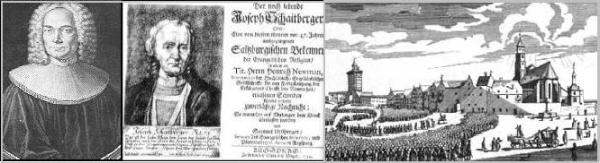
| Urlsperger and his book about Schaitberger; Exiles at St. Annakirche |
| THE SALZBURGERS: GEORGIA |
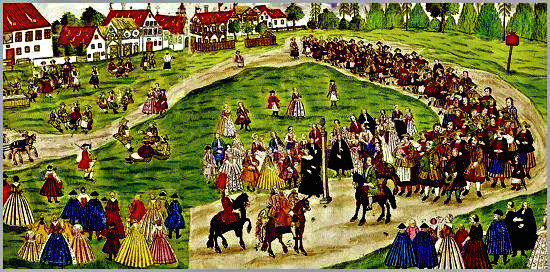
| The Salzburgers gathered outside Annakirche in Augsburg, June 14, 1732 |