Salzburgers in the New World
|
Georgia's first religious refugees were the Salzburgers. On the advise of Reverend Samuel Urlsperger,
an admirer of Joseph Schaitberger and the Pastor of St. Anna's Lutheran Church in Augsburg,
Germany, General Oglethorpe eagerly enlisted prominent men to establish the new colony to give the
needy a new start in life and to extend British dominions. The applicants were examined for honesty
and "inability for English livelihood".
In 1733, the first exiles arrived in Augsburg then travelled north to Frankfurt, then traveled by barge
to the Netherlands. At Rotterdam, the Salzburgers were met by their appointed Lutheran Pastors,
Boltzious and Gronau. Thirty-seven families then proceeded to Dover, England where they swore
allegiance to King George and were therefore awarded the same rights of Englishmen bound for an
English Colony. Their fellow Salzburg exiles who had ventured into German regions had at least
some continuity of food, language, climate and culture, and some were even treated like heroes, soon
becoming the center of legend, poetry and song. The Georgia Salzburgers had to travel into a dreary,
frightening wilderness where nothing was familiar. When once they knew only their small Alpine
farms and quaint villages in the homeland and were surrounded by friends and family, they were
suddenly an ocean away in a harsh and hostile environment.
A year after arriving in England they sailed for Georgia on January 8, 1734 on a two hundred ton
ship named the Purysburg, under Captain Tobias Pry. 63 stormy days later, on March 12, 1734,
their ship arrived at the Savannah River and was met by Oglethorpe who led them to their new
home. The Salzburger pastors had read bible texts during a terrible storm at sea near the end of their
Atlantic voyage, and among these texts was I Samuel 7:12. where Samuel placed a stone where God
had saved his people from their enemy and named it Eben-Ezer, stone of help. Thus, Oglethorpe
named the town, its stream and the Parish, Ebenezer.
The Salzburgers soon formed a new settlement with better soil in a less swampy area and called it
New Ebenezer. In 1769, they formed bricks with clay dug from the Savannah River banks for a new
church, the Jerusalem Evangelical Lutheran Church. Some descendants of the settlers still worship
there, making it the longest continuing congregation in the nation.
The British general quartered nearby ordered Patriot cottages plundered and targeted for cannon
practice. The British used the church for storage, a hospital, and as a stable for their horses. They
burned the pews and Bibles, the library and the pastor's journals. One soldier shot through the swan
weathervane on the church steeple and left a hole. In South Carolina in 1781, Georgia's first elected
Governor, John Adam Treutlen, a Patriot raised in Ebenezer, was murdered by a gang of Tories.
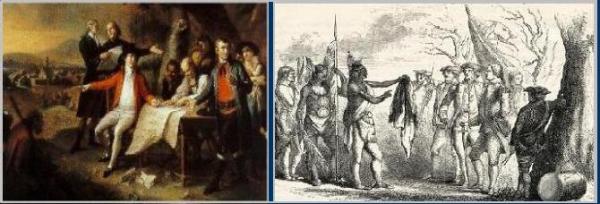
American Gen. Anthony Wayne led Continental soldiers to drive the British from Ebenezer in 1782
and the church was cleaned up. The Georgia Germans were greatly pressured to assimilate after the
Revolution, and many surnames were Anglicized and no longer German. After an interval, Georgia
was reorganized, whereupon new growth, already begun in response to the trustee’s relaxations, put
the colony on a prosperous footing.
Georgia's population shrank by 5,000 inhabitants in 1737 to barely 500 by 1742. While idealistic at
first, the trustees in charge allowed their ideals to be compromised later with introduction of slaves*
and liquor, yet they blamed the colony’s poverty to the " intemperance and laziness" of the settlers.
Beginning in 1738, boatloads of other Germans had arrived in Savannah from the Palatinate and
Baden, some of them indentured for years of servitude in exchange for their passage.
In 1984 Albert Winter of Salzburg, Austria visited Savannah and Ebenezer for the 250th
anniversary of the landing on October 12, 1734. Upon his return home, he requested that
Austrian officials donate a monument to the Georgia Salzburgers. Anton Thuswaldner was
commissioned to sculpt the monument of stone cut from the Austrian mountains and it was
brought to Savannah and dedicated in 1994. The Salzburger Society petitioned the City
Council in June, 1996 to have a half acre area around the monument named Salzburger
Park. Monument, left (click)
In Germany, the plight of the Salzburg exiles gave fodder to imaginative story tellers for many generations. At one time,
even Goethe donned a wide brimmed Salzburg hat which was the craze, left. He wrote his timeless tale of Hermann und
Dorothea based on the Salzburg exiles' story, and later, Schumann composed an overture to it. The basis of the story is
the Salzburg exile, however Goethe adapted it to more recent times and the poor maiden is represented as a German
from the west bank of the Rhine fleeing from the turmoil caused by the French Revolution. Goethe kept some of the
characters original, but he invented others, while weaving historical accounts of the Salzburgers journey into modern fable.
The life of the Georgia Salzburgers was far from romantic. They had immediate concerns, great
challenges and everyday problems that needed attention..one being good beer. Oglethorpe could not
supply enough beer or wine to guarantee the success in the settlement. The settlers brewed a
desperation drink made of molasses, sassafras and the tops of fir trees and they called it beer, but it
was a poor substitute for the real beverage dear to their hearts. Oglethorpe realized this and expressed
his desire to the trustees on October 7, 1738. He urgently requested that "fifty or sixty tuns of beer
from the brewery of Hucks at Southwark" be sent him, and said: "cheap beer is the only means to
keep rum out." Georgia was designed to be a temperance colony, but he probably thought he was
warding off one evil by substituting another less potent evil. Oglethorpe himself apparently even
accompanied the fleet of beer-bringers in his scout boat and placed all the strong beer on board one
boat where he could keep an eye on it. The settlers also made sauerkraut out of collard greens,
probably to accompany their horrid "near beer". An old Salzburger recipe dictates how one salts and
ferments the greens much in the same way as cabbage to make kraut.
During the Salzburg emigration march through Schwaben, one of the hymns of comfort they sang
was an unusually beautiful creation of Paul Gerhardt from 1653, Warum sollt' ich mich denn grämen.
In his dying moments in May, 1740, Friederich Wilhelm of Prussia asked that this hymn be played.
Paul Gerhardt himself recited the words of the fourth stanza when he lay upon his death bed. It was
written based upon Psalm 73:23: “Nevertheless I am continually with Thee: Thou hast holden me by
my right hand.” The hymns of the Salzburgers came with them to America, this being one of them.
John Wesley, not so romantic in his assessment, wrote: "The land is
a hungry barren sand; and upon any sudden Shower, the Brooks
rise several Feet perpendicular, and overflow whatever is near
them, ...and the Water generally so low in Summer-time that a
Boat cannot come within 6 or 7 miles of Town."
Jerusalem Church, Bolzius, typical Ebenezer cabin, left
However, 2,000 of its residents had fled as Ebenezer steadily declined until
1855 when it almost vanished. In 1864, Sherman's Union troops occupied the
church and again the pews, fences and old hymn books were set afire. An
1886 earthquake damaged the church even more. Today, the church, a
cemetery, and one home are all that remain of the town. A museum is on the
site today. Historical marker, left (click to enlarge)
The Salzburgers were opposed to slavery and part of the community agreement they all signed bound them to
reject it. However, three years after their arrival, their minister Rev.Boltzius uncovered the fact that a Mr. Kiefer
was secretly housing slaves on his farm. By 1750, because of pressure from the trustees, Boltzius himself decided,
much against his personal convictions,in favor of slavery. By 1770, two slaves who were Boltzius’ personal
servants were listed as part of the church inventory.
Two other Lutheran pastors kept slaves as well. The Reverands Rabenhorst and Lemcke owned 12 of the 59
young slaves baptized between 1753 and 1781. Boltzius and the others seemed to justify slavery not only because
of political pressure, but from the thought that if one took slaves with the intent of leading them to Christianity, it
would not be a sin, but a blessing.There is some evidence of Lutheran-Muslim interaction found in the journals of
the Salzburger's pastors John Martin Boltzius and Israel Christian Gronau because of the presence of Muslim
slaves originally from West Africa who lived in the area around the Salzburger community.
German settlers gradually pushed north along the Savannah River throughout the mid-18th century.
At length Parliament stopped its subsidy of the colony, and in 1751, the trustees resigned their
charter. By 1770, the entire German population of Georgia was over 1,500, but they would not keep
their ethnic characters for long in the new world.
The Salzburgers were not the only people with drinking habits Oglethorpe had settled in his dry
colony. The virtuous Moravians were mostly beer drinking Germans who had embarked for Georgia
with Oglethorpe and John Wesley, who was so impressed that he studied German in order to
converse with them. He said that they were "the only genuine Christians he had ever met."
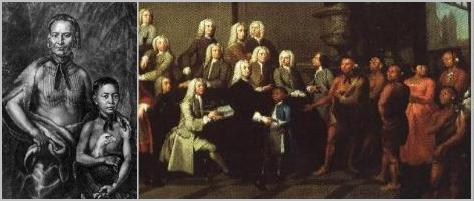
Tomochichi, 1644-1739, was an apparent exile himself from the Creek Indian Nation. He
and several followers first settled what is now Savannah, Georgia. Tomochichi became a lifelong
friend of the early English colonists, helping the settlers in Georgia negotiate treaties and settle
disputes with Indians. In 1734, at age 91,he was taken to England with a small delegation of
family and tribesmen by colonial Oglethorpe. In England, he was a celebrity, and was wined,
dined and even had his portrait painted with his nephew. He returned from his trip to England
with a shipload of presents. Tomochichi created his own tribe of Yamacraws from an assortment
of about 200 Creek and Yamasee Indians around 1728, and they settled within close proximity
to English traders. Tomochichi provided invaluable assistance to the new colony during their
early years of settlement. The chief also made the acquaintance of ministers John and Charles
Wesley. Tomochichi died on October 5, 1739, and received an English military funeral.
The Salzburgers played a prominent role in the affairs of Ebenezer throughout the colonial era
because of its strategic location in the defense of Savannah. They built the first church building, first
grist mill, first rice mill, first saw mill and first silk business in the colony. They opened the first
schools in the colony at Bethany and Eberezer, and the first orphanage. The Salzburgers also brought
the Austrian Pine, called Black Pine, the seeds having allegedly been brought in their baggage by the
early settlers. Some even credit them for the fiery Azalea. They also built the market squares in
Savannah to sell their wares. Sadly, their influence in Georgia politics waned by the time of the
Revolution and it changed hands several times. After the British invasion in 1778, British forces left
the village in ruins from which it never recovered.


Georgia was the last American colony and founded 50 years
after the other twelve. James Oglethorpe, its founder and its
governor, was a member of Parliament and a reformer who
was concerned about the atrocious conditions of the debtor's
prisons. He resolved to ship inmates to America. Georgia was
named for King George II who granted the Charter for 21 years
to a board of 21 trustees for the land between the Savannah
and Altamaha rivers and westward to the "South Sea".
Over the period of the trusteeship (1732-1755), fifty more trustees were added. The settlers had no
control of their own government - it was entirely ruled by the trustees. Georgia granted freedom in
religion to everyone except Catholics. Oglethorpe pointing at his new colony, above
Of 44 named passengers on the ship Purysburg, 20 would die in 1734
and 1735, mainly from malaria and dysentery, and by January of 1736,
21 more had died. Their settlement grew later to 1,200 when, in 1741,
another 300 Immigrants joined them. Other transports arrived until
1752. A short time after the Salzburgers arrived, they were followed by
missionary John Wesley, the founder of methodism, and a large group
of Scottish highlanders who also found a new home in Georgia.
Note: In the area around Ebenezar, the few entities which had "German sounding" names by the time of the First World
War took new identities because of anti-Germanism. The German Mutual Fire Insurance Company became the Atlanta
Mutual Fire Insurance Company and the German-American Club was renamed the Lexington Society.
On the list of Settlers, you will see names from the disappointed Holland group who returned to Germany and
then left on the later boats for friends and family in Ebenezer.
Reverend Bolzius wrote of his flock: "Every year God gives them what they need. And since they have been able to earn
something apart from agriculture, through the mills which have been built and in many other ways, they have managed
rather well with God’s blessing, and have led a calm and quite life of blessedness and honesty."
One of the late comers to Ebenezer was one Johann Wilhelm De Brahm. De Brahm, an engineer and cartographer of no
small repute. He was a native of Germany and a military engineer in the army of Karl VII. Three years after he resigned
his commission, he led a group of immigrants to America in 1751, settling in Ebenezer. He received an appointment as
surveyor general for Georgia in 1754 and a commission from South Carolina in 1755 to repair the fortifications of Charles
Town. De Brahm was also hired to design Fort Loudoun. De Brahm accompanied the first garrison of troops under the
command of Captain Raymond Demeré in the summer of 1756 to the proposed site on the Little Tennessee River. De
Brahm did not approve of the site, which led to hard feelings between he and Demeré. Demeré perceived De Brahm's
actions as inciting mutiny and rallied the officers of the garrison behind him, forcing De Brahm to abandon the project and
abruptly leave the fort on Christmas Eve, 1756.
De Brahm continued his valuable work as an engineer and surveyor. When Colonial leaders wanted a fort on Cockspur
Island to protect the growing port of Savannah from Spanish attack, de Brahm supervised the construction of Fort
George in 1761. When his appointment as surveyor general of Georgia ended in 1764, he became surveyor general for
both East Florida and the Southern District. He learned a great deal about the Cherokee Indians and in 1773 issued his
"Report of the General Survey in the Southern District of North America," which included information obtained
during his stay among them. At the onset of the Revolution, De Brahm returned to England and stayed a few years,
eduring financial hardship. He returned to Charleston in 1789, then moved to Philadelphia, where he died in 1796.