| A Few Notes about Bach |
| Johann Sebastian Bach was the youngest of eight children and orphaned at age ten. He was born in Eisenach, Thuringia in 1685 into a devoutly Lutheran family of professional musicians, including church organists and composers. As a youth, he once spent a month under house arrest because he tried to quit his job as musician for a duke, and during that month, he wrote forty-six pieces of music. He was a married twice, and happily. His first wife Barbara bore him three children, and after her death he married Anna Magdalena, also a talented musician, who bore him seventeen more musically inclined children. By the end of his life, he had composed over 1,100 works in almost every musical genre except opera. In his position at the St. Thomas Church School in Leipzig, Bach taught many subjects, including Latin and music, and he was the first to teach the use of all five fingers on the keyboard. At home he taught music to all of his own children while wife Anna Magdalena maintained a detailed Notebook. Bach consecrated all of his work of a Christian nature "to the only God’s glory." Johann Sebastian Bach spent the last 27 years of his life, from 1723 to 1750, as Cantor of the Thomaskirche, during which time he wrote the Art of Fugue, the Passions of St. Matthew and St. John, and most of his 300 cantatas, only 190 of which survived future wars and bombings. Bach was a presence in many other churches during his lifetime. Wilhelm Friedemann Bach, 1710-1784, was the eldest son of J. S. and Maria Barbara Bach. A 'man of idle and dissolute habits', he studied philosophy and mathematics at Leipzig, but later accepted a post as organist in Sophienkirche at Dresden. He then found a better job in Halle at the Liebfrauenkirche in 1746 where he spent 18 years. Unhappy with the job, Friedemann resigned his Halle post in 1764, and never held a permanent job again. After wandering around a while, with a brief stay in Brunschweig, he moved his family to Berlin in 1774. He left his widow and child destitute when he died. He composed more than forty keyboard works, 7 concertos, chamber music, 10 symphonies, 33 sacred cantatas and vocal works. Johann Christian Bach, 1735-1782, was the youngest surviving son of Bach's twenty children. He studied with his father, his brother Karl Philipp Emanuel and Padre Martini of Bologna. He became known as the "Milan" Bach after becoming organist at the Milan Cathedral in 1760, and then the "London" Bach two years later. He briefly instructed and influenced young Mozart in 1764. His works include chamber works, operas, piano and church works. After his father's death, J.C. Bach turned Roman Catholic in Italy. As his music style fell out of fashion, Johann Christian also tended toward heavy drinking and he built up considerable debts. In June of 1768, one of the first known uses of a piano as a solo instrument in concert was at a concert performance by Johann Christian Bach performed on an English square piano made by the German craftsman Johannes Cristoph Zumpe of London. Karl Philipp Emanuel Bach, 1714-1788, Bach's second surviving oldest son began his career studying law but ended up becoming court musician to Friedrich the Great for thirty years, and then succeeded his godfather Georg Philipp Telemann as the music director at the Hamburg churches, his main task being organizing the music in Hamburg’s five principal churches, the Michaeliskirche, Jakobikirche, St Katharinen, Nikolaikirche and Petrikirche. This Bach wrote 300 keyboard works, symphonies, concertos and choral works. Johann Christoph Friedrich Bach, 1732-1795, left, was the ninth son. Born in Leipzig, he became court chamber musician at Bückeburg the same year as his father's death. This "Bückeburg" Bach composed oratorios, songs, symphonies, cantatas, concertos and keyboard works. Johann Gottfried Bernhard Bach, 1715–1739, is the 4th son that is not talked about too much. He was a baroque organist and contrapuntist, and composed mostly keyboard music. He was born in Weimar and educated in Leipzig. He served briefly as organist in Mühlhausen in Thuringia. In 1735, he fled in debt after only a year, and became organist at Sangerhausen, but fled his debts again, much to his father's chagrin. He showed up as student of law in Jena, where he suddenly died in 1739 at the age of 24. Not much is known about the son of Johann Christoph Friedrich Bach, Wilhelm Friedrich Ernst (1759-1845) of Buckeburg-Berlin. He was a pianist, violinist and teacher at the court in Berlin, but it is thought that he was the last of the musical members of the immediate Bach family. His mother was the Bückeburg court singer Lucia Elizabeth Munchhausen, herself a great-great-granddaughter of the composer Johann Grabbe who, along with Heinrich Schutz, studied under Giovanni Gabrieli. He was music director to Friedrich II of Prussia, where he instructed the royal children. His music includes vocal concertos and lieder, and sinfonias and sonatas for orchestra. As Johann Sebastian Bach's grandson, he once said: "Heredity can tend to run out of ideas." Robert Schumann met him in 1843, and described him as "a very agile old gentleman of 84 years with snow-white hair and expressive features." |
| It is said that Bach's last completed work was a chorale prelude for organ dictated to his son in law, Johann Christoph Altkinol, from his deathbed: "When in the hour of greatest need" and "Before Thy Throne Herewith I Come." His obituary read: "a little after a quarter to nine in the evening, in the sixty-sixth year of his life, he quietly and peacefully, by the merit of his Redeemer, departed this life." |
| 'Night shines deeper, to penetrate more deeply, But yet within there glows bright light. For completing of the greatest work, One soul for a thousand suffices.' Last words attributed to Bach |
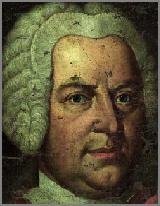
| The Bach Boys |
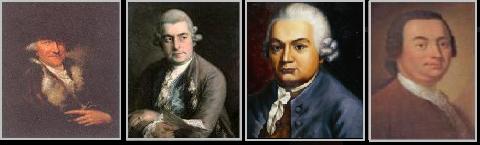
| Papa and Wilhelm Friedemann, Johann Christian, Karl Philipp Emanuel and Johann Christoph Friedrich Bach |