| Leipzig, Lennep, Linz, Lübeck, Ludwigshafen, Magdaburg, Mainz, Mannhein |
| Leipzig was the second largest city of Saxony and the historic center of German printing. An advanced trading center, Leipzig survived the Thirty Years War intact and even continued hosting its famous annual trade fairs. Leipzig, with elegant lanes, formal gardens, libraries, university, elaborate town hall and wealthy burgers' mansions, was considered one of the world's foremost and amost beautiful cultural centers. Trade fairs Bach Early Music Leipzip's End |
| Leipzig |
| Linz |
| Linz was founded by the Romans, who called it Lentia, and it was originally the site of a Roman fort. Later, a small castle was built here, which in time became a heavily defended fortification. As an important crossroads of several trade routes spanning the Danube, Linz was for a short period the most important city of the empire, as it was where the Habsburg Emperor Friedrich III spent his last years. After 1493, it lost much of its importance to Vienna. Karl-Franzens Universität is the city's oldest university, founded in 1585, and Kepler was a professor of mathematics at the University of Graz. The Horse Railway Linz lost 12,084 buildings and 1,679 civilians due to bombing. Altogether in Austria, from August 13, 1943 up until the end of war, approximately 120,000 tons of high explosive and incendiary bombs were dropped. From 1944 to 1945, there were more than 200 air raids and 22 bomb attacks on Linz, left. It was also the scene of "Operation Keelhaul," the horrible betrayal of the Cossacks by the Allies which resulted in the cold blooded slaughter of thousands of forcefully "repatriated" Cossacks to the Soviet Union. |
| Lübeck |
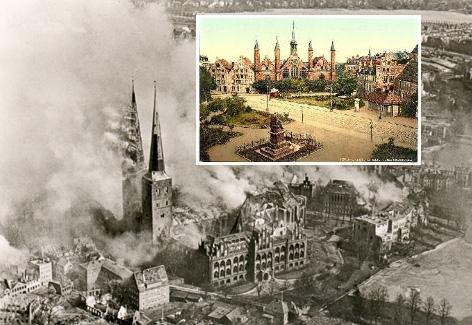
| The Wends established "Liubice" as a royal seat and trade center around 1000 A.D., and in 1143, Count Adolf II of Schauenburg built a settlement of Christian merchants between the Trave and the Wakenitz Rivers near its mouth on the Baltic Sea, calling the city Lübeck. Saxon King Heinrich the Lion established Lübeck for a second time after it burned down, and it bloomed from the mid 12th century on, becoming the center of economics in Northern Europe. Heinrich the Lion laid out the town plan, as well as the cornerstone for the cathedral Dom zu Lübeck in 1173. Two more churches were constructed that year, Marienkirche und Petrikirche. Emperor Friedrich II. granted Lübeck status as a free imperial city in 1226, and this continued for 711 years. At the end of the 13th century, the Hanseatic League developed along with Lübeck. When the League weakened, the last of the Hanse diets was held there in 1630. The city escaped the destruction of the Thirty Years War, but in the French Revolutionary Wars, Lübeck was sacked by the French in 1803, who occupied the city. The first deliberate attack on a cultural target and mass bombing of a historic city was the RAF attack which incinerated over 80 per cent of the old timber built Hanseatic town of Lübeck on Palm Sunday, March 28,1942. This attack by over 200 heavy bombers was ordered by a commander of Bomber Command, Air Marshal Arthur Harris ("Butcher Harris"), as an experiment, to test whether bombing timber framed buildings could start an inferno large enough to be used as an easy aiming point for later waves of bombers: "I wanted my crews to be well blooded, as they say in fox hunting, to have a taste of success for a change." A devastating hail of 33,000 bombs with a weight of approximately 180,000 kilograms fell on the medieval city center. More than 80 % of the historical buildings were victims of the flames and 10,000 people were left shelterless, 300 people were killed and 650 injured. 700,000 cubic meters of rubble were left. Afterwards, Lübeck was very fortunately preserved as an International Red Cross city despite Allied demands to bomb it again. Toward end of the war, Lübeck also accepted nearly 100,000 refugees. |
| Magdaburg |
| Magdeburg, a notoriously beautiful city, was first mentioned in the year 805. Luther preached here in the 16th century. In 1631, during the 30 Years War, the city was burned to the ground and its citizens tortured and murdered. By 1635, there were only 400 homes left standing in the city and by 1644, its population had fallen to 2,464. It was later rebuilt into a grand cultural center. Magdeburg experienced 31 large air raids in the War, in which both British and Americans dumped over 12,000 tons of bombs. Over 6,000 humans died and 11,200 were injured and 190,000 people left homeless. On January 16, 1945, hundreds of British airplanes crowded the skies over the core of the old city, coming in several waves so that their bombs would efficiently detonate at once. The aerial mines, firebombs and high explosives bombs ripped through the city with furious speed and seized fleeing civilians, buildings, trees and even ignited the tar on the roads. Magdeburger Dom 300 Years Previously: The Sack of Magdeburg It took 26 minutes for the oldest part of town to burn up. Over 1,050 tons of bombs rubbed out the civilian center of the city, an area of 2.4 square kilometers. 14 more fierce attacks followed, half of which took place in the last three months of war. Like the bombing of Hamburg, Kassel and Dresden, it was calculated to hit the flammable core of the city and tear its heart out, causing as much destruction and carnage as possible. Magdaburg was the third most heavily destroyed city in Germany. Filled with six million cubic meters of rubble, her population plummeted from 330,000 to less than 90,000. She was then sentenced to slavery under communism.. |
| Mainz |
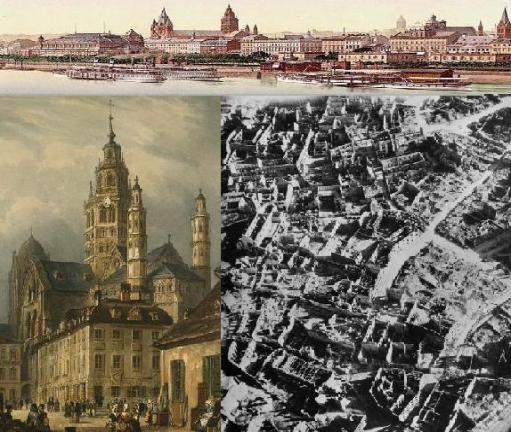
| Mainz was one of the great historical cities of Germany, founded in the 1st century on the site of the Roman camp of Maguntiacum. Charlemagne granted the city its rights. Around 746, Mainz became the seat of the first German archbishop, St. Boniface. The later archbishops acquired considerable territory around Mainz on both sides of the Main and in Frankonia, which they ruled as princes of the Holy Roman Empire with precedence over the other electors in the Imperial elections. Mainz flourished under the rule of the Archbishops-electors and the German kings were crowned here. Mainz became the first printing center of Europe under its citizen Johann Gutenberg, 1397-1468. Although the French burned the city and brought near destruction to Mainz as they did to most of the Rhineland in the 17th century, worse was in store for her on February 27, 1945 when 435 British bombers attacked, dropping 1,500 tons of bombs and thousands of incendiaries. Within 20 minutes, 200 people were dead, and the city center was 86% destroyed, including almost every historic structure. The cathedral, from 1037, was badly damaged and other churches were lost forever. Much of what had stood for centuries bearing testament to early European history was snuffed out. |
| Mannhein |
| Mannhein was first mentioned in 766 and it received city rights in 1607. Destroyed in the 30 Years War, it was rebuilt in 1689. From 1720-1778, Mannheim was the Residence of the Elector of the Palatinate. When Prince Carl Philipp transferred his residence from Heidelberg to Mannheim, the town bloomed as the seat of the Palatinate government. Mannheim's lovely baroque Residence of the Elector was built as a palace in the early 18th century. Before Arthur Harris publicly stated the British intention of bombing German civilian centers, the first 'area air attack’ of World War Two was carried out by British bombers on the old city of Mannheim on December 16, 1940. The object of this deliberate terror bombing, as then Air Chief Marshall Peirse later explained, was 'to concentrate the maximum amount of damage in the center of the town.' "Operation Abigail" was approved by the British War Cabinet on December 13 on the condition that it "receive no publicity". It was carried out by 98 out of 134 twin-engine bombers who dropped 100 tons of explosive bombs and 14,000 incendiaries. Indeed, from December 1940 on, Mannheim was bombed more than 100 times and was the goal of over 150 air raids. The heaviest air raid which destroyed most of the city took place on September 5 and 6, 1943. In 1944, bombing raids destroyed Mannheim Palace, leaving only one undamaged room out of over 500. On March 2, 1945 the RAF launched a 300 bomber attack against Mannheim, causing a devastating firestorm, finishing the grand city off for good. Mannheim was destroyed with the accompanied loss of life. 25.181 tons of bombs fell on Mannheim. |


| Ludwigshafen am Rhein is a city in Rhineland-Palatinate located on the Rhine opposite Mannheim. The Ludwigshafen vicinity was inhabited in prehistoric times and then Celtic and Germanic tribes settled here. In the last century B.C., the Romans conquered the region and a Roman auxiliary fort was constructed nearby. Some of the later suburbs of Ludwigshafen were founded in the Middle Ages, but the year 1843 was the official birth of the city when Bavaria was given this property and Bavarian King Ludwig I renamed it and began construction of city to rival Mannheim. During World War II, the city was a prime target for strategic bombing because its industry which employed 40,000 workers. But the factories were not significantly harmed until almost war's end, rather, the civilian areas were. Thirteen thousand Allied bombers attacked the city in 121 separate raids during the war, of which only 56 were aimed at the main factories, including the Farben plant. Those 56 raids dropped 53,000 bombs each containing 250 to 4,000 pounds of high explosives, plus 2.5 million 4-pound magnesium incendiary bombs. Since cloud cover often obscured the target, "pathfinder" planes identified the general vicinity with flares which bombardiers unloaded. Even then, out of 1,700 bombs dropped on January 7, 1944, for example, only 127 hit the Farben factory and most still hit residential areas. Thousands of homes were destroyed and there was a great loss of civilian life. But in a raid in January of 1945, 1,000 high explosive bombs and 10,000 incendiaries finally fell within the factory fences, starting over 250 separate fires. This bombing also destroyed even more residences and "dehoused" another 1,800 people. 50% of the houses in Ludwigshafen were destroyed and it was one of the most thoroughly bombed cities in Germany. |
| Ludwigshafen |
| Lennep (see Remscheid) |