| Medieval Trade Fairs |
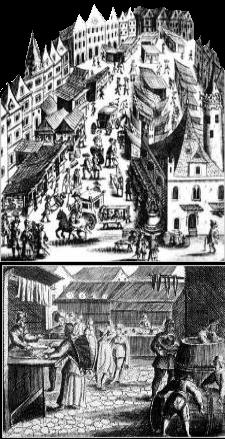
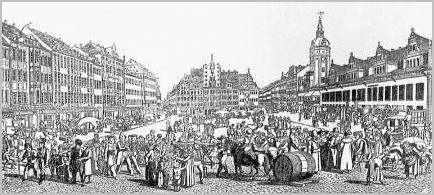
Lübeck (above) and Leipziger Messe; Frankfort, right
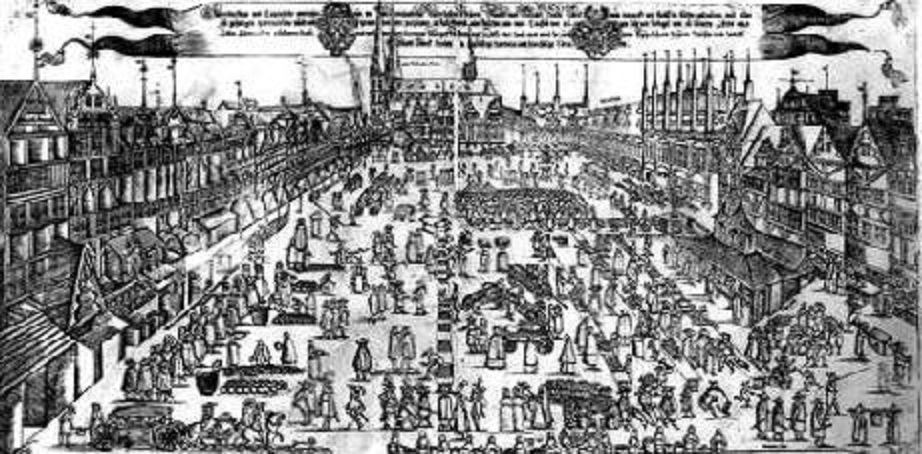
| Trade fairs were an important part of life in the middle ages and they were held in several cities. One city hosting an annual fair was the ancient seaport city of Lübeck. Emperor Friedrich II. granted Lübeck status as a free imperial city in 1226, and this continued for 711 years. At the end of the 13th century, as the Hanseatic League developed with Lübeck, the city grew rich as a lively center of trade. In the year 1630, when the etching above was executed, Lübeck's marketplace was bustling, but it was also the last time that the Hanseatic diets was held there. The Leipzig Trade Fair, or Leipziger Messe, was a major fair in continental Europe for nearly a millennium and dates back to 1165. Otto the Rich, the Margrave of Saxony in 1190, started two fairs in Leipzig and laid down regulations to ensure its success: no other fair was to be held within a mile and the bridges and streets would be toll-free. Later, in 1268, all foreign merchants travelling to or from the fairs were ensured safe conduct, even if their rulers were at war with Saxony, making the Leipzig fairs very popular across Europe. Merchants traded cloth, wine, spices and food. By 1458, a third fair was started by Friedrich II (the Gentle) of Saxony. Emperor Maximilian I extended the ban on other fairs to a 15 mile area in 1507, increasing the dependence on the Leipzig trade for cities for such as Erfurt, Halle and Magdeburg. In time, a stock exchange, factories and stores sprang up and Leipzig's prosperity grew enormously. By the 18th century, Leipzig had even become the center for trade with Polish and English goods and was known as 'the marketplace of all Europe'. The Frankfurt trade fair, or Frankfurter Messe, is actually the world's oldest. An autumn fair in the city of Frankfurt is first mentioned during the Assumption holiday in the year 1150 and is thought to have had its origin in the 11th century as a harvest fair where agricultural surplus was sold. A formal fair here was begun at the time of Emperor Friedrich in the year 1240. "We, Friedrich, God-chosen Roman emperor, King of Jerusalem and Sicily, hereby make known to the world by way of this writ that we, in unity and each as individuals, will provide special protection for each and every person travelling to the fairs of Frankfurt. We demand that no person shall be hindered or harassed in any form during his or her travels to and from the fairs. If anyone should dare to counteract this demand, let it be known that this person shall reap the wrath of Our Majesty. Our Majesty's seal shall serve as assurance for the commands of this document." July 11, 1240 In 1330, Ludwig the Bavarian issued an official privilege granting a spring fair in Frankfurt for products such as spices, Flemish lace, Lübeck herring, furs from the Baltics, Chinese silk, glassware from Venice, jewels, timber and horses. By the 15th century the products at fairs included banks, bourse and books. With the advent of currency and credit during the Middle Ages coming as a direct result of the trade fairs, the foundation was laid for monetary transactions and the bank and stock market trade. The Frankfurt trade fairs of the 14th century offered not only consumer and luxury goods but a growing number of manuscripts composed by monks. When Gutenberg invented movable character printing in 1445, the book trade began and, with it, book fairs. Frankfurt's first book fair took place in 1480. By 1500, Frankfurt had become the first center of German and European book printing. The trade fairs became more international in scope during the 16th century and included foreign- based traders. Books, silk and jewels were the most popular merchandise while the currency exchange boomed. The Thirty Years' War brought trade to a standstill in Frankfurt, but Leipzig did not succumb and, despite the war and severe epidemics, the Leipzig fairs continued every year for seven centuries. When censorship was introduced in Mainz, a considerable decline in the Frankfurt book fair took place at the end of the 17th century and the book trade moved to Leipzig. During the 18th and 19th century, Frankfurt suffered from various armed struggles between rival princes and lords and lost its status as a free-city, and then with the destructive occupation by the French in Frankfurt, trade restrictions and new customs regulations diminished the city's importance even more drastically. Leipzig refused to join the German Customs Union which helped it prosper even more as the trade fair center. However, Frankfurt later emerged as a banking and exchange center after the foundation of the German empire in 1871 while under Prussian rule. The revitalised Frankfurt Fair in the early 20th century also found new success until World War Two when ninety-five percent of the fair grounds were destroyed by Allied bombs. In 1895, the modern "Muster-Messe" replaced the old Leipzig Jubilate-fair and developed the modern concept of what we think of today as a trade fair, with businesses and factory owners presenting samples of their goods. Leipzig became the main German fair for books and consumer-goods. A technical fairground was opened in 1920 and by 1930 it drew visitors and exhibitors from 45 countries. By 1940, the fair included 19 more pavilions. Throughout the centuries, a whole book district developed in Leipzig complete with book museums. The Leipzig fair, which had occurred twice a year for seven centuries, was mostly destroyed by Allied bombs in World War Two along with an estimated 50,000 books, many of them rare, from the historic book district. |