The Thirty Years War 1618-1648
|
In the 1590's Europe suffered from bad weather with periods of rain,
drought and exceptionally cold winters. Starvation and plague went hand
in hand with massive crop failures and food shortages, causing prices to
rise. It was prophesied that the world would end in the year 1600, but a
temporary return of favorable weather arrived instead. However, after
1600 and throughout the 17th century, agricultural crises, food shortages
and economic difficulties in Spain, England, France and the Holy Roman
Empire, accompanied by population decline, would recur and peasant
wars commenced as monarchs increased taxes to pay for their armies.
By 1617, the Habsburgs had chosen a red-haired, good-natured, staunch Catholic and devoted father
and husband Ferdinand II as king of Bohemia. In 1618, he moved against rebellious Protestants who
formed the majority in Bohemia, by closing some Protestant churches in Prague. A year before,
Bohemian leaders had thrown two imperial officials in the Prague Palace out of a window. They
miraculously survived the 70 foot fall, protected by the Virgin Mary according to Catholics, and
protected by falling into a dung hill according to the Protestants. This led to other arguments.
Wallenstein advised Ferdinand II to use his power to create a more centralized Germany, even
though it would be a move which might alienate Maximilian and other Catholic princes who were
opposed to any increase in imperial power. Ferdinand's other alternative was to satisfy the Catholic
Reformation's demand for the restoration of the Church lands seized by the Protestants since the
Peace of Augsburg in 1555, a move which might frighten the remaining Protestant princes, some of
whom had thus far been neutral. He finally chose Catholicism and political disunity. By the Edict of
Restitution in 1629, he ordered the restoration of the former ecclesiastical territories to the Catholics,
and dismissed Wallenstein to placate Maximilian.
The Swedish King, a down to earth, popular man and a sincere Lutheran, wanted control over the
Baltic for economic reasons. Gustavus had been trained since childhood for kingship. From the age
of six, he had begun to accompany the army on campaigns and by age ten sat at the council table and
voiced his opinions. When he was in his teens he received ambassadors. He had been king for 19
years, proving himself an able administrator and a careful a military organizer. The Protestant "Lion
of the North" sent his armies across the Baltic Sea, financed by Cathlolic French King Louis XIII and
his minister Cardinal Richelieu, who wanted to ebb the strength of the Habsburgs. The Swedish "blue
and yellow" brigades of highly disciplined soldiers cut through the Imperial armies which were, at that
point, formed largely from Swiss and German "landsknechts"or mercenaries.
In 1634, the Habsburgs defeated the Swedes at Nordlingen, but Gustavas had gained Catholic France
as an ally, both concerned with Habsburg power, and in 1635 a small, poorly trained French army of
30,000 men crossed the Rhine River and began the bloodiest phase of the war which had by now
spread across Europe to Italy, to the Spanish-French border, and to war between Denmark against
Sweden, with the United Netherlands joining France in war against Spain, annihilating the Spanish
fleet in 1639. Portugal revolted against Habsburg rule and re-established its independence in 1640.
The treaty returned rule in Bohemia to the Habsburgs, but it ended Habsburg dominance in Europe.
France emerged as the preeminent power on the European continent, its authority in Germany
becoming even greater than that of the Holy Roman Empire. France's navy increased as a challenge
to the navies of the British and the Dutch. Sweden gained Western Pomerania and bishoprics in
Bremen and Stettin. They also gained control over the mouths of the Oder, Elbe and Weser rivers
and emerged from the war, for a short time, as one of Europe's great powers. Spain was compelled
to make peace with France in 1659, emerging from the war a weakened state and without Portugal.
The Peace of Westphalia contributed to the concept of sovereign states with equal rights based on an
inter-governmental order constituted of treaties and international law.
The Bohemian nobles were opposed to the encroachment on their power by Habsburg officials and
were afraid that Ferdinand would push them further when he came to power.
The loss of Bohemia could mean the choice of a Protestant instead of a Catholic
Habsburg in an imperial election, and so he asked Maximilian of Bavaria, 1597-
1651, and Spain for assistance, and with these allies quickly reconquered Bohemia
between 1618 and 1625. Catholicism and imperial authority were ruthlessly restored
with the help of the Jesuits and forced conversions. In Prague, on June 21, 1621,
twenty-six noblemen were executed. The confiscated property of other rebel nobles
in Bohemia and Moravia was parceled out to nobles loyal to the Church and
Ferdinand II.
Albrecht von Wallenstein (1583- 1634) was recruited by Ferdinand 11 to raise an
army. Born a Lutheran, ambitious Wallenstein had become a Catholic for political
reasons, but it was said that he turned more to the stars than to God for guidance.
The clever Wallenstein married a wealthy widow who conveniently died soon after, leaving him her
wealth as well as the freedom to marry the rich daughter of one of Ferdinand's councillors.
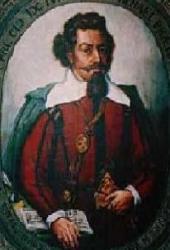
Maximilian of Bavaria, top. Ferdinand II, center. Albrecht of Wallenstein, above. Wallenstein palace, below
The Habsburgs wanted to secure the Baltic Sea as a
buffer against Denmark and Sweden and to stunt
Dutch trade. The Protestant king of Sweden, tall,
handsome, thirty six year old Gustavus II, 1611-1632,
was worried about a Habsburg threat against Sweden's
Baltic Sea domination, and he aggressively expanded
into Poland from where he would expand into northern
Germany, invading Pomerania in June, 1630. He
landed in Germany with a well-trained, disciplined
army to ensure that the Habsburgs would not
consolidate their hold on the southern shores of the
Baltic Sea and secure a place to attack Sweden from
whence they could re-establish Catholicism.
Magdeburg, top. Bottom:Gustavius Adolphus,
Pappenheim and Johan Tserclaes, Count Tilly.
Magdeburg was the most important city on the River Elbe, and had been an Imperial target for some
time. An Imperial army under Gottfried Heinrich Graf zu Pappenheim had been besieging it since
November, 1630, and after a series of setbacks, he was joined by John Tserclaes, Count Tilly, and
the larger Imperial army in April, 1631. Although the city bravely held out repulsing assaults on May
17th and 18th, on the morning of November 20th, Pappenheim attacked again and this time the city
fell. After the capture of the city, populated by both Catholics and Protestants, the victors of
Maximilian's Catholic League ordered soldiers to: "Kill them all. God will find his own." The
Imperial troops rapidly went out of control, and a horrible massacre resulted. Around midday, twenty
or more fires started, and the conquerors could not put out the fire. Only 5,000 of the 30,000
population of the city survived the sack and fire, while the Imperial army found itself without the
supplies and food. A stunned Gustavus Adolphus was unable to help the city in its moment of agony.
The Swedish invasion completely altered the situation in the Empire. After a great victory in the
battle of Breitenfeld, Gustavus Adolphus was free to march anywhere he pleased. Protestant princes
joined Gustavus' forces, and by 1631 had secured northern Germany for Protestantism, and
Gustavus was hailed as a liberator. The Swedish army pushed on and wintered in Mainz. In the
spring of 1632, war resumed. A Protestant army from Saxony drove into Bohemia and occupied
Prague.Gustavus recruited, among others, 20,000 to 30,000 Scottish Highlanders.
He shrewdly came into control a quarter of the land in Bohemia, and he
offered to raise, quarter and provision 50,000 men at his own expense,
leaving to Ferdinand only the responsibility of their pay, an offer Ferdinand
couldn't refuse.
The king of Denmark and Norway, Christian IV, who expressed his support for Protestant princes,
invaded Germany in 1625 to stunt the power of the Habsburgs and expand his holdings. Habsburg
forces under Wallenstein pushed northward from Germany into Denmark against him, and the two
foes made peace in the Treaty of Lübeck in 1629. Wallenstein was given Mecklenburg as a reward
for his services after its former ruler made the mistake of siding with the Danes.
The Swedes passionately avenged the destruction of the lovely city of Magdeburg. They defeated an
imperial army at Breitenfeld and then cut like lightning through imperial territory between the Rhine
and the Danube defeating every army.
The Swedes drove as far south as Augsburg and Munich, where Bavarian Catholic peasants battled
them. Ferdinand had no choice but to recall Wallenstein, and the two generals fought an indecisive
battle at Nürnberg, and Gustavus Adolphus withdrew to the north. Once more they clashed at
Lützen. The Swedes were victorious, but at the cost of their king's life. The death of Gustavus gave
the Catholics new hope, but the rivalry between Maximilian and Wallenstein remained.
The Bohemian Wallenstein, who had never forgiven Maximilian and Ferdinand for his first dismissal,
plotted with the Swedes and French. Ferdinand knew that he could not be trusted and declared him
guilty of treason and Wallenstein was murdered, defenseless in his bedroom.
Germany lost a third of its urban population and two-fifths of its rural people. 13 out of 17 million
Germans were killed from the war, starvation or pestilence. 943,000 persons in Saxony and 500,000
in Würtemberg died in just one year. 90 percent of Thuringia's population was eliminated. The
Palatinate lost 457,000 out of 500,000 people. The war ended in 1648 with a negotiated settlement,
the Peace of Westphalia, 30 years after the war's start, with France and Spain continuing the war for
ten more years. Over 300,000 people had been killed in battle and millions had died of malnutrition
and disease. Wandering, out of work mercenaries and thousands of homeless drifted, robbed,
burned, and looted, damaging crops and spreading the plague and syphilis. Most authorities believe
that the population of the Empire dropped from about 21,000,000 to 13,500,000 between 1618 and
1648. It took years to restore law and order. Swedish troops did not withdraw until 1650 and some
remained in Pomerania.
The devastation of the Thirty Years' War awakened in people the need for some tolerance, and the
Peace of Westphalia readjusted the religious and political affairs of Europe, and Lutheranism,
Calvanism and Catholicism were recognized as legitimate faiths. The borders of German principalities
were restored to what had been in 1618. The Peace of Westphalia gave recognition to secular
kingship as the legitimate and dominant form of government. The sovereignty of Switzerland and the
United Netherlands was recognized. With this new order, Europe's period of religious wars as such
came largely to an end.
In 1632, Scots mercenaries arrived in Stettin to serve with the
Swedish army. Often described as "Irrlanders," Scots were
often thought of as Irish as they both spoke Gaelic. However,
in 1609, Gustav Adolphus had recruited Irishmen along with
Scotsmen to fight in the German lands. But the Swedes were
wary of the Catholic Irish, and many later joined the Polish
and German armies. The Spanish also raised Irish Regiments.
The rebels quickly seized control of Bohemia, won assistance from Transylvania and
elected the Calvinist Elector Friedrich of the Palatinate as king. They marched on
Vienna. Ferdinand had neither money nor troops, and he badly needed to regain
Bohemia which furnished half the imperial revenue.
1618 Map The Religious Situation in Europe