| Boblingen, Bocholt, Böhlen, Bonn, Braunschweig, Breisach, Bremen, Bremerhaven, Breslau, Bruchköbel, Bruehl |

| The name Bocholt was first written about in 779, when Charlemagne won a battle against the Saxons nearby, but the settlement was probably much older. Bishop Dietrich III von Isenburg from Münster gave Bocholt city rights in 1222, and by the 15th century the city flourished. On March 22, 1945, Bocholt was 85 % destroyed when 98 British bombers dumped 180 tons of high explosive bombs and over 171,000 incendiary bombs of 1.8 Kilos each. In just a few minutes, the entire city center experienced the ungodly and terrible heat. According to the bomber crews the smoke rose to over four kilometers high. The ensuing fire suction burned everyone alive in its path and sucked the air out of those trying to survive underground in cellars. Mutilated corpses littered the roads leading out of the city center, and those found within the city later were completely shrunken. |
| Bocholt |
| Bonn |
| Braunschweig |
| Bremen and Bremerhaven |
| Breslau |
| Roman soldiers first bridged the Rhine at Bonn in the year 11AD, and the name "Bonna" appeared in official records by the 9th century. Bonn, Beethoven's birthplace, developed into a beautiful and vibrant cultural center. In an Allied fire bomb attack of World War Two that struck directly into the heart of Bonn, these centuries were thrown into an ash heap. 700 buildings were destroyed and 1,000 seriously damaged, with its university, many cultural and public buildings and large residential area within the ancient city center totally destroyed with a great loss of life. So was the organ in a church Beethoven once played. |
| The City of Braunschweig (Brunswick) is very old. Over one thousand years ago, merchants found a quiet rest stop at the intersection of busy trade routes where the Oker river was navigable by way of the Aller and Weser to Bremen and then to the sea. Because it was such a strategic location, Heinrich the Lion choose Braunschweig as his residence in the middle of the 12th century, and it grew into a large medieval city of five districts: Altstadt, Hagen, Sack, Altewiek, and Neustadt, each with its own constitution, townhall, market and church. By the 13th and 14th centuries, Braunschweig was an important and prosperous merchant city trading with Flanders, England, the Nordic countries and even Russian regions. The resulting riches produced magnificent timber framed buildings. The Braunschweig Altstadt had the largest ensemble of half-timbered framework houses in Germany, and over 800 were located in the heart of the old city surrounded by 17th and 18th century stone buildings, gorgeous churches, schools and monuments. The independence of the city was lost when the absolutist Welf rulers moved their place of residence in 1753 back from Wolfenbüttel to Braunschweig, but soon trade and culture recommenced and the Dukes formed a college in 1745 and a bank in 1765 to promote the economy. The dukes also promoted science, art, music and theater, turning the city into a glistening cultural center in the Enlightenment. The dukes maintained law and order, and ran their duchies like tight ships. All would vanish within less than an hour. The Bloody Silly Baron Its Destruction On the fifth British raid on Braunschweig by the RAF, October 15, 1944, 240 bombers dropped their lethal load which produced an intentional fire storm that completely destroyed the old city center within the moat, and other large areas. In what was called "sector bombing," the RAF used the cathedral as a reckoning point for the master bomber in the lead plane who dropped a green marker on the cathedral dome to guide the aimers in the following aircraft, who then flew over it from various directions in a fan-shaped formation and dropped their deadly loads. The first of the 200,000 phosphorus and incendiary bombs to fall on the city were 12,000 "Blockbuster" explosive bombs. These were typically laid in "carpets" on the historical centers of old timber-frame towns to efficiently expose the town's guts for an injection of fire and the intended firestorm and Braunschweig's medieval houses were perfect fuel. The blasts blew off the old wooden houses' roofs and windows, then split the house's interior walls open so as to receive their death by fire. After the explosive bombs, the phosphorus and incendiary bombs were dropped. Their job was to ignite the firestorm. The British perfected this technique after careful research done in conjunction with the US in places like Dugway. The bombers were long gone when the firestorm reached its peak in the core of the city. In a scene reminiscent of the eruption of Vesuvius, sparks and embers rained in a lethal deluge over the blazing inner city, making it nearly impossible for rescue vehicles and fire engines to reach into the fire and try to save people. The city had a well planned system of bunkers for shelters, but some were made inaccessible to rescue crews by flames. Rescue and fire personnel screamed into the burning city from all surrounding areas to help and an amazing and courageous rescue of 23,000 trapped people was carried out, although 100 people in one shelter suffocated and could not be saved. 1,000 were killed, but 2,905 more died later from after effects and UXB's. The hideous glow of the incinerating city could be seen for miles and miles. It was so bad that even the next morning when British reconnaissance flew overhead to take pictures of their handiwork, they had to turn back because the smoke was still too thick. They were satisfied none the less, for they only lost a single Lancaster bomber to anti-aircraft fire that night. The fires raged for 2½ days., in the case of Braunschweig about 200,000 phosphorus and incendiary bombs. Within the 24 hours of "Operation Hurricane," the RAF dropped over 10,000 tons of bombs on Duisburg and Braunschweig alone, the greatest bomb load dropped on any one day in the war. There were 202,284 city citizens before the war, and only 149,641 by the war's end. The city also lost 15,000 men during the war years. The lovely ancient city is but a small shred of her former self. A woman prays at the site of children killed in the bombing, below. |
| Bremen, on the banks of the river Weser that flows into the North Sea, was founded in the 9th century and was an important and lovely member of the Hanseatic League. When silt on the Weser began to reduce access to Bremen's docks, Bremen's mayor purchased land 30 miles away near the mouth of the river from Hannover in 1825 for use as a new port. Bremen was the historic point of departure for millions of immigrants leaving Germany and central Europe for America and elsewhere, especially during the 19th century. The new harbor of Bremerhaven received its first customer in 1830, the American schooner Draper. Although a massive re-routing of the Weser above Bremerhaven eventually solved the problem of accumulating silt, Bremerhaven remained the busiest emigrant port in Germany and soon became the embarkation point for most emigrants leaving Germany through Bremen. On June 26, 1942, British attacked the heart of old Bremen City with one of their infamous mega bombings called a "thousand bomber raid." Blockbuster bombs and 20,000 incendiary bombs were dropped in an hour, destroying hundreds of homes and leaving thousands homeless. On August 18,1944, another massive attack on the Hanseatic city was launched by both Americans and British. 273 British bombers flew in five waves of attacks on the city, pounding her nearly to death, leaving so many victims that they had to be put in mass graves. While the harm to the civilian population was horrible, damage to military targets was rather light. As for Bremerhaven, the goal of the Allies on September 18, 1944 was purportedly the complete destruction of the port, but within 20 minutes of bombing, 421,060 incendiary bombs, 480 high-explosive bombs and thousands of mines were instead dumped on the city itself. In this civilian attack, 30,000 people were homeless, dead or dying under a rain of burning debris or a crush of rubble. 97% of the city's buildings were destroyed. The harbor facilities and the German barracks were unharmed |
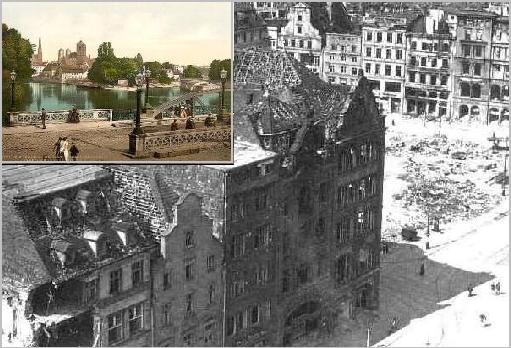
| Breslau, first mentioned in 1000A.D., was made the seat of a bishop in the 11th century it and became the capital of an independent duchy in 1163. Mongols destroyed it in 1241, and it stagnated until a large influx of enterprising German colonists arrived. The bishop was titled "Prince of the Empire" in 1290. King Johann of Bohemia bought it in 1335, and it was ruled by his successors until about 1460. Various privileges were given to Breslau by the Bohemian kings, and it grew wealthy. The overwhelmingly German-populated city fell under the rule of Matthias Corvinus until his death, and in 1490 it again became subject to Bohemia, passing with the rest of Silesia to the Habsburg dynasty. From 1526 through the Reformation and the Thirty Years War, Breslau remained mostly undisturbed, and it came under the rule of Friedrich the Great in 1741. Reclaimed by the Austrians in 1757, it was again taken by Friedrich and belonged to Prussia until the end of World War One. Breslau was the last major city in eastern Germany to fall on May 7, 1945. Although the city was only bombed once, massive destruction took place in the aftermath and Breslau was largely destroyed. The medieval parts of the city and almost all historical landmarks were gutted. The buildings that escaped bomb damage were burned and looted by the Soviets. It is said there was a murdered and disfigured or disembowled German soldier hung on every lamp post in the city. Like most of Silesia, Breslau was placed under Polish administration. Most surviving German inhabitants were expelled and all German property was taken. By the 1950s, Breslau had been cleansed of most of its dried blood as well as remaining Germans and the real history of the city. Renamed "Wrocław", it was resettled with Poles. |


| The Allied artillery could not resist shooting at old German castles, and stocked castle wine cellars also made them targets for plundering. The castles had been sometimes used to store art work and archives evacuated from the cities. Augustusburg Schloss in Bruehl, the old castle of the Dukes of Württemberg, was a stunning example of Rhineland baroque architecture, complete with a grand staircase, chapel, gardens and hunting lodge. On October 10, 1944, a single bomb destroyed the north wing for no strategic reason. On December 28, bombs hit near the chapel and the impact smashed the plaster baroque and rococo interior. On March 4, only two days before the castle fell into American hands anyway, artillery shells struck the main building. Testimony taken later indicated that no German troops had been in or near the building. One shell blew a corner off the roof and the other two detonated inside and did extensive damage. Before the military government detachment arrived in Bruehl, troops had bivouacked in the Schloss and caused even more damage. The Allied detachment finally stationed two policemen on the grounds, but they had no authority or incentive to control US soldiers who continued to go in and out, looting and vandalizing as they pleased. |
| Bruehl |

| Böblingen |
| Böhlen is another very old Saxon city. First mentioned in 1353, Böhlen remained rural and sleepy until the 1920s. 224 Lancasters and 11 Mosquitos attacked an oil plant near Böhlen, also managing to damage the town and kill a few civilians. |
| Böhlen |
| Breisach |
| Breisach, Celtic for breakwater, is situated along the Rhine in the Rhine Valley where a bridge leads over the Rhine to Neuf-Brisach, Alsace. The hill on which Breisach came into existence was once in the middle of the Rhine River until the Rhine was straightened by the engineer Johann Gottfried Tulla in the 19th century. The seat of a Celtic prince was at the hill on which Breisach lies. The Romans maintained an auxiliary castle on Mons Brisiacus here and the ancient Staufer dynasty founded Breisach as a city. St. Stephans-münster, the cathedral in Breisach, was started in the early 13th century, and by the early 16th century, Breisach was a significant stronghold of the Holy Roman Empire. During World War II, 85% of Breisach was destroyed by Allied artillery as the Allies crossed the Rhine. The Cathedral was heavily damaged. |

| Böblingen was one of the charming small university towns around Württemberg founded in 1253 by Count Wilhelm von Tübingen-Böblingen. 16th century Boblingen, pictured above On October 7, 1943, 408 incendiary bombs and 35 high explosive bombs were aimed at the small, militarily insignificant old town center, killing 44 civilians and wounding 200. 1,735 people were left homeless, and 70% of the old part of town was ruined. In July of 1944, another attack killed 36. |
| Bruchköbel |
| Bruchköbel is a peaceful village in Hesse, approximately 8 km north of Hanau. The landmark of the city is the tower built in 1410, and it grew around the church building of Jakobuskirche. In 2003, remains were found nearby of Neolithic settlements which thus leads the first settlement back to 5000 BC. From about 800 BC, Celts settled in the area, and around 100 AD, Romans settled there. Bruchköbel was attacked on August 10, 1940 by the RAF for no apparent reason. It was bombed for about 2 1/2 hours with incendiary and high explosive bombs which initially ignited several barns on fire, and residents still remember the plaintive cries of cattle, pigs, horses and all manner of trapped beasts, some of which were rescued. In all, some 25 buildings, houses, sheds and barns were destroyed. A large crater, uprooted trees and collapsed roofs bore witnesses to the event. In March 1945, the Americans occupied the town. |



| click |
| click |
| click |
| click |
| click |
| click |
| click |