| A Belly of the Whale Tale and the Mighty Dukes of Braunschweig |
| Anton Ulrich the Younger (1714-1776) not to be mistaken with an earlier Duke Anton Ulrich (1633- 1714), was the second son of Ferdinand Albrecht II. of Braunschweig-Wolfenbüttel-Bevern. Anton Ulrich the Younger was, as younger brother of the duke of Braunschweig-Wolfenbüttel- Bevern, not intended as ruler of Wolfenbüttel, so his aunt in Vienna, Empress Elisabeth Christine of the house of Braunschweig, arranged a marriage in 1739 between Anton Ulrich the Younger and the Russian regent Elizabeth (Anna Leopoldowna). This marriage connected the house of Romanov with the house of Braunschweig, and was calculated to foster a closer bind between Russia and Austria, which had begun under Tsar Peter I., the Great (1672-1725). However, Anton Ulrich's wife, Anna Leopoldowna, governed for only one year as Regent in Russia before a political revolution occurred in 1741. The daughter of Peter the Great, Elizabeth Petrowna, took over and ruled for the next 20 years. Her politics favored France, and she soon ended the good relationship with Austria, leaving Anton Ulrich and his family weakened, which resulted in their imprisonment in the monastery Cholmogory in Russia for the remainder of their lives. Three children were born: Elizabeth, Peter and Alexander. Their eldest son, IvanVI., was kept separately imprisoned from his parents, never to see his parents again. He was murdered in the year 1764 after the accession of Tsarina Katharina II. the Great (1729-1796). Anton Ulrich's other children were allowed to leave only with the permission of Katharina II. in 1780 when they were moved to Denmark. Here the children remained the rest of their lives, still monitored closely. Karl Friedrich Hieronymus, Freiherr von Münchhausen was born in Bodenwerder as a German baron. When he was young, he had been sent to serve Anthony Ulrich as page and moved to Russia with Ulrich before later joining the Russian military. He was a cornet in the Russian cavalry, and then lieutenant under Anthony Ulrich. He was in two campaigns against the Ottoman Empire, and remained in the Russian military even after Ulrich was imprisoned in 1741. In 1744, Münchhausen married Jacobine von Dunten in Livonia. He was promoted to cavalry captain in 1750 and ended his service shortly thereafter. They retired to his manor in Bodenwerder. After his wife died, he remarried in 1794 and this second marriage ended in a bitter, contested divorce. He never had any children, and died in 1797. When Münchhausen, not known for his modesty, had returned home to Bodenwerder, he entertained others with tall tales of the adventures he'd supposedly experienced which included living in the belly of a whale, riding on cannonballs, going to the Moon, and numerous other remarkable feats. Soon, these stories spread across the land. Rudolf Erich Raspe wrote 'Baron Munchhausen's Narrative of his Marvellous Travels and Campaigns in Russia', or 'The Surprising Adventures of Baron Munchhausen'. Raspe's stories, many of which were actually based on old folk tales, were republished in German by Gottfried August Bürger, who further extended them, under the title of 'Wunderbare Reisen zu Wasser und zu Lande: Feldzüge und lustige Abenteuer des Freiherrn von Münchhausen'. The story had undergone many transformations by various authors and has been translated into several languages and over 100 different editions, and they are especially popular in Russia. A statue of Munchhausen, a gift from Bodenwerder, was erected in 2005 in former East Prussia. Bodenwerder, the hometown of Muenchhausen, was founded in 1245 on an island in the river Weser. The former estate of the Baron, it is used today as the town hall of Bodenwerder and is located at the entrance to the city. Until into the year 1948, when the arm of the Weser which separated the city from the left river bank was filled in by the communist government, the historical old part of town retained its island character. Fortunately, von Münchhausen's birthplace of Bodenwerder fared better than Braunschweig. Today more than 100 half-timbered houses and 3 fortified towers with sections of the ancient surrounding walls still stand as a small window into what was once old Germany. Long before the Silly Baron, another protege of the Dukes of Braunschweig was Prateorius. Praetorius was born Michael Schultheiß in Creuzburg an der Werra. His father was a pastor who had been a pupil of Luther, and because of his stand on the Augsburg Interim, the family was forced to move to Torgau in 1573. Praetorius was one of the most prolific composers of his generation in Germany, listing over forty volumes of printed music, including sacred and secular works of all kinds for voices, instruments, choirs and organ. His style was strongly influenced by Schütz, Scheidt and the latest Italian music, and most of Praetorius’s sacred music is based on Protestant hymns. His patron was the Duke of Braunschweig-Lüneburg and Praetorius accompanied him to the city of Wolfenbüttel to become his Kapell-meister in 1603. His position necessitated much travelling in Germany which enabled him to earn widespread renown as a conductor of musical performances, an organ consultant and an expert on practical music and musical instruments. From 1613-1616, Praetorius was in Dresden at the court of the Elector of Saxony, and he later returned to Braunschweig well-versed in philosophy, theology, and languages, including Greek, Hebrew and Latin. In addition to his composing and his amazing theoretical and practical understanding of music, he was also a gifted musicologist. From 1605 to 1610 he edited Musae Sioniae, a collection of 1,244 arrangements of songs and hymns in nine volumes. From 1615 to 1619, he edited his 3 volume Syntagma musicum, about sacred and profane musicology. Energetic Praetorius also wrote much other liturgical music and a set of over three hundred dances. He died in 1621. Praetorious lived for a time in Wolfenbüttel in Lower Saxony on the Oker River south of Braunschweig, which developed around an 11th century castle of the dukes of Braunschweig-Wolfenbüttel from 1432 to 1753. Today, in this small gem of a place, Wolfenbüttel's Herzog August Bibliothek, a ducal library founded in 1572, has one of the largest and best-known collections of bibles, incubula, books of the Reformation period and ancient books, plus some 10,000 manuscripts. Its librarians included Gottfried Wilhelm Leibniz, 1646-1716, philosopher, logician and mathematician who is probably most well known for having invented the differential and integral calculus (independently of Sir Isaac Newton). Another librarian here was Gotthold Ephraim Lessing (1729–1781) philosopher, author, dramatist, critic and one of the most influential figures of the Age of Enlightenment. Lessing differentiated between the poet as interpreter of time and the artist as interpreter of space; A deist, his plays reflected many of his theological controversies because of his insistence on freedom of thought. 'Erziehung des Menschengeschlechts' (Education of the Human Race) reflect ideas of progress and evolution typical of the Enlightenment to religion. Lessing was foremost in the move to introduce English literature and Shakespeare to Germany. There was a battle here in 1641 during the Thirty Years War when the Swedes defeated the Austrians. But most famously and gloriously, Jägermeister is a Wolfenbüttel specialty. Maybe that is why it is one of the few medieval towns in Germany that wasn't pulverized by bombs. |
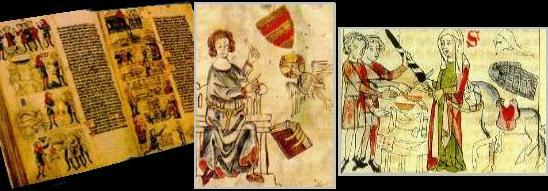
| The Most Important Law Book of the German Middle Ages (click on image) |
| Between 1220 and 1235, the illuminated manuscript called the Sachsenspiegel (Mirror of the Saxons) was written by Saxon administrator Eike of Repgow (1180-1235) in Middle Low German, with the aim of recording regional jurisprudence which, until the 13th century, had been only an oral tradition. The book was written for those charged with administering the law and it contains information on a wide variety of legal topics, including enforcement of the law; penal law; laws concerning inheritance, dowries, and marriage; property law; and laws governing the herding, keeping and hunting of animals. The Sachsenspiegel profoundly influenced legal writing and the drafting of laws throughout Germany and beyond, and it was translated into Latin, Dutch, Polish, Czech and Russian and widely distributed, even into Eastern Europe, the Netherlands, and the Baltic States. Originally written in Latin, it was translated into German at the request of Count Hoyer von Falkenstein and some believe it to have been written at his castle, Burg Falkenstein. The Sachsenspiegel is divided into two parts, one concerned with laws regarding the management of fiefs, the Lehnrecht, and the other with more general laws, the Landrecht, or regional law. The Landrecht pertains to the space occupied by lord and peasant and it served as a model for other later law books. It exists in more than 200 manuscripts, some of which contain magnificent and detailed illustrations. It was used in parts of Germany until as late as 1900, and is important not only for its lasting effect on German law, but also as an early example of German prose. It was the first large legal document to be written in German instead of Latin. Its precedents continued to be cited as recently as 1932. Of the seven original illuminated manuscripts, four exist today, named after their present locations: the Heidelberg (c.1300), the Oldenburg (c.1336), the Dresden (c.1350), and the Wolfenbüttel (c.1350-70). The detailed illustrations make the work understandable and contain index numbers to the corresponding legal text. Eike von Repgow, c.1180-1235, was very possibly a well-educated freeman and also vassal to von Falkenstein. Eike mentions von Falkenstein as the one inspiring the translation the original Latin version into German, and Eike's and his names both appear on some of the same documents, therefore some confusion has ensued over time as to who was the true author. In any case, with the power struggles between the Staufern and Welfen lines, between the Kings and the Pope and the problems of early Germanic colonization in Slavic areas, the book was a valuable tool for peace and order as it recorded all standard law that every person should abide by. This written documentation ensured the preservation of centuries old traditions and norms passed down through generations. There are over 450 preserved manuscripts and fragments in existence today. Therein is a countless wealth of information about the rural and knightly daily life of the Middle-Ages The Heidelburger manuscript contains an assortment of 30 pages with 310 pictures and is maintained only in fragments. The Oldenburger Sachsenspiegel offers the most complete text of the four codices but only 44 of the 578 hand-painted pictures remain fully preserved. Both the Dresdner Codex and the Wolfenbüttleler Sachsenspiegel contain exquisite illustrations with abundant gold. The Wolfenbütteler Sachsenspiegel with 776 painted pictures laid out over 86 pages is without question the best preserved and most precious example of illustrated Codices of the Sachsenspiegels. It most likely originated in the third quarter of the 14th century in upper Saxony. At one point it was acquired by Duke August, the youngest son of the Braunschweig-Lüneburg family and the founder of the second and permanent library in Wolfenbüttel. The Herzog August Library remains the permanent home of the original Wolfenbütteler Sachsenspiegel. This picture above on the right show a wife swearing an oath indicating that she does not have all the standard items from the list. After a widow had distributed half of her food supplies to the heirs, she had to dispossess herself of all her husband's military gear, including his sword, his best horse, his finest armor as well as his bedding. She was not required to turn over anything she didn't have, but had to swear an oath for every missing item she could not provide to the heirs. |