| Münster, Naumburg, Neumünster, Neuss, Neustrelitz, Neuwied, Nürnberg, Nordhausen, Offenburg, Ohrdruf |
| Münster |
| Neuss |
| Neuss on the Rhine was one of the oldest towns in Germany. Under Roman Emperor Augustus, the Romans established a huge military camp called Novaesium around 16 B.C south of Neuss, and shortly afterwards a civil settlement was founded at the site. It soon became a flourishing trade center. The city erected the first fortifications for defence at the beginning of the 12th century, when Neuss was chartered as a city. It belonged to the archbishopric of Cologne until the French Revolutionary Wars. In 1474–75, Charles the Bold of Burgundy, supporting the archbishop in a quarrel with the chapter of Neuss, unsuccessfully besieged the city for a year. Between 1940 and 1945, Allied bombers flew 136 air raids on ancient, medieval Neuss because of its proximity to Düsseldorf, and in ten large scale attacks dropped approximately 12,000 high-explosive bombs,130 aerial mines,102,500 staff incendiary bombs, 6,300 phosphorus bombs and 70 phosphorus canisters, destroying the hospital, schools, churches and transforming the ancient city into rubble and killing 900 civilians. On New Years Eve of 1945, they destroyed the medieval center. Only 189 dwellings were still intact out of 7,100 by the end of war. |
| Neuwied |
| The oldest proof of human settlement in the area of today's Neuwied is an ice-age hunting encampment, and since Celtic and Roman time the area was permanently settled. It is on the right bank of the Rhine river near the mouth of the Wied stream. Neuwied was mentioned in documents from the 8th century, and was the home of the Wied counts from before 1129. It obtained municipal rights in 1653 from Ferdinand III. Neuwied was a fifth, or almost 20%, destroyed by Allied bombing. Prince Maximilian of Wied |
| Nordhausen |
| Nordhausen is a 1080 years old Saxon German town at the southern edge of the Harz mountains in Thuringia. Emperor Friedrich II declared Nordhausen an Imperial City on July 27,1220. On August 24, 1944, 11 B-17 Flying Fortresses of Mission 568 bombed the airfield at Nordhausen as a "target of opportunity". The British repeatedly struck Nordhausen, murdering around 8,800 civilians. On April 3 and 4, 1945 three-quarters of the town was destroyed by more bombing raids. The labor camp nearby was bombed purportedly because it was "mistaken for a German munitions depot" by the US. This bombing killed thousands of inmates which were later erroneously reported as being killed by Germans. 20% of Nordhausen's civilian population was killed by Allied bombing before the US Army gave it to the communists. |


| Ohrdruf |
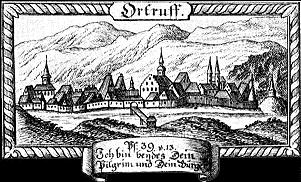
| J. S. Bach was orphaned, and from the ages of 10 to 15 he went to live with his eldest brother, Johann Christoph Bach, who was the organist at the Michaeliskirche in the Thuringian town of Ohrdruf. It contained an historic three-manual Austrian baroque organ in a historic, and it was here that Bach learned about organ construction. It was destroyed along with other gems by Allied bombing in 1945. Only a tower fragment remains |
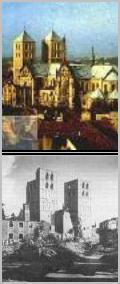
| Charlemagne sent out missionaries in 793 under the Frisian Ludger to convert the Saxons. Ludger built his church and cloister on the right bank of the river Aa, on the height called the Horsteberg: it was the monastery ("monasterium") from which Münster derives its name. In 805, he travelled to Rome to be ordained a bishop, and soon founded a school. The combination of ford and crossroad, marketplace, episcopal center, library and school established Münster's as a Cathedral city. Münster was a leading member of the Hanseatic League. In 1534, the Anabaptists took power in the what was called the Münster Rebellion, and founded their own democratic state, but in 1535, when the town was recaptured, the Anabaptists were tortured to death. At the Peace of Westphalia in 1648, the legal foundations upon which modern Europe was built were laid. Munster remained Catholic. The ancient city center of Münster was turned to cheese and 91% destroyed by allied bombing by both British and Americans, with the loss of nearly all historical buildings. With the first air raid on May 16,1940, an industrial camp was destroyed. By December 23, further attacks followed. In the nights between July 6th and 10th, 1941, the first surface bombardments came. After a large-scale night attack on June 12, 1943, in which the target was the Cathedral entry, and in a daylight raid on October 10, 1943, large parts of the city center were destroyed or heavily damage. Between September, 1944 and March, 1945 there were 50 more air raids directed at the cathedral city, of which the last and most devastating was on March 25, 1945 toward the end of the war. 112 heavy bombers dropped over 1,800 high impact bombs and 150,000 incendiary bombs. The fabulous cathedral sustained direct hits on the western porch and the nave, and was filled with unexploded bombs, leaving the nave and towers roofless. The Prior responsible for the church treasures was dead. On the evening of April 2, 1945, the Allies took the town anyway. Up to this time there were 1,128 air alarms and 112 air raids in altogether. The bombs amounted to altogether 32,000 high- explosives, 642,000 staff incendiaries and 8,100 phosphorus (napalm) bombs. With the numerous attacks more than 1,600 humans died. Of 33,737 dwellings once in the city, only 1,050 remained intact, and more than 60% were mostly or completely destroyed.The infrastructure broke down completely. Substantial parts of the water pipe lines were destroyed as well as electricity and gas supply. Roads were not any longer passable. 24 schools as well as a majority of the hospitals were destroyed, so that only 400 beds remained to treat the wounded. 2.5 million cubic feet of debris and rubble stood in place of hundreds of years of history. Burned out towers of the medieval churches jutted up in the ruined city, the 14th to 18th century buildings all gone The piled up rubble caused a flood disaster by February of 1946. These gigantic heaps of rubble had to be removed for traffic to flow again. Young kids, women and old people had to do this all over Germany because the men were either dead, missing or prisoners. |
| Nürnberg (see under Featured Cities) |
| Neustrelitz |
| Neustrelitz is an old Pommeranian town and today the capital of the district of Mecklenburg-Strelitz, birthplace of Germany's most beloved queen who stood up to Napoleon, Queen Luise of Prussia, born Princess of Mecklenburg- Strelitz. The village of Strelitz was first mentioned in 1278 and it grew to a small town in the following centuries. In the 17th century Strelitz was a part of the duchy of Mecklenburg-Güstrow, which ceased to exist after the death of the last duke in 1695. Afterwards the new duchy of Mecklenburg-Strelitz was established (1701). This small duchy contained the present-day district and an enclave around Ratzeburg, which is today situated in Schleswig-Holstein. Its Baroque Schloß (palace) was destroyed in 1945, when it was enslaved by communism, but the palace gardens (Schloßgarten) still exist. |
| Offenburg |
| Offenburg is a city located in today's Baden-Württemberg. The city is first mentioned in historical documents dating from 1148. By 1240, Offenburg had already been declared a Free Imperial City. Offenburg was the target of 1944 bomb attacks which, beside the railway facilities, destroyed the bell tower and stained-glass windows of an ancient church. |
| Neumünster is one of four independent towns in Schleswig-Holstein, first recorded in 1127 when the Neumünster Abbey was founded. The first bomb attack from the air was in 1941, followed by more bombings, the worst of them on April 13, 1945. After the end of the War, Neumuenster had a wave of refugees and a severe housing |
| Neumünster |


| Naumburg (Saale) |
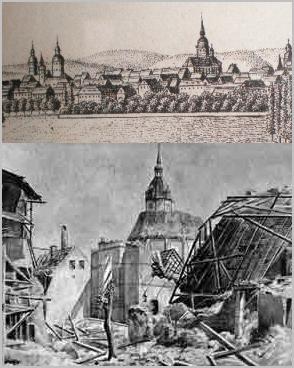
| Naumburg (Saale) is a town in today's Saxony-Anhalt, first mentioned in 1012, when at the crossroads of two trade routes, the Margrave of Meissen, was born. In the Middle Ages it was an important trading center on the Via Regia, mentioned in 1278 for its trade fairs. Later in time, Friedrich Nietzsche spent most of his childhood and youth in nearby Pforta. On April 9, 10 and 11, 1945, just weeks before the war ended, British and American planes bombed the city destroying or heavily damaging areas of the Old Town and adjacent areas. On April, 12, the city of Naumburg was hit by an American bomb attack which severely affected it. More than 100 people died and about 700 houses were damaged. American troops occupied the city and opened up a notorious prisoner of war camp. Only three months later, the city was handed over to the Red Army. With the influx of refugees and displaced persons, the city held up to 60,000 people. |
click
| click on images |