| Prince Maximilian of Wied |
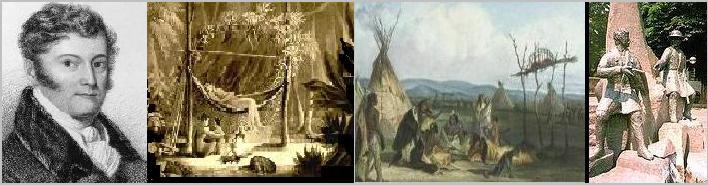
| Prince Alexander Philipp Maximilian of Wied, born in 1782, was one of eight childen born to an aristocratic Protestant family at their hereditary estate in Neuwied, near the Rhine. His parents were Friedrich Carl Count of Wied-Neuwied and Louise Wilhelmine Countess of Sayn-Wittgenstein- Berleburg. As a younger son, he had little chance of having to manage the family interests, and instead, he turned his attention to natural history and attended the University of Götingen. Afterwards, he entered the Prussian military and was captured by the French in 1806. After his release, he resumed studies and rejoined the Prussian service in 1813 as a major in a Hussar Regiment. During the invasion of France in 1814, he earned an Iron Cross..and also amassed a few pickled frogs of the amphibian variety; since he had always kept specimens. He managed to preserve some reptiles and other goodies he found along the way in brandy. In Paris, he met Alexander von Humboldt who talked him into going to South America, and in 1815, he formed an expedition and did, collecting a wide variety of plant and animal specimens and studying local Indians. He was accompanied by Friedrich Sello, the great German botanist and early scientific explorers of the Brazilian flora, and David Dreidoppel, Wied's servant and hunter-taxidermist. Accompanied by his retinue, he journeyed for two years in unknown and unexplored regions of eastern Brazil, collecting exotic animals and plants and locating isolated Indian tribes whose habits and languages he recorded and sketched before returning to Europe in 1817. He composed a two-volume narrative, then a four-volume, beautifully illustrated work on Brazilian natural history and also wrote articles. Even today, some of his work is still a major source of information about these obscure, now vanished tribes. Later, he wanted to go to North America, and found a young painter, Karl Bodmer who was born in 1809 to a cotton merchant near Zurich. At 13, Bodmer had begun an apprenticeship in an engraving shop owned by his uncle, and here he learned drawing and painting. He and his brother were traveling Switzerland and Germany sketching and painting when Wied approached him. In April, 1832, 50 year old Wied, again accompanied by Dreidoppel and also by Bodmer, set sail from Holland for America, where he would spend two years on the Western frontier. Arriving in Boston, Massachusetts, on July 4, 1832, his entourage proceeded westward by stagecoach to Pittsburgh, they sailed by steamboat to Indiana. Trekking north on the Wabash River, they proceeded to St. Louis, Missouri, where they met retired explorer William Clark. In April of 1833, they went up the Missouri River to Nebraska, then South Dakota near the North Dakota-Montana border. In July, they continued to Montana. He was uninspired by the western prairies and generally disliked the American culture, or lack thereof. He found their harsh climate uncomfortable, and his health suffered on the journey. His work in United States was not as much of a novelty as were his discoveries in Brazil. The journey was extremely rigorous, not without danger, and they experienced several setbacks. At various times they got lost on the prairie, saw prairie fires, suffered cold, wet and heat, and got trapped in fierce storms. In 1835, the steamer carrying his extensive collections and specimens sunk. However, his observations of Indians accompanied by hundreds of Bodmer's drawings and paintings, were priceless enough that he published them, and amid delays and difficulties, an illustrated account of the journey appeared in a two volume German edition, a three volume French edition and an inferior, over-edited, one volume English version where some matters were considered too "indelicate" for the English and omitted. All were very expensive to purchase. Today, there are fewer than twenty known editions of Wied's journal in the United States. Bodmer and Wied parted company. Bodmer, who had so masterfully executed the essence of the North American Indian, was cynical at the financial failure he experienced from the escapade, and rarely painted people again. He died poor and relatively unknown in Paris in 1893. Wied spent his remaining years in quiet study, sending all over the globe for the specimen collection he kept at Neuwied. His greatest contributions were his studies of native people. He tended to report what he observed as accurately as possible and worked diligently at his studies until he died on February 3, 1867. Wied's legacy also survives in both North and South America in the nomenclature of many plants and animals, such as the orchid Maxillaria neuwiedii and the bird "Maximilian's Parrot" Pionus maximiliani. His magnificent collections were largely dispersed or forgotten after his death. In 1870, the Museum of Natural History in New York acquired his natural history collection containing over 4,000 stuffed birds, 600 mammals, and 2,000 fishes and reptiles, and the Museum für Völkerkunde (Museum for Ethnology) in West Berlin and the Linden Museum in Stuttgart received his Plains Indians artifacts. Remaining material at Neuwied was basically hidden for decades. After the Second World War, Dr. Josef Roeder, a Koblenz museum director, found some of Wied's diaries and correspondence and over 400 of Bodmer's original watercolors and sketches while researching at the family archives. They were later sold by the Wied family and are now in US museums. |
| The oldest proof of human settlement in the area of the today's Neuwied is an ice-age hunting encampment, and since Celtic and Roman time the area was permanently settled. It is on the right bank of the Rhine river near the mouth of the Wied stream. Neuwied was mentioned in documents from the 8th century, and was the home of the Wied counts from before 1129. It was impoverished during the Thirty Years War, and obtained municipal rights in 1653 from Ferdinand III The Count Friedrich III zu Wied shifted his residence to Neuwied, and most other parts of the town date back to the Medieval or Roman times. Neuwied was an 'open town' without fortifications and no restrictions for settlers, and it was destroyed in 1694 by French troops. The policy of religious tolerance set in place by Count Friedrich III zu Wied continued and lured numerous immigrants into the young city. By the 18th century, there were seven religious communities in Neuwied at work making furniture and clocks, or working in metallurgy or in mills. Castle Neuwied was built from 1702–1712 in the Classic style in place of the old castle that had been destroyed by the French.The end of the city as the Wied royal residence came with the French revolutionary wars: In the battle of Neuwied, which is noted on the Arc de Triomphe, 1797 French revolutionary troops achieved the first large victory in the wars against the Austrians. After the French, in 1815 the entire city went under Prussian administration, although the counts still had certain privileges until 1848. |

| Above: Weid; In Brazil; With the Sioux by Bodmer; Weid monument in Germany |
Neuwied, 1784 and 1945