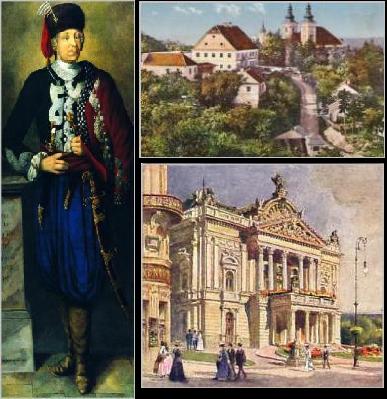
| Brünn, home of Gregor Mendel, the father of modern genetics, was originally the site of a Celtic settlement. Its origins go back to a castle founded around 1021, and an early document mentions the settlement in 1091. The town itself was founded in 1243 by Wenceslaus I of Bohemia. Brünn was situated at the crossroads of old trade routes which joined Northern and Southern European civilizations. As part of the Habsburg Empire, Brünn represented the center of the province of Moravia where German settlers arrived in the 12th and 13th Century. Germans were, until the end of the World War II, the majority population here living alongside of a minority Czech population. Brünn was destroyed in the Thirty Years War and devastated by the Plague, which killed 2,000 of its inhabitants. The city recovered and flourished again under the progressive reforms of Austrian Emperor Josef II from 1760 to 1790, and religious tolerance was imposed. Since for centuries Germans were the majority, the town mayors were all German. In 1850, Brünn's population was 37,500, with a German majority and an efficient, successful German administration who had continually developed new and improved roads, lighted and paved streets, gas, water and sewage lines, new weaving and cloth mills as well as a machinery industry. In 1882, Franz (Francis) Jehl (1860-1941), the long time German-American assistant of Thomas Alva Edison, went throughout Europe introducing the Edison light system to the various European countries. He traveled to Brünn to design and install an electric lighting in the Brünner Stadttheaters, the oldest theater building in central Europe and the first public building in the world to use Edison's electric lamps. Edison himself visited Brünn in 1911. Jehl had participated with Edison from the first attempts to create a suitable thread for the first bulb. His tours greatly influenced many European scientists, a couple of them being Emil Rathenau, one of the greatest Edison pioneers in Europe, and Professor Guiseppe Colombo, founder of the great electrical system at Milan. Jehl later wrote a book titled "Reminiscences of Menlo Park". In it he relates the following about his meeting with Emperor Franz Joseph: "In Vienna I was invited to court by the Emperor Franz Josef, and had one of the greatest thrills of my life," Mr. Jehl said. "I spoke with him in the Hofburg Palace. It was like a fairyland, filled with officers of the various regiments of the old Austro- Hungarian Empire. Edison was a great man, the Emperor told me. He said that when Edison invented the phonograph he had instructed his ambassador to send him one right away. I spoke to him in German and told him about Edison and his work." Franz Josef was impressed and later, Mr.Jehl was decorated by order of the Emperor. Although Brünn's historical city center was predominantly Germans, the industrial revolution changed the town's labor force, and the newer factories and workshops employed many Czechs who arrived daily from the suburbs. Both languages were understood in Brünn and there were eventually families of mixed nationalities. It prospered and grew, and by 1910, Brünn had a population of 108,944, of whom 70% were Germans and 30% Czechs. Alas, policies from Versailles after World War One would soon altar and rewrite the history, culture and ethnic balance of Brünn. When the Austrian Monarchy was crushed after World War One, the Czechs received their own state and, with the inclusion of the Slovaks, it became known as Czechoslovakia with Prague as its capital. A number of neighboring communities were suddenly incorporated into the municipality of Brünn so that Czechs would become the majority for the first time in history, and therefore Brünn's administration also became Czech. The numbers of Germans/Austrians in the border regions was about 3.5 million. In late 1918, only 160,000 Czechs had lived in these regions. A mere twenty years later, in May of 1939, official statistics numbered twice as many Czechs, or approximately 320,000, and they had been intentionally lured to these purely German regions to "Czechify" them. This spelled its doom. From the beginning, activist Czechs decided to create a Nationalistic Czech state in which Germans would be robbed of their farms, homes and businesses and resettled elsewhere. The Slovaks had also become a minority, and the rights of both minorities were soon trampled. In the early years of the young Czech Republic, even some Germans had been enthused by the new spirit that filled the Czech citizens, but unfortunately, the two factions were overshadowed by national differences, and soon Germans had to fight to protect their ethnic installations and organizations. Hard feelings were growing in intensity, and once the shoe was on the other foot, the Germans were treated harshly and vindictively, resulting in consistent acts of violence against them. In 1938, the area was annexed to Germany. Note: After the Sudetenland's annexation, many of the new Czech immigrants moved back into their Czech homeland, the future Protectorate, but none were forcibly expelled. |
| Brünn's Capuchin Monastery still holds the mortal remains of Franz Freiherr von der Trenck, an adventurous Austrian soldier. Born in 1711 in Reggio di Calabria to a military family and educated by Jesuits, Trenck entered the Imperial army in 1728, but resigned in disgrace 3 years later. He married and lived on his estates until his wife died in the plague of 1737. He then offered to raise a corps of "pandures" for service against the Turks but, after being refused, he entered the Russian army as a mercenary. He was accused of bad conduct, brutality and disobedience and condemned to death for defying an order to retreat while serving against the Turks as a captain and major. Despite his insubordination, his sentence was commuted to imprisonment. Trenck returned to Austria, where his father was governor of a small fortress, but with his bad manners and surly disposition, he soon came into greater conflicts and he had to hide in a Vienna convent. After obtaining an amnesty and a commission in a corps of irregulars, he was cited for bravery and even promoted to lieutenant-colonel, and then colonel in 1744. In February, 1745, he was given a reception and paid high respects by Maria Therese in Vienna. He had captured 4,500 soldiers and non-commissioned officers, 27 officers and 9 staff officers as well as seizing 22 guns, 7 flags, 3 mortars and 3 standards. During the War of Austrian Succession, Trenck gained fame as leader and commander of the "Pandur", a paramilitary regiment of the Austrian army, which specialized in frontier warfare and guerrilla tactics. He recruited experienced Croatian and Serbian mercenaries from the Austro-Ottoman border, infamous for the civilian atrocities they committed. During the War of the Austrian Succession, despite the fact that Trenck rallied volunteers to assist Maria Theresa, he and his irregulars had so busied themselves plundering at the battle of Soor that the king of Prussia was allowed to escape. Court martialed in Vienna, he was convicted of having sold and withdrawn commissions to his officers without royal permission, having breeched military code when punishing his men and having drawn pay and allowance for fictitious men. His brutality and theft made him detested throughout Austria and Silesia. The death sentence which followed was commuted by the Empress and he spent the remainder of his life in mild captivity in the fortress of Spielberg in Brünn, where he died on October 4, 1749. He bequeathed the sum of 30,000 Gulden to the small town of Marienburg which his troops had sacked and burned. Austrian Franz Freiherr von der Trenck has been reincarnated as a Czech named "Frantisek Svobodny pan Trenck". His mummified remains in a glass-topped coffing are on display in the crypt of Brünn's (now "Brno") Capuchin Monastery. His head, like his name and ethnicity, was stolen a long time ago and replaced with another head. |
| Brünn: Scene of the Crime |
| The Population before the Purge |
| Trenck, the town and the theater |
| An Old Soldier Reincarnated |