| The Brünner Todesmarsch Silent Memorials to the Genocide Against Germans |
| There are many German/Austrian towns throughout history books that have faded away into dust. We try to find them on a map, but cannot. Brünn, since renamed "Brno", is such a place. |
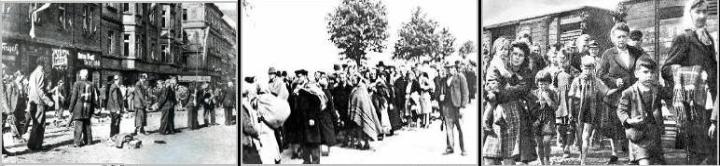
| After World War II, a dire circumstance developed in the town of Brünn which the Americans had bombed heavily in March and April of 1945 to help the Red Army's forward push into German territory. As the communists closed in on Brünn, only women, children, the disabled and elderly were left of the German population of the city, the men and older boys all being absent or dead. Sheer horror awaited these non-combatant German civilians. From his exile in London, Czech President Eduard Benes, portrayed as a heroic figure by the Allied media, urged the Czech population through the radio to arm themselves and murder Germans. Following his suggestion to "take everything from the Germans, leave them only a handkerchief to weep into" and to "collectively liquidate all Germans", Czechs formed vigilante groups, and by the time the Soviet Army occupied the city on April 26, 1945, the situation had become lethal for German civilians with gruesome and horrifying attacks. In Prague, Germans were hung head-down from lamp posts and set on fire as living torches in Benes's honor. The number of victims of the genocide which followed has been historically cited as 250,000, but more reliable sources claim no less than 460,000. This time is referred to as the "wild expulsions," when ethnic Germans were being hunted down and murdered all over Czechoslovakia. Benes told his audience "what the Germans have done in our lands since 1938 will be revenged on them multifold and mercilessly", and Sergej Ingr, the commander-in-chief of Czech forces who issued calls from his own exile in England said to: "Beat them, kill them, let nobody survive." Teen aged German boys were especially targeted. Spring came early to Brünn in 1945 and it was especially beautiful, that Easter being the loveliest anybody could remember. On April 18, the last of two special trains filled with Germans fleeing the city departed. By May 30, 1945, the 25,000 to 30,000 German women, children and elderly citizens unable to leave Brünn in time were driven out in a well-organized, genocidal exile. This was arranged and accomplished predominantly with the help of Czech workers of the Brünn weapon works. Excited and anxious for the anticipated loot and free automobiles, farms, businesses and real estate, they were supervised by Czech staff captain Bedřich Pokorný. German civilians were yanked out of their homes by force, some naked from their beds, and forced at gunpoint to assemble on the street in several parts of the city where they were "marked" by an identifying mark "N" for "Nemec" (a German). Most of the males among them were taken away and shot while, flanked by armed guards, the women were indecently "prodded" for hidden jewelry and other items of values they might have tried to take with them. The people were then driven out like a herd of cattle past cheering, sneering crowds. No stopping was allowed and the old, infirm or exhausted were simply shoved by the side of the road and shot or left to die. By the thousands they were driven towards the remote Austrian border without food, water or medical assistance. The majority of the deaths occurred at the first stop in the small, unprepared town of Pohrlitz, half way between Brünn and the border of Lower Austria, where many people succumbed to dysentery, brought on by hunger, exposure, stress and fatigue. Some, too weak to continue, were shot on the spot. There are several mass graves here for hundreds of the victims. The sorry procession of remaining victims took two days to reach the Austrian border, only to find more misery. For weeks they had to vegetate in primitive camps where more of them died because the Russian troops that occupied Austria did not permit them to cross the border. According to a report published in the New York Times, the Germans were allowed to take with them no more than 500 marks (roughly $50) and a maximum of 300 kilograms of luggage, but robbed every step of the journey, most ended their trek with nothing left at all. All along the way they were taunted, tortured, robbed, raped, murdered, beaten or killed from pure exhaustion and bodies lined the roadways. More of the dead were placed in several cemeteries on the Austrian side in single graves, and there are large mass graves in Drasenhofen, Mistelbach, Stammersdorf, and Purkersdorf in Austria. There are none for those who were murdered before they even left Brünn. |
| Brünn was not an isolated event. Komotau (now "Chomutov") was a town in northwestern Bohemia with 33,492 inhabitants in 1939, 90% of them German and they had been there for centuries. The area extends north of the border with Saxony in the middle Erzgebirge region and in the south to Egerbogen. It was populated by Germans for at least 700 years, and in 1252 it came into the possession of the Teutonic Order who promoted its further development. German farmers from Franconia cleared the forests on the mountain slopes and cultivated the first fruit and wine in the area. Over the centuries, the land blossomed with the labor. In 1396, it received a town charter and in 1416 the Knights sold both town to Wenceslaus IV. After several changes in ownership, the town purchased its freedom in 1605 and became a royal city. In 1594, it came under Habsburg rule. It had an old Gothic church, and its townhall was the former commandery of the Teutonic knights. In the industrial revolution, cloth, linen and paper mills were built, and dyeing houses, breweries, distilleries and vinegar works sprouted up, and the central workshops of the railway were located here later. There were also lignite mines in the area. On June 9, 1945, all German male inhabitants of Komotau from 13 to 65 years of age were forced to gather at the town playgrounds. First, 15 bystanders of the assembled crowd were sorted out for protesting and they were tortured and beaten to death on the spot. A Czech officer gave a speech saying: "Now the hour of revenge has come, but revenge should not be practiced, just retribution ... " He then forced the crowd to sing "Deutschland über alles", lift their arms and say in chorus: "We thank our leader!" 6,000 or more people, including many aged or infirm men and young boys, who had gathered were stripped of their shirts and forced to raise their arms so that any who had been members of the SS could be found. Those with markings were tortured in a frenzied fit of sadism. Gunshots mingled with the screams of the mutilated, amplified by hysterical cursing and ecstatic laughter from the torturers. One victim was flayed and salt rubbed into his open flesh, another held while his genitals were burned with a lit newspaper. In all manner of grotesque punishments, they were eliminated one by one in front of their horrified friends and families. The head of this action was Staff Captain Prášil who was subsequently promoted to Major. Next, the names of about 120 men who were to be employed in vital establishments (which Germans were initially required to operate) were announced and they were led away. The rest, the whole male population of the city, were marched in six columns out of town and on toward the mountainous road into their slavery. Prodded by armed Czechs who shot those who became sick or exhausted and could not continue, soldiers with machine guns rode on trucks at the rear as the parade was driven like animals to the slaughter. The exact number of those killed in this part of the march alone is estimated at more than 70. When the first night came, several succeeded in escaping. Having no food for 4 days, the others had only grass to eat and were tormented by thirst. On they continued, resting briefly at night, and on the third day they found out what their destination was: the slave-labor camp at the coal basin of Maltheuern (now "Zálužie") where 250 young local boys had previously been sent in the very early days after war. After arrival on August 10, 1945, they were again searched for any remaining possessions. Being found with even a small piece of soap, a pencil, or especially money met violent abuse. The German Communists and Social Democrats in the group were at first protected by a red armband, but they still had to work as slaves like all other Germans, and by September of 1945 the armbands came off. German children from age 13 were worked as adults. Fifteen of the group developed pulmonary tuberculosis and were shot to death. Another slave was shot in front of the whole group when it was discovered he had cut a piece of his belt to fix the soles of his shoe. The commander used one boy as a "court jester" and in a "show" for guests, put a hat on the slave's head to shoot at. In the process, the boy was shot through the head. Not quite dead, he was finished off by two shots to the heart. The slaves were subjected to daily beatings, torture sessions and constant humiliation. After regular beatings from fists, whips and the rubber cords, the victims had to spend hours in the blazing sun. If they passed out, saltwater was squirted into the eyes of the unconscious or their mustache or eye lashes with lit with burning matches until they came to. The guards also liked to jump on their bodies. The orgy of beatings continued until the tormentors tired from exhaustion or those groaning in death were no longer fun, so deep was their hatred of the Germans whose properties they had stolen. Most of the Germans did not survive the conditions in this concentration camp, although 200 to 300 lucky ones were eventually sent to eastern Germany. But by far, one of the largest planned murder of German civilians took place in the small village of Postelberg (now "Postoloprty") in province of Saaz (now "Zatec") in Bohemia. It had been a German town since the 12th century. When the Soviet army pulled out of this newly "liberated" area, soldiers of the 1st Czechoslovakian Corps moved in and mounted attacks on the region's trapped ethnic Germans with help from civilian Czechs anxious for their anticipated real estate. On Sunday, June 3, 1945, the army ordered all ethnic German non-combatant males, mostly old men and young boys, in Zatec to gather on the market square, from where they were forced to march at gunpoint to Postoloprty. They were forced to run around the square and sing "Nazi" songs and those who didn't run or did not know the lyrics were flogged. Then, group by group, they were led out to be methodically executed, many forced to dig their own graves. Hundreds of Germans who had not fled their homes were herded together on the parade ground, just a month after the end of war. First, five boys from ages 12 to 15 who had hidden from the revenge seeking Czechs were discovered. They were flogged until their skin shed and then shot with rifles in full view of the others, who were held back at gunpoint. They did not die quickly. One of the boys who survived the initial burst of gunfire and beating begged to go to his mother, but he was shot again, this time mortally. In the space of the following days, 1,995 more Germans were murdered in cold blood in this location. The largest mass grave, containing almost 500 bodies of males executed in stages by soldiers (with enthusiastic backing from the local population), was later discovered in a former pheasant farm out of town. To hide their actions from the world, in August 1947, several mass graves were dug up by soldiers of unit No 2142 from Theresienstadt, and hundreds of bodies were removed and cremated in a top-secret operation. There is little doubt that there were many more victims whose bodies were never found. Any official documents about "the events in Postoloprty" disappeared into the Interior Ministry archives to the relief of the postwar residents of Postoloprty and Zatec, who now lived in the houses of the killed or displaced Germans with all of their possessions. There were other mass graves in Postberg for murdered Germans: 34 corpses in one, 103 corpses in two others, 4 corpses in another in Weinberg, 26 corpses in a sand pit, 349 corpses at Lewanitzer, 10 corpses in another sand pit by Kreuz, 7 corpses in one house, 225 corpses in a grave at the school and 5 corpses at the military barracks. A Czech reporter stumbled upon the crime in the mid-90s and with a collegue, began investigating. They soon met with violent resistance and threats. Since, then there have been requests for some sort of memorial, but residents insist that if one is erected, it must be worded in such a way that the victims "deserved what they got". Atrocities were committed across the land. The massacre of Aussig on July 31, 1945 occurred the day after an explosion of a ammunition depot in Krásné Březno. Immediately, and without trying to find the guilty parties, all German civilians, who were easily recognizable from the white armlets they were forced to wear, were rounded up and drowned by a mob using fire hoses to push them off the Elbe bridge. Survivors were then fired at in the water. The corpses floated into neighbouring Saxony where 80 corpses were retrieved at Meissen alone and 117 more were found downstream. The number of the dead from this massacre was indicated for many years as approximately 2,000 (Czech records insist it was "only" 40-100). In Prerau, on June 18/19, 1945, 265 German refugees from the Upper and Unterzips who were in a railway station were murdered by Czechoslovakian soldiers. They had been evacuated briefly before end of war and wanted to return to their homeland. They ran into Czechoslovakian soldiers returning from a victory celebration in Prague. The intelligence collection officer, Karol Pazúr, with his soldiers forced the 265 defenseless civilians to leave the building and dig a mass grave throughout the night. They then had to undress to their underwear, deliver all personal objects of value and were all shot in the neck one by one. Beside the 71 old men and 120 women, there were 74 children among the murdered, the youngest victim only eight months old. The murderers were never condemned. Karol Pazur was arrested briefly, but fell under the Benes Czechoslovakian amnesty law (still in effect) which allowed the murdering of German civilians and he was therefore never punished. |
| Other Czech Death Dances |

| Photos above were recently released by a Czech news service. They are from an amateur movie made at the time and hidden for decades for fear of the communist government. It shows ethnic German civilian men and boys being rounded up, shot and thrown into a mass grave. |