| Our Destroyed German Heritage: Yankee Doodle do or die....The Violence |
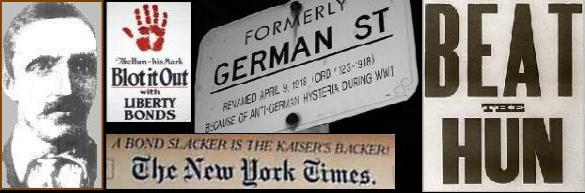
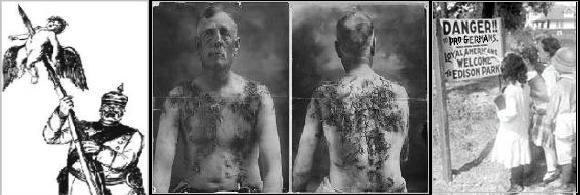
| German Americans were soon under siege as government-sanctioned vigilante groups sprang up nationwide to handle the "German problem". Forced to buy Liberty Bonds, imprisoned for making disloyal remarks and threatened by flag-kissing ceremonies, even children were victimized. Citizens from coast to coast were beaten, whipped, flogged, forced from jobs and even lynched. The situation grew so intense that even acts of murder were merely winked at, such as in the case of miner Robert Prager, above, who was hanged by an angry mob in Illinois because they "suspected" he might be a German spy. The perpetrators of this heinous act received no punishment. By 1918, most major newspapers had begun to subtly endorse curing "treason and disloyalty" by means of a noose or firing squad. From the President on down, the idea was put forth that "traitors" deserved harsh punishment. Incidents such as the Prager case did not elicit much adverse reaction or shock. They were instead justified as noble acts of retribution for the despicable crimes of "Huns". On Sept. 14, 1918, 200 people surrounded the Clark County, Wisconsin home of Mrs. Caroline Krueger because, as pacifists, her three sons refused to serve in a foreign war. When they stated “that it was not right to send American soldiers to France and that they never would go”, the mob riddled the Krueger home with bullet holes, killing one of the Krueger boys and a member of their mob in the process. Previously, on May 2, 1918, in San Jose, California, a German-American tailor was hanged by the local "Knights of Liberty" and no trace of him was ever found. In 1917 in El Paso, Texas, German-American Charles H. Feige was shot to death by a soldier as he took photos near the border because he "looked to be a German spy." No charges were brought. It wasn't only Germans that paid dearly. A headline in the September, 1918 Duluth, Minn. Herald read: "Knights Of Liberty Tar And Feather Slacker." Finnish immigrant Olli Kinkkonen was dragged from a boarding house and never seen again. The local Knights took credit for the abduction, saying it should to serve as "a warning to all slackers". Kinkkonen's body was found 2 weeks later dangling from a tree outside of town covered with tar and feathers. Duluth authorities declared the death a suicide. Olli, a logger and dock worker, didn't want to fight in the war and planned a return to Finland. No one faced charges for his abduction and death, and he was buried in an unmarked grave. Vigilantes in these years seldom got punished. Kidnapped Wisconsin German professor E. Schimler had come to America from Germany with his parents at age 14. He was kidnapped, robbed, tarred, feathered and left on a back road and forced to walk home naked. The police and the local media faulted him for 'not reporting the crime sooner', but the mob that committed the criminal act was not pursued. There were numerous other incidents of tarring and feathering. On April 11, 1918, Adolph Anton was kidnapped from his home by six armed men who bashed in his front door and grabbed him in front of his wife who was holding a baby. They dragged him off, tarred and feathered him and left him in the countryside alone and naked. The six "patriots" who did it were not charged. The Nonpartisan League was an agrarian movement around 1915 in North Dakota and Minnesota. League members advocated economic reforms to help farmers. Decried as "socialist" from its start, the League simply opted to endorse whichever candidates pledged to support their goals. Charles Lindbergh's father was an NPL member in Minnesota. Once World War I began, Leaguers were ruthlessly attacked as disloyal for not supporting war bond drives. In one case in 1917, farmer John Meintz, photo above, who had been subjected to at least three previous attacks by mobs, was dragged from home, tarred and feathered and threatened with lynching unless he left the state. Meintz visited the US Justice Department headquarters to obtain relief and justice, but found none. Children in a in Chicago park read a sign warning that only "loyal Americans" are welcome, and "pro-Germans" are in danger. In fact, 376 other farmers from Rock County, Minnisota were forced to register for war duty under threats of being deported from the state, and then the Minnesota state government via their zealous "Commission of Public Safety" crushed the League in 1918. In San Jose, California, when George Koetzer was taken from his bed, tarred and feathered, then chained to a gun in front of the McKinley Monument, the police found him.. . and arrested him. The Knights of Liberty in Tulsa, Oklahoma tarred and feathered a German-American before giving him 50 lashes and making him promise to leave the city. In April, 1918 in Seward, Nebraska, a gang of 20 to 30 men visited two German homes, tarring and feathering the farmers. In Illinois, yellow stripes were painted on the doors of German Methodists if they didn't buy Liberty Bonds, and four men, including a Catholic priest, were tarred and feathered in Christopher, Illinois. On April 22, 1918, in McPherson County, Kansas, forty masked men drove to the farm of pacifist Mennonite preacherWalter Cooprider, cut his phone wires and demanded he buy Liberty Bonds or be tarred and feathered. When his son asked to be substituted for his father, they tarred and feathered him on the head and shoulders. The mob then moved to another German pastor's house and tarred and feathered him as well. On June 3, 1918, the same mob raided the home of a poor local Pastor and demanded he write a $50 check for the Red Cross. The next day, he stopped payment on the check, so on June 10 they struck again, ransacked his home, stole his watch, money and smeared his house with yellow paint. Not satisfied, they dragged him into the barn where they whipped, tarred and feathered him. Both he and son his purchased Liberty Bonds the next day. Mennonites were constantly under siege. A judge in Cass County, Missouri forced Mennonites to regularly "donate" to the Red Cross, and in Illinois, "nightrider" attacks on Mennonite churches left skulls and crossbones painted over the doors. A Mennonite flour mill in South Dakota was shut down by authorities on rumors that there were glass chips in the flour. In Burton, Kansas, a mob seized John Schrag, who had refused to salute the flag or buy liberty bonds on religious grounds. After ransacking his farmhouse and barns, they dragged Schrag back to town with a group of "slackers" and made them salute the flag and buy Liberty Bonds. When Schrag refused, the mob beat him, poured yellow paint on his beard and decided to hang him. After a townsman drew a gun to save Schrag, the mob burned the farmers' buggies. Schrag was jailed for violating the Espionage Act but later found not guilty. Nobody could whip up war fever more than an accomplished preacher with good oratory skills. America's most famous evangelist, Billy Sunday, grandson of German immigrants, gave hundreds of sermons and speeches which centered around the evil German race. He portrayed Germans as "pretzel chewing, sauerkraut spawn of blood-thirsty Huns!" By spewing hate, Sunday raised large amounts of money for the troops, sold war bonds, and stumped for recruitment. Sunday was outdone by Liberty Loan hero Reverand Newell Dwight Hillis, once pastor of historic Plymouth Church of the Pilgrims in Brooklyn, NY. Having travelling Germany extensively and praising "German genius", he now crisscrossed the USA courtesy of the American Banking Association whipping up war fever by spreading outlandish German atrocity stories. His 400 or so hun-hating speeches in 162 cities between 1917 and 1918 netted an astonishing 100 million dollars in 46 days! This man of God even wrote a book suggesting that to flush the world of the "German cancer", Germans must be sterilized and surgeons were standing by to sterilize 10,000,000 of them. A mob of eight men busted into a Birmingham, Ohio, minister's office and set his books on fire.A German Lutheran pastor was beaten for preaching in German after the Omaha, Nebraska city council had forbidden it, and a pastor was publicly flogged for negative remarks about local war committees. Back in Iowa, federal officials raided the Des Moines reading room of the Jehovah's Witnesses in 1918 and confiscated books advocating pacifism. In Sioux City, Iowa, 100 German song books were burned by a group who broke into a German church. In Audubon, Iowa, two Evangelical Lutheran preachers were repeatedly brought before the county council of defense until one day a mob finally tied ropes around their necks and dragged them a block to the public square in 1917. They escape lynching when one of their wives ran hysterically into the mob and fainted. The stunned mob then released their prisoners on the promise that one of them leave the county. In May 8,1918, a Davenport, Iowa newspaper stated: "Government Marshals begin round-up of pro-Germans!" and reported that the "county defense council" had visited a half-dozen farmers suspected of having made anti-American statements. At the office of the Deutscher Herold in Des Moines, Iowa in 1918, a mob painted "Beware!" in yellow on the windows, doors and steps as well as the front of a nearby German restaurant. In Waukon, Iowa, a local attorney accused of "unpatriotic remarks" in 1918 escaped from a large lynch mob only because he promised he would move. Another German Lutheran Pastor in Bishop, Texas was whipped for preaching in German. In one Rhode Island town, a mob driving in sixty separate cars went out to "get some Huns." They dragged a 66 year-old German minister from his home, beat him, kidnapped him, dragged him up the courthouse steps and threw him in a jail cell with no food or water. When the minister, who suffered partial deafness from the attack, later sued them, the judge reduced the charge to only three of the men who the jury later acquitted. Outside, a huge group supported the perpetrators with picnics and parades. A similar assault on another German minister resulted in the authorities taking no other action than to give the man a safe jail cell to sleep in until he got out of town. Nebraska also aimed at preachers. On March 20, 1918, their State Legislature passed the Sedition Law, which dictated that "no alien enemy may act in the capacity of preacher...without having first filed an application in district court... The applicant must show when he came to this country, what places he has been, what steps taken toward completing naturalization and what contributions he has made toward winning the war." Consequently, German born priests and ministers, especially those who were not yet citizens, were barred from preaching until they went through a grueling procedure of proving their loyalty. In the interim, they were deemed "possible enemy aliens." In 1918, the South Dakota Council of Defense entered a German private school, removed the US flag, seized the German books, fired the minister/teacher and marched the kids to the district school. On January 16, 1918 in Armour, South Dakota, another preacher was arrested and interned for allegedly preaching sedition. At an old Hessian burial ground in New Jersey, remains from the Revolutionary era graves were dug up and thrown in the river. At Chicago's St. Clement's Church, the sisters were forced to report and register alien members. The Improved Steam Traction Engine Company in Pennsylvania came out with a new, unique design patented by Mennonite minister D. Miller. By 1914, the company had become successful and even purchased another company. Their success was cut short three years later. Since Rev. Miller's Mennonite faith did not allow him to contribute to the taking of human life, he balked when faced with a Government order to convert his shop to the production of cannon barrels and armaments. The Reverend refused, so the company was prohibited by the government from buying "strategic" materials and was forced into bankruptcy and was polished off for good in 1918. Baptist preacher John August Tubbe was born in Texas and never saw or visited Germany in his lifetime, nor did he speak German. He had a 50 year career as a minister, 55 years of marriage and led an exemplary life. He had, as a young man, taken an oath of allegiance to the USA. Yet, he was arrested in 1917 as an enemy alien and accused of “spying for the Fatherland” simply because of his German descent. He was released after a month and a half in jail only when the authorities were presented with a petition signed by the leading citizens of his county. Never recovering from his maltreatment and humiliation, he died a year later. A Methodist Minister in Texas who baptized a baby with the same common name as the Kaiser (Wilhelm) was arrested in Amarillo on April 16, 1918 and held in lieu of $1000 bail, tormented by a mob all the while. In March, 1918, on the same day the Fergus, Montana High School was burned down by an angry mob because German classes had not stopped, a local realtor who objected forced by a mob to carry the American flag three city blocks and back again. The same mob then rounded up another citizen who had not bought Liberty Bonds on religious grounds. After the mob got a rope, town official convinced the crowd to let him go. Liberty bonds were an issue in Montana as well, and those who did not purchase them were rounded up, resulting in a German-American architect being forced to resign from the state board, a city councilman forced from office and another man forced to kiss the flag and declare his allegiance to the USA. "Knights of Liberty" terrorists were active in California. A 60 year old German American in San Diego refused to buy liberty bonds when approached by a gang of ten bond "salesmen" and was beaten. Even onlookers joined in the assault. When police arrived, they arrested the victim! Also in San Diego, after a German American was seriously injured when a mob claimed he had insulted a Liberty Loan speaker, he, too, also arrested. In San Francisco, a "Neutrality Squad" of police were formed to find out what "every enemy alien is doing to help the US win the war". Gangs of white-robed men rode through the streets of small California towns in 1918 forcing people to buy bonds and punishing those who did not or did not buy enough.In a case of attempted murder, a mob in Oklahoma took Henry Rheimer from police custody on April 23, 1918, forced him to kiss each star of the flag and began to hang him with an electrical cord. He was saved when the assistant police chief pleaded with the mob. Church bells rang and whistles blew in Sprague Washingtom, calling together several hundred citizens on March 27, 1918 and leading them to the home of a German American man who the mob led back to the town square where he was forced to kneel, kiss the American flag and forced to literally eat a "seditious" German poetry book found in his home. A long time mayor, clerk and postmaster in Bremerton, Washington was roughed up and forced to resign on February 7, 1918 because it was discovered that he was born in Germany. In Bozeman, Montana, a 70 year-old man's home was vandalized by an armed mob who painted "Slacker" and profanities on his house because he had a German name and had only bought $500 worth of bonds. In Denver, Colorado, a mob tied a man to a truck with a sign saying "The Kaiser" and paraded him through the streets. Reaching a newspaper office, he was pulled from the truck with the mob screaming "Hang him!" as they placed a rope around his neck, An ambulance appeared and several citizens stopped the gang. The victim was taken to the hospital in critical condition, then jailed for "inciting a riot". In Granville, North Dakota on November 19, 1917, a "German sympathizer" was attacked in his bed by a mob armed with the town fire engine. They broke his windows and thoroughly soaked both he and his house before dragging him to city hall and forcing to kiss the flag. In Waterloo, North Dakota, a railroad worker with a German sounding name was beaten by fellow workers on January 3, 1918, painted yellow and fired for "seditious statements". On April 26, 1918 in Madison, South Dakota, a mob painted the farm of a German American yellow for not contributing to the Liberty Loan drive. He gave his life savings to them the following Monday. Farmers of Brandenburg, North Texas changed the name of their town to Old Glory and Marienfeld was renamed Stanton. The German Cemetery in Houston became Washington Cemetery. In Van Houten, New Mexico, a mob accused an immigrant of sympathy for Huns and forced him to kneel before them, kiss the flag, and shout "to hell with the Kaiser". In Oregon, 72 year old Jules Rhuberg received 15 months in jail for disliking the war. A German American optician named Howenstein was jailed on charges he gave men eye drops so they would purposely fail the Army draft exams. A German-American woman in Florida received a flogging and was ordered to leave the state by local "patriots" and an Indiana woman was abducted from her home and dragged through her town in a circus cage because she did not contribute enough to the Liberty Loan drive. In Havana, Illinois, a group of 15 armed men entered the home of a German-American, accused him of making unpatriotic remarks and demanded his loyalty. A German-American couple from Willard, Ohio was taken by a crowd of men to the city hall and made to salute the American flag and then kiss it before a large mob. The male victim was given a flag and commanded to display it in front of his cigar store. The hatred engendered during the Hysteria lingered long after war's end. German churches still felt pressure to Americanize. Church services that had for generations been conducted in both German and English almost all switched to English only, but it wasn't always enough. Olfen, Texas was an old, established German Catholic community. In 1909, their priest built a new church. In 1921, a mob from elsewhere who still had war fever snatched Father Joseph Meiser from his rectory so as to tar and feather him. His housekeeper had managed to hide, and she telephoned parishioners who within minutes pursued the mob in a caravan of cars. Upon being found out, the mob quickly beat the priest and shoved him out of the car. The church was burned to the ground a year later. In July of 1917, the minister of a German Reformed Church in Lowden, Iowa, had been arrested and charged with sedition under the new law. In a German sermon to his flock, he had denounced a recent July 4th hate speech in town where the crowd tied one German flag to a goat and another to a car bumper so they would be dragged through the streets. He said that, despite the "wrong-headed and mistaken" actions of the Kaiser, German cultural traditions could still be respected. At war's end, mobs celebrating Germany's defeat converged upon the town and made the minister march through the streets carrying an American flag. He was forced to stand on a coffin with the words "Kaiser now ruler of Hell" written on it, and then kiss the flag while a band played the Star Spangled Banner. He was then forced to leave town. There was no armistice for him. Back in Wisconsin, the Dane County Council of Defense had been so relentless and successful in their attacks on German Americans that even after the war ended, anti-German sentiment remained high. When Conrad Heuser and Rev. Gotthold Nitardy, pastor of the German Valley Lutheran Church, took a six-month trip to Germany to visit relatives in 1924, the two were summoned to the courthouse in Madison upon their return and grilled about the purpose of their trip and the length of time they had spent in Europe. Under presidential warrant, a total of 6,300 German-Americans were arrested during the period of United States military involvement in the War, of which most were paroled, but 2,300 of them were interned by military authorities. There were over 2,000 indictments obtained by the Justice Dept. under the Espionage Act, but not one person was actually accused of being a spy. We will never know how many innocent German Americans suffered as a result of hysteria. |