Strike they did, and the New World Pariah had been invented. Even Germans hated Germans.
| Charles T. Schenck and other members of the Socialist Party in Philadelphia were convicted of conspiring to mail circulars to drafted men, leaflets saying that the Thirteenth Amendment, in forbidding slavery, forbade the draft. Oliver Wendell Holmes wrote that "in many places and in ordinary time, the Socialists would be within their constitutional rights. But the Bill of Rights does not protect words creating a clear and present danger of evils that Congress has a right to prevent." Schenck was sentenced to six months in jail. On June 16, 1918, socialist Eugene Debs made an anti-war speech in Canton, Ohio and was arrested and convicted under the Sedition Act of 1918. He was sentenced to serve ten years in prison and lost his citizenship. Debs appealed his conviction to the US Supreme Court. In its ruling on Debs v. the US, the Court examined statements Debs had made regarding the war, and found he still had the intention and effect of obstructing the draft and recruitment for the war. Again, Justice Holmes stated in his opinion that little attention was needed since Debs' case was essentially the same as that of Schenck's. Debs went to prison. In 1918, The journalist H.L. Mencken, who himself fell under government suspicion for his German ancestry and sincere love of German culture, commented on the absurdity of trading fundamental liberties for security. He vehemently and publicly disagreed with Holmes. Kate Richards O'Hare, 1877-1948, was a mother of four and a prominent Socialist. As the editor of a magazine she raged against the war, continuing to lecture even though she was being watched by the government,. She was especially concerned with the war's effect upon women. She was arrested on July 29, 1917 for "obstructing the enlistment/recruitment service of the US" because of her lectures. Expecting the normal six-month sentence or a fine, Judge Martin J. Wade instead bitterly lectured her for two hours on patriotism and a "woman's place"and sentenced her to an unprecedented five years in prison. She was torn from her family and sent to an archaic old prison, Missouri State Penitentiary, and while in prison, she continued to write. Her experience there caused her to spend a good part of her life after release working on prison reform. She received a presidential pardoned in 1920. The CPI was concerned about the level of support for the war among women. They needed women to "contribute to the war effort by practicing food conservation and planting gardens" and they needed women to unquestioningly send their sons off to die. O'Hare and others such as Carrie Chapman Catt and Jane Addams who had helped found the Women’s Peace Party in January of 1915 (which grew to over 40,000 members in a year) were obstacles to the government's agenda. Creel and company were frightened that such women: “might constitute a subversive element in the nation, detrimental to wartime unity and the smooth functioning of selective service.” Consequently, the CPI put serious effort into discrediting the views of women activists. Pacifists were at first depicted as well meaning but misguided, and were shown as being gullible to German propaganda. There was a spate of movies portraying "unnatural" mothers smothering their sons with affection, thereby ruining them for life. Good mothers went home from the movies and begged their sons to enlist and do their duty. Later, the pacifists were slandered, libeled, often arrested and even victims of violent (unsolved) physical crimes. Under the 1917 law, government attorneys filed almost 2,000 prosecutions. While only a handful of these cases reached the Supreme Court, it was only after the Armistice that the Justices heard a case challenging the law under the First Amendment guarantee of free speech. In 1917, Theodore Roosevelt, once a friend of the Kaiser, said: "The Hun within our gates is the worst of the foes of our own household, whether he is the paid or the unpaid agent of Germany. Whether he is pro-German or poses as a pacifist, or a peace-at-any-price-man, matters little....The German-language papers carry on a consistent campaign in favor of Germany against England. They should be put out of existence for the period of this war....Every disloyal native-born American should be disfranchised and interned. It is time to strike our enemies at home heavily and quickly." |
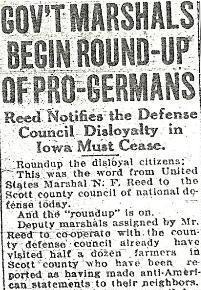
| 1918 headlines announcing a "round-up" of suspected German sympathizers. (click) H.L. Mencken and Kate O'Hare were among those who questioned the government's actions |
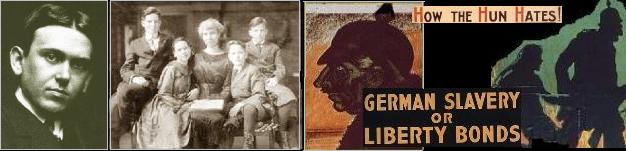
| "Millions of men and women of German birth and native sympathy live amongst us...Should there be any disloyalty it will be dealt with a firm hand of repression." Wilson |
| Suspending the Constitution ~ Internment of German Americans |
| When Wilson begged the Senate to give him power to restrain the press in 1917, Senator Robert LaFolette of Wisconsin had quipped: "The purpose of this ridiculous campaign is to throw the country into a state of sheer terror, to change public opinion, to stifle criticism, and suppress discussion. People are being unlawfully arrested, thrown into jail, held incommunicado for days, only to be eventually discharged without ever having been taken into court, because they have committed no crime. But more than this, if every preparation for war can be made the excuse for destroying free speech and a free press and the right of the people to assemble together for peaceful discussion, then we may well despair of ever again finding ourselves for a long period in a state of peace. The destruction of rights now occurring will be pointed to then as precedents for a still further invasion of the rights of the citizen." Little did he know how very destructive it would become. On April 16, 1917, all males older than 14 who were still “natives, citizens, denizens, or subjects” of the German Empire became alien enemies. With the Espionage Act on June 15, 1917, "interfering with the draft and attempting insubordination within the military" became punishable crimes, and this was widely interpreted. On November 16, 1917, eight more regulations were added to the original twelve, including punishment for speaking, writing or publishing anything that was critical of the government, with a maximum penalty a $10,000 fine and/or 20 years imprisonment. On May 16, 1918, the Act was broadened again to include German women aged 14 and older as enemies. There were very few advocates for peace after that point. Socialists and "German sympathizers" were considered a threat, as were pacifists. The draft law exempted from combat service, but not military service, those conscripts who came from traditional peace churches, but only 4,000 of 65,000 drafted men who had at first claimed to be conscientious objectors remained as such, and most of the rest did other war work for the army, many under severe duress. 450 men who would not cooperate in any way with the conscription system went to federal prisons. Of German Americans opposed to the war, Woodrow Wilson said: "There is disloyalty active in the United States and it must be crushed," as he spoke to hundreds of thousands at a "preparedness" rally in Washington, DC on Flag Day. Wilson predicted that the American nation "will teach these gentlemen once and for all that loyalty to this flag is the first test of tolerance in the US" When Congress declared war, there were over 2.8 million people of enemy German birth in the USA and the Justice Department had began surveillance of them in 1915. With the declaration of war, presidential proclamations were targeted at "alien enemies" or Germans who had not completed the process of naturalization. The Administration chose to selectively intern German aliens. Within a few weeks of the declaration, the first wave of arrests was completed. 125 Germans had been interned by May, 1916, and 900 by October, 1917. Three camps were initially established for civilian internees and prisoners of war: Fort McPherson and Fort Oglethorpe in Georgia, Fort Douglas, Utah and Hot Springs, North Carolina, but soon others sprang up elsewhere. Fort Oglethorpe barracks, left. Torn from their families, homes and jobs, many internees soon became despondent, ill and even suicidal. Others lost everything they owned and had nothing left to go home to when the war was over. The War also brought German prisoners of war to camps like Utah's Fort Douglas. Between June 1917 and March 1918, more than 500 German seamen captured on board the German cruiser SMS Cormoran at Guam and the SMS Geier at Hawaii when America declared war on Germany were interned at Fort Douglas and mixed with enemy aliens, conscientious objectors, and others arrested for violations of wartime legislation. A monument to twenty POWs who died there under captivity was created by the German-born stone carver and immigrant to Utah, Arlo Steineke. Assistant Attorney General Charles Warren drafted the Espionage Act, the Trading with the Enemy Act and the Sedition Act, passed by Congress in 1918. It levied severe punishment for "all forms of expression in any way critical of "the government, its symbols, or its mobilization of resources for the war." Under that dictatorial act, even mere skeptics were imprisoned for voicing any criticism of the war. To make matters even more appalling, the Justice Department subcontracted enforcement of that act to the numerous citizen "loyalty leagues" created to act as vigilantes on behalf of Wilson and his war policies. It was eventually perceived as violating civil liberties, and Warren's dictatorial powers ended, but not until grave damage was done. Even then, the power to arrest simply shifted to local political appointees and US Marshals, setting the stage for an even bigger civil rights disaster. The second set of regulations for alien enemies was proclaimed by President Wilson and included a series of exclusion zones which often stood between a man and his job or school or home. "Military masters of Germany are sowing unsuspecting communities with vicious conspirators and spies who seek to undermine the Government with false professions of loyalty!" Wilson With increased participation in the war, hysteria grew and ambitious marshals filled jails in the spring of 1918 without warrants. Creel crafted his agenda with vigilantes put in place to do the dirty work. German settled areas were under suspicion because some people were getting uncensored news from relatives and friends in Germany. Harmless German social clubs became "covers for spies" and groups like The German-American National Alliance, formed to discourage war against Germany, were soon under attack as being "pro-German" traitors. One CPI pamphlet stated: "The German-American National Alliance had long endeavored to weld persons of German descent in the United States into a compact body, to be used when desirable, in the interests of Germany. The hand of the German Government was extended to America to influence members of Congress through German-American voters and their sympathizers." "America has been the great background of the European War. Though far removed from the trenches with the play of artillery and the heroic charges, this country has been the scene of an equally dramatic, though silent struggle-a battle not visible to the eye. It has been a conflict of wits, of statesman pitted against statesman, of secret agent striving to outdo his opponent of a belligerent nation; for in America, agents of Germany have been striving for a two-fold aim. They have sought to enmesh the United States in an international conspiracy and to use this country as the means of a rear attack on the Entente Allies." The German Spy in America, 1917 by John Price Creel's idea of government using private groups for domestic surveillance and encouraging individuals to spy on their neighbors came to fruition with the American Protective League, a private organization formed by wealthy Chicago businessmen who worked in support of the anti-German movement and against anti-war citizens and organizations. The APL had 250,000 to 300,000 members in 600 cities at its height of power and conducted more than 40,000 citizen arrests as well as uncounted lynchings, beatings and assaults. Officially condoned by the Attorney General, the APL loaned its support to the Bureau of Investigation, the precursor to the FBI. The APL's network of operatives ("the web") expanded and swept across the United States, focusing first on aliens and dissenters, then eventually on ordinary citizens, collecting domestic intelligence for the War Department. Since it had no actual legal authority, its members acted as vigilantes running down "Hun sympathizers" and "slackers" (draft dodgers), in the process violating the civil liberties of thousands of American citizens, including those associated with labor, and pacifist movements. These auxiliary police would detain suspects that were simply believed to be "too German" and in the spring of 1918, mass arrests commenced and Washington was flooded with requests for warrants. Wilson took almost totalitarian measures to enforce his will and that of his cohorts on the American public. The people he appointed to set his policies in motion and carry them out were given nearly a free hand in their various, and often nefarious, activities. Thousands were arrested in the spring of 1918 for minor infractions such as walking into an exclusion zone, living in an exclusion zone and belonging to an alleged subversive group. Religious/Conscientious Objectors, socialists and others were all subject to arrest. The Armistice of November 11, 1918 did not slow arrests which continued until February, 1919. The Justice Department wanted the nation cleansed of the 5,000 or so German "subversives" as soon as possible. Eventually, a third of the internees were released, and another third took the option given them: repatriation to a Europe many of them barely knew. The rest were not set free until the camps closed in 1920. Thousands of lives were shattered. "We were cursed, beaten, kicked, and compelled to go through exercises to the extent that a few were unconscious for some minutes. They kept it up for the greater part of the afternoon, and then those who could possibly stand on their feet were compelled to take cold shower baths. One of the boys was scrubbed with a scrubbing brush using lye on him. They drew blood in several places." A Mennonite from Camp Lee, Virginia 1918 |