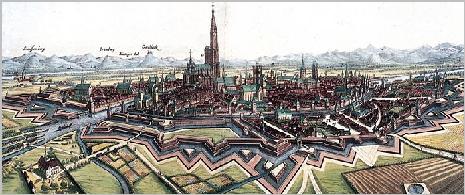
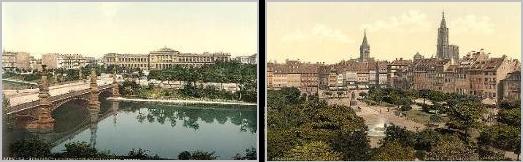
| A Free Imperial city and seat of a bishopric, Strassburg was one of the larger cities of the Holy Roman Empire and the hub of the central Elsass (Alsace), a region of historical political fragmentation. The original site of Strassburg was a Celtic settlement captured by Romans and replaced by the fort of Argentoratum. Around the year 400, the Alamanni seized it from the Romans, and the whole of Alsace fell into their hands until it passed to the Germanic Franks at the end of the 5th century. The area of Lothringen (Lorraine) fell within the Roman provinces of Germania Superior and Maxima Sequanorum for 500 years, and witnessed the arrival of the Germanic Triboci. In the 5th century, other German tribes, including the Alamanni, arrived and stayed until driven out by the Franks, who then took the area. The name Lothringen is derived from Charlemagne's grandson, Lothair I., who was given the territory of Lotharingia in 843.The duchy was then re-established after the death of the German king Heinrich I. and it became hereditary in the Hohenstaufen family. In 842, the so called "Strassburg Oaths" between Charles the Bold and Ludwig the German were taken here. In 923, the Duke of Lothringen ceded the city to German King Heinrich I., firmly establishing the connection of the city of Strassburg with the German kingdom for the next seven centuries. In 1262, Swabian King Philip conferred imperial city status upon Strassburg, and the city on the Rhine was of major importance to trade, and Strassburg's early printing presses printed Luther's 95 Theses and the German bible between 1523 and 1534. A Catholic minority still lived in the city and monasteries continued to exist in the Reformation when Strassburg officially adopted Lutheranism in 1536. The Strassburg school system was distinguished and greatly advanced. The University of Strassburg, founded in 1567 and later be suppressed during the French Revolution, was a stronghold of German sentiment. Elsass was also home to a group of Anabaptists and later the scene of a peasants revolt. After the Schmalkaldic War, 1546-1547, Strassburg had to readmit Catholic religious masses and some prominent Protestant leaders fled the city. In 1551, the city accepted the Augsburg Interim. In the Thirty Years War, Strassburg took a stance of neutrality and escaped without major destruction. Elsass, however, was devastated by the Swedes and the French in the Thirty Years' War, and in 1648 tits German rulers had no choice but to cede the area to France in the treaty of Westphalia. Depopulated and uncultivated, it languished. Elsass-Lothringin was clearly German speaking when it came under French rule. French King Louis XIV., while planning to seize Holland, also wanted to take even more of the Rhine territory, and in 1680 laid his claim to a number of territories belonging to German princes who were so impoverished and depleted because of the wars that they were helpless in resisting his aggression. Strassburg, German and Protestant in character, was suddenly and unjustifiably seized and annexed by France during a time of peace and yet this dubious action received formal recognition at the Peace of Ryswick in 1697. Immediately this change favored Catholicism, but the city still remained essentially German until the French Revolution, when it was deprived of its privileges as a free town. The episcopal lands and smaller territories, including Mülhausen, which had been a republic allied to Germany, were annexed by France in 1789. Although Strassburg was annexed by France in 1683, it remained firmly connected to the German- speaking intellectual world throughout the 18th century, and the university attracted students from throughout the Holy Roman Empire, including Goethe and other great figures. In the war of 1870-71, Strassburg was bitterly surrendered back to her German homeland after a seven week siege in 1871. Before the Prussian-Franco War, more than half of the inhabitants still spoke German, and this proportion increased greatly afterwards. Elsass once more became German under Bismarck, who gave the people until September 30, 1872 to declare their loyalty to either Prussia or France. The overwhelming majority agreed to stay, but 45,000 elected to remain French, and left by choice. France would bitterly desire to recover the provinces they had themselves once stolen, especially since Strassburg had been greatly enhanced from costly German investments in its infrastructure. |
| Old German Lands: Strassburg; Elsass-Lothringen |
| Beyond the Stinky Cheese: German Belgium |
| The province of Limburg has as distinct a character as its cheese. It is today the southernmost of the twelve provinces of the Netherlands, located in the south-east of the country, with Maastricht as its capital. It is bordered by Belgium in the west and Germany in the east. The original duchy of Limburg extended into present Germany. This should not be confused with the town of Limburg in Germany proper. Because of its strategic importance, Romans, Spaniards, Prussians, Austrians and French have all ruled Limburg although Limburgians were always defiant and managed to maintain their own language, called Limburgish, which since 1997 is an official regional language and as such receives moderate protection under Chapter 2 of the European Charter for Regional or Minority Languages. It is not recognised by the Dutch, German or Belgian governments as an official language even though it is spoken by an estimated 4 million people in those countries. It even has distinct "sub-dialects" depending on which border one lives near, and the Limburgians have fought to preserve these regional dialects as well. Dutch, German, Belgian and English are spoken too. The German presence in Eastern Belgium goes back just as far. German is the language spoken in a small 850-square- kilometre strip of land along Belgium's eastern border, and it is home to Belgium's 71,000 minority German community. Until 1919, much of this area belonged to Germany. |