| Some Old German Lands: Silesia and Sudetenland |
| German Silesia |
| German Silesia, part of the German Empire, was bounded by Brandenburg, Posen, Russian Poland, Galicia, Austrian Silesia, Moravia, Bohemia and Saxony. Besides the bulk of the old duchy of Silesia, it comprised Glatz, a fragment of the Neumark and. later, part of Upper Lusatia. The province was the largest in Prussia, was divided into three governmental districts, those of Liegnitz and Breslau comprising lower Silesia, and of Oppeln taking in the greater part of mountainous Silesia. Full of rivers, streams, hills and low mountains, Silesia was also comprised of fertile pastures and meadows and forests abundant with deer and game, tremendous fisheries and mineral wealth. About a third of the land was in the hands of large German estates and German castles The original population of Silesia was probably Celtic and about the year 1138 Silesia was first transferred to the Germans. The independent dynasty was drawn up under the influence of Barbarossa and two princes who in 1163 divided the sovereignty among themselves as dukes of Upper and Lower Silesia. The whole of sparsely populated rural Silesia was covered with German settlements by the 12th century. The capital was Breslau, the largest and most important town which was refounded about 1250 as a German town. By the end of the 13th century, Silesia had virtually become a German land with Breslau, above, growing into a leading center of trade. The rich Silesian duchies partitioned their territories with each new succession and by the end of the 14th century the country had been split up into 18 small, bickering principalities. In 1290, the Silesian princes sought the protection of the German dynasty then ruling in Bohemia. The intervention of these kings resulted in the appropriation of several petty states as crown domains. The earliest of these Bohemian overlords, King Johann and the emperor Karl IV restored order vigorously. Later, however, the Bohemians brought no benefit, but involved Silesia in the destructive Hussite wars and then in a series of invasions from 1425 to 1435 which devastated the country and put the German element of population in Upper Silesia in a weaker position, and a complete restitution of the Slavonic nationality seemed imminent on the appointment of the Hussite, George Podiebrad, to the Bohemian kingship in 1457. The burghers of Breslau repudiated the new suzerain, and before he could enforce his claims he was ousted by Hungarian king Matthias Corvinus. Through confiscations of the nobles' lands, Corvinus asserted his dominance and instituted a permanent diet of Silesian princes and tried to establish an effective central government. But the Silesians, who experienced financial discomfort at Corninus' hands, began to resent the control of the Bohemian crown, and under his successor Vladislav, they secured semi-autonomy which was theirs until the outset of the Reformation. German king Ferdinand I reimposed the Bohemian crown upon them, and the Silesians lost power completely. From 1550, Silesia passed almost completely under foreign administration, first under the Habsburgs, who had united the kingship of Bohemia with Austria and the imperial crown. The Thirty Years War, however, brought most of Silesia to almost total ruin. It was estimated that 75% of the population perished and commerce and industry were at a standstill. A greater measure of religious liberty was secured for the Silesians by representatives of King Karl XII of Sweden, and effective measures were taken by the emperor Karl VI to stimulate trade between Silesia and Austria, but the country remained very poor in the earlier part of the 18th century. In 1740, after Silesia went under Prussian rule, and despite the Seven Years War, Friedrich the Great brilliantly managed to bring Silesia back to normalcy. He made yearly visits to the country and kept himself in touch with it, enacting numerous political reforms including strict Prussian enforcement of religious toleration, bringing peace. By judicious regulations he brought about a dramatic increase of Silesia's growth. He revived the mining industry and introduced Merino sheep to boost weaving operations. Under Prussia, Silesia also acquired its first public schools. Most notably, he introduced the staple foods of potatoes and turnips so that people would no longer starve. Silesia was occupied by French troops during the Napoleonic wars, and in 1815 it was enlarged by receiving back a portion of Lusatia which, until then, had become detached from Silesia in the 11th century and annexed to the kingdom of Saxony. "Austrian Silesia" was a duchy and the smallest province of Austria and all that was left of Austria's part of the country after the Seven Years War. It formed, with Moravia, a single province until 1849, when it was created into a separate duchy. Silesia was German and only 25% Polish at the time of World War One. |
| Sudetenland |
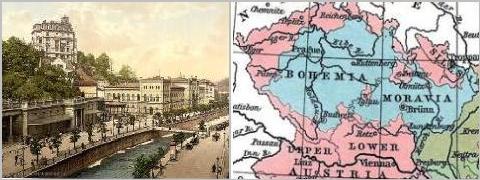
| "Sudeten" refers to a mountain range 200 miles long and 20 to 40 miles wide, covering the north of Bohemia and Moravia as well as part of Sudeten Silesia. Major German settlement in the Sudeten began during the reign of King Premysl Otakar II in the 13th century when the area was largely uninhabited and heavily forested, but Germans had lived in modern day "Czech" territory well before Slavic tribes arrived around 500 AD. Bohemia itself owed its name to the Celtic "Boii", a people which occupied the country in prehistoric times. About 78 B.C. the land was occupied by Germanic tribes, and some years after the birth of Christ, the Marcomanni King Marbod united the German tribes as far as the North Sea and the Baltic to form a great confederation which menaced the Roman Empire. When these tribes left Bohemia and Moravia in the sixth century, a Slavonic people came in from the northeast which was soon to appear in history under the general name of Cechen (Czechs). Bohemia went back and forth between Celts, Germans, Hungarians and various Slavs, but German and Latin remained the prevalent language of the aristocracy in south Bohemia and Moravia, as well as in parts of north Moravia and northeast Bohemia from the 11th century, even among the Royal house of the Přemyslid dynasty. Around 1306, Bohemia came under the sway of John of Luxembourg (1310-46). The Bohemian rulers of the Luxembourg line, from Karl I, of Bohemia (Emperor, Karl IV) until the extinction of the dynasty at the death of Sigismund (1437), were all German emperors. Bohemia reached the height of its prosperity under the Emperor Karl IV who conquered Silesia and also occupied the Mark of Brandenburg and the Upper Palatinate for a time . In 1348, Karl founded the University of Prague, the first university on German soil. By his Golden Bull, Karl IV gave Bohemia the highest secular electoral dignity of the Holy Roman Empire.After 1437, Bohemia was ruled by kings of various lines until the death of King Ludwig II of Bohemia and Hungary who fell in the battle of Mohácz (1526). After this battle, both Bohemia and Hungary came into the possession of Ferdinand I of Habsburg who had married the sister of Ludwig II. and the land became part of the Austro-Hungarian Monarchy. When the Czech protestant aristocracy was defeated in the Thirty Years War, German language and culture remained dominant for three centuries under the Austro-Hungarian Empire. There were large German speaking populations in Prague, Brünn and other areas. Towns with German majorities included Karlsbad, Krumau, Znaim and Reichenberg. The Germans maintained their language and culture for centuries, becoming a third of the population of Bohemia and Moravia. In 1860 Prague lost its German majority which remained since the middle ages. Bohemia had a population of 6,318,697 in December of 1900. It was one of the most thickly settled provinces of the Empire, with Czechs forming 63 percent of the population and Germans 36 per cent. The Germans lived chiefly near the boundaries of the country especially near the northern and northwestern boundaries. Today there is barely a trace of their existence. They once spoke in dialects which are now extinct, Saxon in north Bohemia, Frankish-Egerlandish in west Bohemia, Silesian German in Silesia and north Moravia, and Bavarian-Austrian in south Bohemia and Moravia. Czech and German-speaking inhabitants generally lived peacefully together for centuries. |