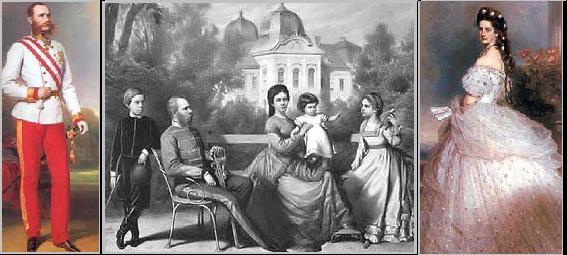
| Kaiser Franz Joseph came to the throne as ruler of Austria-Hungary cursed: his brother would be executed in Mexico, his only son would die, his wife and his nephew would be assassinated. His grief would be tempered only by the tremendous responsibilities he was forced to bear. The world was already becoming unstable. Franz Joseph ruled an empire of 50 million people and would face revolts in his realm and emerging new political philosophies, all the while facing his own personal tragedies. Yet, he would be the longest ruling monarch of the Habsburg Dynasty in history and his 68-year reign is the third-longest in the recorded history of Europe. Franz Joseph was born in 1830 in the Schönbrunn Palace in Vienna, the oldest son of mild- mannered Archduke Franz Karl and his formidable wife Princess Sophie of Bavaria. It was Sophie who groomed "Franzl" as a future Emperor, and at age 13 he began his career as a colonel in the army. Following the Revolutions of 1848, he was appointed Governor of Bohemia but never took up the post and instead was sent to the Italian front. At around the same time, the Imperial Family was fleeing revolutionary Vienna for the calmer setting of Innsbruck. After the abdication of his uncle and the renunciation of his father, Franz Joseph succeeded as Emperor of Austria under a heavy burden. Austria faced further fighting in Italy, revolts in Hungary and Franz Joseph would preside over a world on the brink of chaos. His future wife Elizabeth Amalia Eugenia was born on the December 24, 1837 in Munich, the fourth of nine children born to Duke Maximilian of Bavaria and his wife Ludovika. They met in the summer of 1853 at romantic Bad Ischl in the Salzkammergut. The family was hoping that Franz would marry her sister Helen, however, defying his mother's marriage plans, he was instead smitten with Helene's 15 year old sister Elizabeth who had accidently accompanied the party and on the day after their first meeting, Franz Joseph and Elizabeth celebrated their sensational engagement. They married in Vienna on April 24, 1854, and a year later their daughter Sophie was born, soon followed by another girl. Finally, in 1858, baby Crown Prince Rudolph arrived. Difficulties with her mother-in-law arose, and Elizabeth often hid behind illness and in isolation. "Sissi", as she was called, disliked the strict court etiquette and lost herself in vigorous exercise and horseback riding while educating herself, learning Hungarian and modern Greek perfectly and developing a passion for classical Greek history. She later immersed herself completely in the world of ancient Greece and built a palace named "Achillion"on the Greek island of Corfu. She travelled extensively, spending a lot of time in Madeira and Corfu, while her children remained behind at the court. In 1859, after more personal problems, Elizabeth left her family to live in seclusion at Madeira, Corfu, and Venice. The Kaiser meanwhile engaged himself in a "mutually satisfying relationship" with actress Katherine Schratt, and he built a villa named Villa Schratt in Bad Ischl for her. |
| The Unlucky Monarch |
| On February 18, 1853, Franz Joseph survived an assassination attempt. Under Franz Joseph, Austria was forced out of Italy, expelled from Germany, and in 1867 the remaining Habsburg empire were reconstructed as the Dual Monarchy of Austria- Hungary. The non-Hungarian half of the dual monarchy did not have a separate name and was officially referred to as the "kingdoms and crownlands represented in the imperial parliament." It became known as Austria, or Cis-Leithania, meaning the lands on "this side" of the Leitha River which formed part of the boundary of Austria and Hungary. When a fourth child, Marie Valerie, was born ten months after the coronation of Franz Joseph as King of Hungary, she was brought up and schooled in the Hungarian language and was therefore nicknamed the "Hungarian child" for her mother's public love for Hungary. The Empress Sisi accompanied the Emperor on an important trip to Hungary in 1857 and ingratiated herself with the Hungarian people. Sadly, it was on this trip that their little daughter Sophie became ill and died. Elizabeth was adored in Budapest, and many buildings and institutions were named after her. After a mysterious illness in 1860, the Empress had become increasingly shy, and she hid her beautiful face behind fans and travelled incognito in order to avoid publicity. After a time, she refused to be photographed at all. Rumors spread that she was as insane as her cousin, King Ludwig II of Bavaria. Whatever the case, she was self absorbed to the extreme, quite taken with her own beauty, and totally preoccupied with travelling, her poetry and her studies of Hungarian and Greek. |