| The Habsburgs |
| With the election of Count Rudolf as the German king and Holy Roman emperor in 1273, the family became prominent. Rudolf took possession of the Babenberg inheritance, including the duchies of Austria, Styria, Carinthia, and Carniola from King Ottokar II of Bohemia in 1278, and in 1282, he granted these duchies to his successors and these Austrian lands became the center of the Habsburg- ruled domain. The Habsburgs only occasionally held the imperial title in the 150 years after Rudolf's death in 1291, but after the election of Frederick III in 1452, the dynasty became so dominant among the German nobility that only one non-Habsburg was elected emperor in the remaining 354 year history of the Holy Roman Empire. The collection of territories united under the Habsburg Empire, however, were not all part of the Holy Roman Empire. After 1356 the seven electors were regularly the three Rhenish Archbishops of Mainz, Cologne and Trier, four lay magnates of the Palatine of the Rhine, the Duke of Saxony and the Margrave of Brandenburg, and the King of Bohemia. The rights of the seven electors, in their collective capacity as an electoral college, were often a matter of dispute with the papacy. The result of the election, whether made, as at first, by the princes generally or, as after 1257, alone by the seven electors, was in itself simply the creation of a German king. Since 962, however, the German king was also, after coronation by the pope, Roman emperor. By the end of the 14th century the position of the electors, both individually and as a corporate body, was precisely defined and they were distinguished from all other princes by the indivisibility of their territories and by the custom of primogeniture. They were further distinguished by the fact that their person, like that of the emperor himself, was protected by the law of treason, while their territories were only subject to the jurisdiction of their own courts. They were independent territorial sovereigns; and their position was at once the envy and the ideal of the other princes of Germany. In 1623, however, in the course of the Thirty Years' War, there were some changes. The basic structure remained as it was until 1806 with the dissolution of the Holy Roman Empire by Napoleon when the electors ceased to exist. The Habsburgs expanded through diplomacy and by marriage with the houses of Bohemia and Hungary. The imperial office of the Holy Roman emperor therefore remained from that point firmly in Habsburg hands and various branches of the Habsburgs at the peak of their power inherited Spain with its foreign empire, parts of Italy, the Netherlands and various German and Austrian possessions. The Spanish Habsburg line became extinct in 1700 and the House of Habsburg was divided, with the Austrian branch retaining the imperial title in the early 18th century as Spain passed from the Habsburgs to the French Bourbons, and the Austrian branch acquired Spain's Italian possessions (except for Sicily) and also the southern Netherlands. From its hub in Vienna, the Habsburg Empire at one time or another included Hungary, Czech lands, Croatia, Slovakia, Slovenia, Bosnia-Herzegovina, and important parts of Italy, Poland, and Romania. These countries all share a common Habsburg heritage and, going back further in time, a legacy of an enormous amount of largely beneficial and progressive cultural and economic contact with the German-speaking world. The end of World War One spelled the end of over half a millennium of Habsburg domination in their realms. Although some critics have harshly ridiculed it as "a prison of nations", the Empire not only offered its protection to many small national groups and enabled their cultural/ethnic survival in the face of powerful enemies, it also developed Central Europe industrially with its money, talent and brains, leaving often overlooked contributions over the many centuries of its reign. |
| We will step into the Habsburg history toward the inglorious end of their long march through history. |
| The Holy Roman Empire is divided into four periods: the Age of Emperors from 962 to 1250, the Age of Princes from 1250 to 1438, the Early Habsburg Period where from 1438 the electors almost always chose a member of the Habsburg dynasty of Austria as king, and the Final Phase from after the Treaty of Westphalia (1648) when it was a loose confederation of about 300 independent principalities and 1,500 or more semi-sovereign bodies or individuals until dissolved by Napoleon. From 1273, when Habsburg Swiss nobleman Count Rudolf was elected King of Germany, the seven electors may be regarded as a definite body with an acknowledged right. Until 1918, the Habsburgs reigned over a territory that grew from a small section of Austria into a vast realm of reality and fable. No other royal line on the continent lasted as long, left its mark on as many centuries or had an impact on so many countries. Most of Europe, with the exception of Britain, Scandinavia, the Baltic States, Russia, central France, Greece and some small nations, was at one time either greatly influenced or ruled by the family of Habsburg. The actual origin of the royal Habsburg Family of Europe is obscure. Around 1020–1030, in modern day Switzerland, Bishop Werner of Strasburg had the castle "Habichtsburg" ("Hawk's Castle") erected for his nephew, the Count Radbot, who became the first count of Habsburg. The castle fortress therefore became the ancestral seat of the House of Habsburg. It was allegedly named after a hawk (Habicht) sitting on its walls, and this may be where family derived its name. The earliest traceable Habsburg ancestor is Guntram the Rich, who died in 1096. |
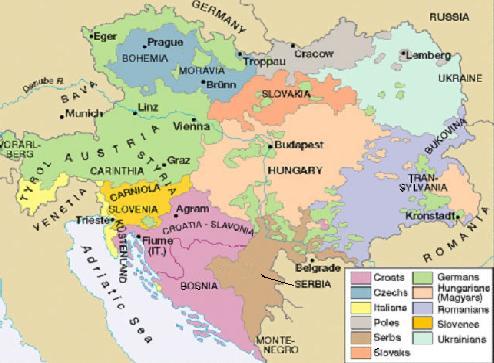
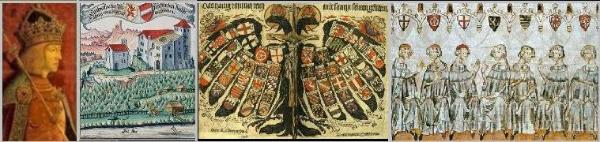
| Rudolf; Habichtsburg; Heraldry of the H.R.E. of the German Nation. From 1356-1648, the composition of the electoral body had remained unchanged. The Prince-electors of the Holy Roman Empire: Archbishop of Cologne, Archbishop of Mainz, Archbishop of Trier, Count Palatine, Duke of Saxony, Margrave of Brandenburg and King of Bohemia. Electors (Kurfilrsten) were a body of German princes, originally seven in number, with whom rested the election of the German king from the 13th until the beginning of the 19th century. Map (click) |