| Since 1572, a lawless, disorderly clique called the "Republic of Nobles" had existed in Poland, which was at the time comprised of 40% non-Poles, including Germans, Ukrainians, White Russians and Letts, and they had declared that the King had to be elected. When the throne of Poland became vacant in 1764, Russian Empress Catherine II decided to have her friend Stanislas Poniatowski crowned King of Poland. When the Polish Nobles opposed this move, Catherine sent Russian troops into Poland. Turkey declared war on Russia at the same time. Friedrich was concerned about the explosiveness of the situation as he had a treaty with Russia and he wanted to maintain a peaceful coexistence. Queen Maria Theresa's son Emperor Joseph II, meanwhile, met with Friedrich. Eager to avoid a huge conflagration and to maintain peace on their borders, Friedrich felt that all three nations, Russia, Austria and Prussia should probably divide a weak and vulnerable Poland. On August 5, 1772 the three powers signed an agreement which allotted certain regions of Poland to the three nations. Poland at the time was very large, reaching from Posen to Kiev and from Riga to Czernowitz. In all, it lost about five million people, of which the largest share went to Austria and the smallest to Prussia. Friedrich received West Prussia, the old realm of the Teutonic Knights, without the cities of Danzig and Thorun which were to remain as free cities. Friedrich wrote in his memoirs "My position was of a delicate nature. Through my alliance with Russia I was obliged to furnish troops in case of a war with Austria. I either fulfilled my obligations, or I remained a neutral bystander, which was to me the most dangerous position to take. An Alliance between Russia and Austria could have led to total isolation of Prussia, which would have been a mistake I was not willing to make." He further stated: "The hostilities between Turkey and Russia changed the whole political system in Europe. I would have been very clumsy or very stupid not to take advantage of the situation for my state. I was able to compensate Prussia for the terrible losses of the war, and to unite Polish Prussia with my old provinces." This territory linked central Prussia with Brandenburg. In the next six years, Prussia made speedy improvements to the underdeveloped and sparsely populated area. In the next hundred years, German settlers founded new towns and cities in these lands, and railroads, libraries, school, churches, farms and businesses were developed. Friedrich took his responsibilities seriously in regard to the Polish people. He not only spoke Polish himself, he also advised his successors to learn Polish, a policy followed by his successors. After he introduced the Prussian school system, which was regarded as the most modern in the world at the time, into the newly acquired lands, he had 750 schools built there between 1772 and 1775. He insisted that both Protestant and Roman Catholic teachers be hired to teach in West Prussia, and that preferably both they and school administrators be able to speak both German and Polish. Friedrich forbade the import any goods which could be manufactured domestically and he instituted protective tariffs. Berlin became the largest textile city in Germany by the end of his reign and was culturally enhanced with an opera house, several theaters, St. Hedwig Cathedral and the Prince Heinrich Palais as well as an enlarged "Unter den Linden" avenue and Tiergarten public park. He did not believe in the Divine Right of Kings and often wore old military uniforms; he once said that the crown was "a hat that let the rain in". Friedrich disassociated Prussia from what he regarded as the corrupt judicial systems of the Greater German Reich. He reorganized a system of indirect taxes which provided the state with greater revenue and completely revised the civil service code. Prussia became the first country in continental Europe to abolish torture, give people total equality and fairness under the law and enjoy complete religious tolerance. At a time when much of Europe still remembered the Ottoman invasions, he said, "All religions are equal and good and as long as those practicing are an honest people and wish to populate our land, may they be Turks or Pagans, we will build them mosques and churches." He allowed freedom of speech and print (when a foreign dignitary once commented on a political cartoon which ridiculed Friedrich's liking for coffee and asked why the King allowed such nonsense, Friedrich quipped, “They can say whatever they want, as long as I can do whatever I want”). He gave Prussia the reputation of having the finest legal and administration system in Europe. Once his military struggles were over, Friedrich, by then known reverently as "Der Alte Fritz," settled down to 23 years of uninterrupted rebuilding, land development, community improvement and civil and legal reform to benefit his Kingdom and all of the people who inhabited it. In the struggles of the mid 18th century, he weakened the already tenuous Holy Roman Empire. The Austro-Prussian rivalry lasted for over a century until the final Prussian victory over Austria in 1866. Friedrich was later vilified by those who saw him as having prevented the emergence of a united Greater Germany sooner, including all of the major German speaking areas of Europe, but he had no interest in what would later be called German nationalism. Friedrich's main responsibility was his own Prussia, and he took it from a provincial backwater to a great European power and center of culture. People were probably better off under his reign than at any other time past or present. Unlike some representations of him, he was a man's man in all senses. He rode and fought with his troops. He endured the dirt, heat, cold, sweat and blood of battle, and was just 'one of the guys' on the battlefield where in dull moments he enjoyed being lightened up by the latest barracks jokes while he spun a few yarns himself. At the 1757 Battle of Kolin, in one of the last horrific attacks against the Austrian line, Friedrich directly cried out to his men to work harder: “Bastards! Do you want to live forever?” A musketeer reportedly replied, “Fritz, we’ve earned our 50 cents for today!” He had no less than six horses shot from under him during battle. More importantly, he is often admired as one of the greatest tactical geniuses of all time, especially for his usage of the oblique order of battle. He was as not effeminate, silly or foppish as some modern historians like to portray him. After all, the Prussians made Spartan simplicity a virtue, causing one defeated French officer to whine to his Prussian captors, “Sirs, you are an army. We are but a traveling whorehouse” (with) “valets, servants, cooks, hairdressers, courtesans, priests and actors, dressing gowns, hairnets, sunshades, nightgowns and parrots.” Soon, however, with its greatest king gone to protect his lands, Napoleon would ride into Prussia's history. Prussia attempted to remain neutral, but Napoleon was less than gracious with Prussian king Friedrich Wilhelm III and his dear wife. |
| Poland |
| Friedrich der Große |
| One of eight surviving children of Friedrich Wilhelm 1 and Sophea Dorothea von Hannover, Friedrich was born during a time of prosperity in the last year of his grandfather’s reign, becoming Crown Prince at the age of one. He was brought up by French Huguenot governesses and tutors, learning French and German at the same time. In addition, he spoke English, Spanish, Portuguese, and Italian, with an understanding of Latin, ancient and modern Greek, and Hebrew. Later in his life, he learned Basque, Slavic, and Chinese. Since childhood, he also had a passion for French literature, art and enjoyed philosophy and music. Friedrich was a gifted musician and played the cross-flute, composing one hundred sonatas for the flute as well as four symphonies, and he was a brilliant soldier and strategist who was respected world-wide for generations. As a child, he was given his own regiment, the 'Crown Prince Cadets', made up of 131 boys whom he could command and frolic with as he liked. At fourteen, Friedrich was made a major of the giant Potsdam Grenadiers, and on the parade ground he commanded the giants. He and his father were said to have had a strained relationship, but Friedrich spoke of him quite proudly in letters. Some say that Friedrich was often beaten and berated, and he soon rebelled, plotting a runaway to England with a group of his friends and fellow junior army officers at age 18. They were found out, and while narrowly avoiding execution himself, Friedrich was said to have been forced to watch his best friend's beheading for the crime of treason. At a young age, he was coaxed into marrying Elisabeth Christine von Braunschweig-Bevern in 1733. His father gave him the Schloss Rheinsburg north of Berlin, and here, for the first time, Friedrich assembled a small number of musicians, actors and other artists and spent his time here in leisurely pursuit of the fine arts. He and Elizabeth may have had a barren and by all reports boring marriage, but this time was regarded by Friedrich as one of the happiest in his life. Here, refined Friedrich wrote poetry in French, composed music and played the flute. He also revived the study of science and encouraged education. He wanted to be a philosopher-king and described himself as "the first servant of the state." He wanted to emulate the type of leaders of mankind Plato envisioned, and he despised despotism. He had come to power at a challenging time and he had to deal with the "petticoat league" formed by Maria Theresa of Austria-Hungary, Elizabeth of Russia and Madame Pompadour of France. He could not rely on military conflict alone, but instead had to form a strong yet controlled approach using his charm and wit to survive, succeed and prosper. To reach his goals, he also needed to be a shrewd military tactician. When Friedrich became King at age 28, his father left him a strong economy, a cash surplus and Europe's best-trained army, yet Prussia was underdeveloped in industry and trade. There was no navy, no raw materials and no regions suitable for mining, but there was loyalty. Upon reviewing his troops for the first time as a King, Friedrich said: "Meine Herren, troops must not only be pleasant to look at, they must be useful. It is the duty of every soldier to be unafraid and brave. Meine Herren (to the generals), I know all your names, and I know of the complaints against you for greed and cruelty. See to it that in time I will be able to forget them. Let me advise you as your friend and warn you as your King." With his soldiers' love and respect, Friedrich led the Prussian forces during the war Austrian Succession, the Seven Years War and the War of Bavarian Succession, not only as king, but also as a brilliant field commander. Although young, cultured Friedrich established a court orchestra and provided Berlin with an opera house, he also jumped to attention when Emperor Karl VI of Austria died on October 20, 1740. Despite the Pragmatic sanction, an agreement that all of the Electors in the Empire would support the succession of Carl VI's daughter Maria Theresa to the throne of Austria should he have no male heir, Elector Carl Albert of Bavaria, King Philip V of Spain and Augustus III of Saxony all contested Maria Theresa’s succession. Friedrich II offered to adhere to the Pragmatic Sanction and support Maria Theresa in return for Prussia occupying the rich Habsburg province of Silesia. Maria Theresa refused. So, taking advantage of the turmoil caused by the disputed succession, in December of 1740, Friedrich the Great ordered his army to invade Silesia, astonishing Europe. When the Prussian army crossed the border into Silesia, the peasants armed themselves with scythes and hoes and joined the Prussians in their fight against Austria. To them, they were liberators. The new Habsburg ruler, 23 year old Maria Theresa was strong, but her Habsburg armies proved no match for the Prussians. After Friedrich's first victory over the Austrians in April of 1741, he convinced the French and Bavarians to join him against Maria Theresa. A series of three later victories in 1745 won him the title of the Great. By the treaty of Dresden in 1745, Maria Theresa unhappily ceded the greater part of Silesia to Prussia, adding fifty percent more people to Prussia's population. However, Friedrich was still being underestimated. In May 1756, Maria Theresa engineered a solution to reclaim Silesia by convincing France (via the politically influential mistress King Louis XV, Madame de Pompadour) and Empress Elizabeth of Russia to join forces with Austria and side against Prussia. Friedrich derisively referred to their scheming alliance as the "petticoat plot". In 1757, Austria and Russia were joined by France after Friedrich had launched a preemptive invasion of Saxony in August 1756. Sweden and most of the other German states soon followed suit. Prussia had only the support of England, Hanover, Hesse-Cassel and Brunswick. All the same, on August 29, 1756, Friedrich the Great led 70,000 Prussian soldiers from his small Prussian monarchy of 3 million against France, Austria-Hungary, Russia, Sweden and Saxony with their combined force of 43 million people and marched into Saxony, launching the Seven Years War. During the course of the war, a string of victories at Leuthen, Rossbach, and Zorndorf blocked the Allied advance into Brandenburg, but the Russians captured East Prussia. Meanwhile, England was being trounced by the French. However, luckily for Friedrich, Elizabeth of Russia died in 1762 and Peter III, an admirer of Friedrich, took her place and immediately ceased hostilities with Prussia and restored the territories that the Russians had captured. The Swedes backed off as well, and Friedrich could now concentrate his efforts on Austria. He finally drove them out of Silesia. He was later admired by Napoleon and others as the greatest tactical genius in history. Friedrich felt that success for the Prussian military depended upon strict discipline, impressive and inspiring uniforms, and even good music. He increased his soldiers' pay, provided medical care and better, improved housing, but would order strict reprisals for looting and plundering in foreign lands by his soldiers. He avoided large, vague battles of destruction and concentrated on short, decisive engagements which left the opponent awe struck and willing to surrender quickly. He expressed disgust at the injury of non-combatants. When Friedrich took the throne, Prussia had 2,400,000 people, 600,000 of them exiles and or their descendants. In his reign, he introduced another 300,000 more. By 1786, one third of Prussia's population was of foreign (non Prussian) birth or foreign descent. He visited every corner of his kingdom, and struggled to convince farmers to start planting potatoes and turnips to avoid famines. In the beginning of 1747, while the building of the Finow canal was under way to connect Berlin's rivers Havel and Spree, with the river Oder, the construction of the port of Swinemünde was begun, all to enhance trade and bring prosperity into the new regions. He had canals dug for irrigation and encouraged people to settle in the sparsely populated areas once devastated by plague and war. In addition to receiving an exemption from taxes and military service for several years, they received free wood to build houses, animals and seeds for their land. By 1764, 21,000 destroyed houses had been rebuilt and by 1769, 175 new villages were erected in Silesia, which had room for 75,000 people. The results of his labor were striking. He had taken it from desolate wasteland to prosperity. Silesia went from having ten coal mines in 1740 to fifty within four decades, and he gave military exemptions to miners. |
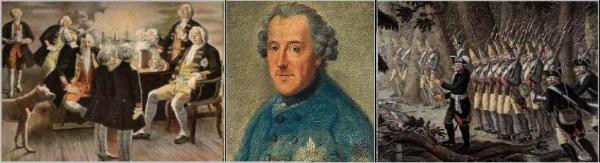
| Friedrich II, the Great 1712-1786. King of Prussia from 1740 to 1786 |
| Above: Friedrich and his brother visit at his father's tobacco party; The only portrait Friedrich personally sat for painted in 1763 by Johann Georg Ziesenis; The Seven Years War |