| We took shelter in the parsonage building. For twenty long minutes our hearts pounded in the cellar while an inferno shakes the earth around us and makes the walls of the cellar tremble. We are silent and pray. After the first 10 minutes the bombs come closer. An enormous impact and air pressure leaves the whole house uneven. Windowpanes splinter, the door to our cellar break in, a cloud of dust makes breathing heavy. The electricity dies. We light candles and look for water in order to dampen the handkerchiefs and hold them before our mouths and noses. I put the gas mask on. Then we begin to pray. In the cellar are all of the house inhabitants and also including 2 old men, 2 housekeepers, a young mother, an orphan child, 2 young girls and a neighbor from across the road. |
| We are pushed close together as we bend and pray, with each impact twitching as one. The weak light of the candle and temporary flashing of the flashlights give a ghostly look to the light in the smoke and dust of the explosions. The minutes become the eternity - outside is hell. Finally the bombardment diminishes; it becomes quieter, the engine roars weaken. Mrs Anna, the older of our lady housekeepers, sits there severely trembling. We all are intact, but we worry for the dying and dead ones in the city, and we pray for the victims of these dreadful 23 minutes. Then however, the priests call for us outside to assist the dying and wounded one. Into all houses of the parish, as long as they are not on fire or in debris and rubble, we try to come to and ask which ones need a wish priest. Everyone had been reminded to go into the actual air raid shelter, but nobody quite trusted them. |
| I was led to a collapsed air raid shelter with 2 persons buried under its rubble. When my friend preceded me as a good deed and took the first step, the cellar collapsed, and only his hands could be seen. I could do nothing. We continued to go through the rubble-scattered roads, and despite the late night hours were terribly illuminated from the fire light of the burning houses. A tremendous cloud of smoke and dust lay over the whole city, by which the moon, so bleached and weak, gleamed through. The gymnasium between the two large schools in the Eschholzstrasse was changed into a wild chaos by an aerial mine which damaged both schools heavily. |
| Hundred pound stone blocks had been hurled far on the road. The electrical overhead line, all telephone wires, were in confused disorder because of the blasts. In the schoolyard, 50 motor vehicles and buses of the red cross, which had brought all wounded there earlier in the afternoon since the schools were being used as military hospitals, were all afire. Some collapsed buildings now in rubble worked like a barricade. Behind the boys school on the church square, there was an enormous funnel of a large high-explosive bomb; it had turned the back of the school to rubble. The church stands still. Thank God! But on the inside there is much damage from the bombing air pressure and the constant vibrations. Round after round, the heavy bombs and aerial mines, also staff incendiary bombs had rained down. Yet the high altar, the pulpit and the Beichtstühle stayed intact and in the devastation stood still . Under the organ stage many people had sought shelter. |
| It looked worst on the cross road and the on adjacent roads. No more houses stood on Colmarerstrasse. From the collapsed heaps of rubble the flames still struck wildly to the sky. Here and there the front walls alone stood, and a tremendous fire glow lay on the road surfaces. Three times I tried to go on it that night, but in vain. Where were the humans? It cost the most victims here. Days, weeks later, it was still not excavated. Who should find and bury the dead? Most humans fled from the destroyed city. Many houses even later burned down, because nobody was there anymore to discovered or put out fires. |
| Returning to the parsonage building, we looked around there once. The first impression is bad. We spend the remainder of the night sitting up sleeping in the cellar with some more people who came out of completely destroyed houses. We hear that two clergyman died in the city. Some days after, I moved about in the destroyed city. It was an uncanny sea of rubble. Parts of the city are not any more. Only the cathedral stands still as well as the Martins and Swabia gate. Two big other churches are not to be recognized. Enormous old trees bent, the pavilion disappeared, other parts of buildings lie around. Here an aerial mine came down. Dead ones still are under a thin layer of branches, humans, who were here on the way to the station and by death were surprised. The journey is fast into the eternity! The bridge hangs on the left side in mid air. Only by a narrow foot path can one cross. |
| Before me the once proud city theatre, now dead and destroyed from heavy high-explosives. There still another fire-engine stands; while whole rows of houses burned bright there was nobody left to have fought it. The Bertholdstrasse is hardly passable. By meter-high debris one cleared a narrow path, which is in the snow-wet weather slippery and dirty. There to right goes off the road to the university. The old University church, which was so beautifully restored, is destroyed. Now I stand before the former Bertholdsbrunnen. Everywhere the same picture! Before me, the entrance to the salt road impassable. The old emperor route, elegant Freiburg promenade, is all in ruins. The Friedrichstrasse is the same way. In many places people dig in order to save something from their property or in order to find dead loved ones. The Boys seminary burns and smolders still. The Karolushaus, the hospital, everything gone completely. |
| So are everywhere misery and wrong. People desperately throw themselves on the road and beat their chest and cry out, others carry it more quietly. How many victims who remain under the rubble only God knows. Most came without coffin into mass graves. Some very few, for which the members themselves had to dig the grave, could be privately interred. And everywhere it smelled of corpses and chlorinated lime. The dead ones, often terribly mutilated, lay disfigured, burnt like roasted meat, and some also with invariably peaceful expression. Together: Men and women, old and children, soldiers and worker, everything indiscriminately in body rows now, notes with their names on any article of clothing attached, many still completely unknown. (end) |
| A Personal Account of the Bombing: A Nun's Story |
| Right: Freiburg in 1900, 1944 and 1990 |
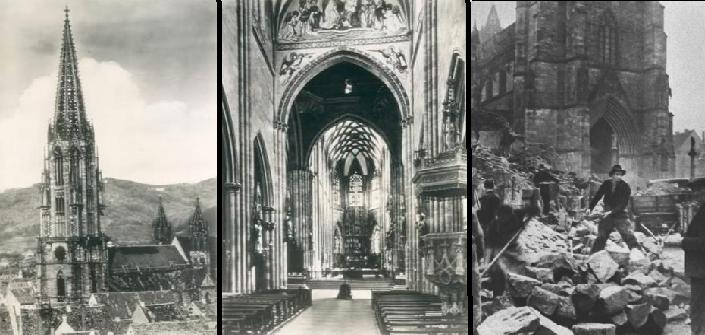
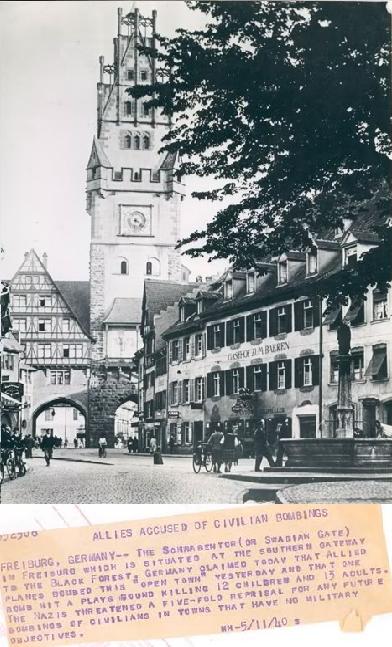
| One of the earliest purely civilian bombing attacks by the British was on the town of Freiburg when in 1940, a playground was bombed, killing 15 adults and 12 children. The British denied it, claiming it was mere propaganda. Wire service photo, below left, click, describes the playground bombing in 1940. The deadliest bombing came later and caused an intense firestorm and utterly savaged the quiet old university town, leaving almost no historical landmarks intact and causing massive civilian loss of life and hideous carnage. Like many cities in Germany it was rebuilt in a grey, drab, "modern" method devoid of aesthetic beauty. The great cathedral, the Münster of Freiburg, was built across a span of several centuries, and exhibited a range of architecture from late Romanesque to Late Gothic and even a tad of Rococo. Its single tower with a lacy spire was the first of its kind. The building remained mostly unchanged since its completion in 1513. Miraculously, unlike so many great cathedrals and churches in Germany, it was not entirely destroyed during the severe Allied bombing of Freiburg and its ensuing firestorm, although the whole area around it was reduced to rubble. Its ancient stained glass windows had fortunately been taken to safety first. Its only remaining original bell, the oldest Angelus bell in Germany, called the Hosannaglocke was cast in 1258 and weighs a hefty 5.5 tons. |
| Freiburg |