| "The Age of Goethe" from 1770 to 1832, describes the time when German culture was respected world wide, with the genius of Goethe at its center surrounded with brilliant fellow writers and poets, folklorists and philologists such as Lessing, Herder, Wieland, Schiller, Kleist, the Schlegels, Hölderlin, Novalis, Tieck, Brentano, Eichendorf, Hoffmann, and the Grimm Brothers with an interaction with the philosophers of German Idealism: Kant, Fichte, Schelling, and Hegel. Simultaneously, German music also reached its new heights with Haydn, Mozart, and Beethoven, followed by Weber, Schubert and Schumann. Schubert set 80 of Goethe's texts to music. Many of these songs have remained among the best loved in the lieder repertory. Johann Wolfgang Goethe was born on August 28, 1749 into a patrician family in Frankfurt am Main. His education there embraced many areas and foreign language, and at the age of eight, Goethe had already acquired some knowledge of Greek, Latin, French and Italian. At 16, he was sent to Leipzig to study law, but spent much of his time writing. In 1770, Goethe went to Strassburg, finished his education and took up his legal career in Frankfurt and Wetzlar. In 1771, Goethe returned to Frankfurt to practice law, but he was soon deep in work on what was to be his first dramatic success, a story of a 16th century robber baron, a popular theme, and its success brought him fame and recognition. Then, he accepted young Prince Karl August's invitation to the court at Weimar in 1775. Goethe was not only a friend and educator of the prince, but assumed the administrative responsibilities for the Duchy of Sachsen-Weimar as well, such as supervising the mining industry. His interest in the natural sciences led to an essay on "Granite" and the discovery of the intermaxillary bone. During this time he still wrote creatively. He had a lifelong devotion to Charlotte von Stein, a lady of the court at Weimar, wife of the master of the horse, thirty-three years of age and the mother of seven. For fifty years they corresponded. His relations with von Stein, though harmless, became every year a bit more risky for their hearts, and it was partly to escape from this influence that Goethe undertook a journey to Italy to "recuperate," and he returned refreshed to Weimar with the dramas of "Iphigenie" and "Egmont," and the unfinished "Tasso" and "Faust." He confined his administrative roles to the arts and sciences and the creation of a national theater, and devoted energy to the study of optics and the "Theory of Colors." He and Schiller became very close friends, and Goethe was inspired to energize his literary output, such as the completion of "Faust I". Together, they produced Germany's finest ballads. Goethe eventually met a pretty young girl named Christiane Vulpius in one of the parks near Rome, and she soon became his common-law wife and the mother of his children. He did not marry her immediately, although he lived with her seventeen years. When the terrors of French occupation made him anxious for his eldest son, they finally wed. She had little education, and he could not take her into high society, but she was a warm and affectionate wife. The writing of his most famous work, Faust, extended over almost his entire literary life and was not finished until he was age 81. Goethe was buried in the grand-ducal vault where the bones of Schiller were also laid. Goethe's birth house was destroyed by British bombing. Among the translators of Goethe into English we find names such as Thomas and Jane Carlyle, Samuel Taylor Coleridge, Sir Walter Scott, Percy Shelley, Henry Wadsworth Longfellow, William Cullen Bryant, John Greenleaf Whittier, Harriet Beecher Stowe and others. By 1912, there existed 2,660 musical compositions for works by Goethe. Franz Schubert excelled with his Goethe Lieder, so did Robert Schumann, Richard Strauss and many others. Beethoven composed the opera "Egmont," Charles Gounod the popular "Margaretha," Hector Berlioz the dramatic legend "La Damnation de Faust," Franz Liszt wrote four "Mephisto Waltzes," and Paul Dukas an orchestral scherzo, "The Sorcerer's Apprentice." |
| Beyond Goethe: Other Treasures for the Young of Heart and Sound of Thumb |
| While Goethe is revered, Frankfurt produced other literary greats. More than one hundred years after 'Der Struwwelpeter' hit the marketplace, psychologists, academicians, writers, scientists and teachers are still in a stew over the still controversial "Slovenly Peter", a boy who had bad manners, and this broth gives intellectuals an excuse for summits, sabbaticals, studies, conferences and grant requests to yak in depth about the effects of simply dispensing with thumbs as a cure for thumbsucking. The gory lessons are simple and honest: if one teases dogs one might get bitten. In 1844, a Frankfurt doctor and lunatic asylum supervisor named Heinrich Hoffman was tired of boring children's books, so composed the book known in English as Slovenly Peter, a collection of "cautionary" tales in verse and picture, as a Christmas gift for his three year old son. Published the following year after encouragement from friends, Der Struwwelpeter was a hit. This energetically illustrated book described horrific things that happen to naughty children: Cruel Frederick is attacked by his own mistreated dog; Pauline plays with matches and burns to death; Conrad the thumb-sucker ends up with his thumbs cut off by the giant sized scissor-man. Even more fun is watching the kid who is a picky eater slowly, but ever so defiantly, waste away into a little stick figure heading off to the wormy, old graveyard. It was grisly, gruesome and so popular that Mark Twain couldn't resist translating it. In 1891 he published Slovenly Peter, thankfully bringing millions more children closer to the mayhem and mutilation contained in the book. |
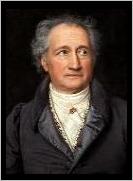
| Johann Wolfgang von Goethe 1749-1832 |