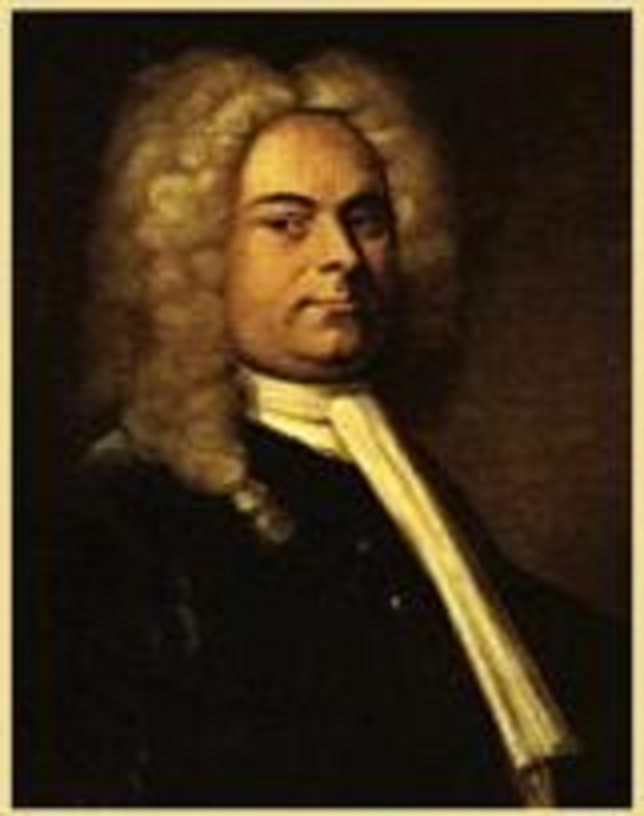
| Georg Friedrich Händel was born in Halle in the same year as Bach. He was appointed violinist- composer for Hamburg's German opera in 1703. In 1706, he travelled to Italy where he met Corelli and the Scarlattis. Upon his return to Germany four years later, he assumed the post of Kapellmeister to the Elector of Hanover, the future King George I of England. Handel moved to London in 1712 where as a chapel master to the Duke of Chandos, he wrote Italian operas. In 1719, Handel returned to his birthplace for eight days in 1719 but a planned meeting between he and Bach mysteriously never took place. Handel became a subject of the British crown in 1727. After suffering a stroke, he wrote oratorios, including "Messiah" in 1741, and Psalms, motets, anthems, passions, cantatas, instrumental chamber works, plus works for keyboard. Handel never married. Upon his death, more than 3,000 mourners attended his funeral, which was given full state honors. He was buried in Westminster Abbey. Ironically, both Handel and Bach were afflicted with cataracts and both courageously underwent a crude surgical treatment at the hands of the same doctor which involved manually shoving the cataract covered lens back into the eyeball without anesthesia to let in a little more light. Handel lived out his life but went completely blind at the end, the last music he ever heard being his own Messiah at his death on April 14, 1759. Bach was not so lucky. He died July 20, 1750 from septicemia induced by the procedure. Eyeballs were not the only thing Bach and Handel had in common. It was approximately 196 walking miles from Salzburg to Nürnberg, and this is the almost the distance young 21 year old Johann Sebastion Bach supposedly walked just to hear the great Dietrich Buxtehude (1637-1707) play the organ at the Marienkirche in Lübeck (later destroyed by Allied bombing). An eighteen year old Handel, the same age as Bach, had visited Buxtehude three years earlier in 1703 to witness his phenomenal keyboard technique. Bach’s four week visit turned into a four month stay. After this encounter, Bach's music, as Handel's, changed dramatically. He had taken the cantata and fugue, and developed them into complex and sublime pieces. In 1723, Bach moved to Leipzig, and during this period, his major works included: St. John Passion, St. Matthew Passion, Suite No. 3 in D, Magnificat in D Major, Christmas Oratorio , Italian Concerto, Goldberg Variations, named after Bach's student Johann Gottlieb Goldberg), The Well-Tempered Clavier, the Musical Offering, and The Art of the Fugue. |
| THE CITY OF HANDEL’S YOUTH from 'Zigzag Journeys in Northern Lands' by Hezekiah Butterworth; Boston 1884 The composer of the “Messiah,” George Frederick Handel, was born at Halle, Germany, Feb. 23, 1685. He sang before he could talk plainly. His father, a physician, was alarmed, for he had a poor opinion of music and musicians. As the child grew, nature asserted that he would be a musician; the father declared he should be a lawyer. Little George was kept from the public school, because the gamut was there taught. He might go to no place where music would be heard, and no musical instrument was permitted in the house. But nature, aided by the wiser mother, triumphed. In those days musical nuns played upon a dumb spinet, that they might not disturb the quiet of their convents. It was a sort of piano, and the strings were muffled with cloth. One of these spinets was smuggled into the garret of Dr. Handel’s house. At night, George would steal up to the attic and practise upon it. But not a tinkle could the watchful father hear. Before the child was seven years of age he had taught himself to play upon the dumb instrument. One day Dr. Handel started to visit a son in the service of a German duke. George begged to go, as he wished to hear the organ in the duke’s chapel. But not until he ran after the coach did the father consent. They arrived at the palace as a chapel service was going on. The boy stole away to the organ-loft, and, after service, began playing. The duke, recognizing that it was not his organist’s style, sent a servant to learn who was playing. The man returned with the trembling boy. Dr. Handel was both amazed and enraged. But the duke, patting the child on the head, drew out his story. “You are stifling a genius,” he said to the angry father; “this boy must not be snubbed.” The doctor, more subservient to a prince than to nature, consented that his son should study music. Extensive landscaped gardens with a lake and statuary SANS-SOUCI. During three years the boy studied with Zachau, the organist of the Halle Cathedral. They were years of hard work. One day his teacher said to George, “I can teach you no longer; you already know more than I do. You must go and study in Berlin.” Berlin was at once attracted to the youthful musician by his playing on the harpsichord and the organ. But the death of his father compelled him to earn his daily bread. Willing to descend, that he might rise, he became a violin player of minor parts at the Hamburg Opera House. The homage he had received prompted his vanity to create a surprise. He played badly, and acted as a verdant youth. The members of the orchestra sneeringly informed him that he would never earn his salt. Handel, however, waited his opportunity. One day the harpsichordist, the principal person in the orchestra, was absent. The band, thinking it would be a good joke, persuaded Handel to take his place. Laying aside his violin, he seated himself at the harpsichord, amid the smiles of the musicians. As he touched the keys the smiles gave place to looks of wonder. He played on, and the whole orchestra broke into loud applause. From that day until he left Hamburg, the youth of nineteen led the band. Handel’s extraordinary skill as a performer was not wholly due to genius. He practised incessantly, so that every key of his harpsichord was hollowed like a spoon. Handel’s greatest triumphs, as a composer, were won in England. But the music-loving Irish of Dublin had the honor of first welcoming his masterpiece, the “Messiah.” Such was the enthusiasm it created that ladies left their hoops at home, in order to get one hundred more listeners into the room. A German poet calls the “Messiah” “a Christian epic in musical sounds.” The expression is a felicitous description of its theme and style. It celebrates the grandest of events with the sublimest strains that music may utter. The great composer commanded, and all the powers of music hastened with song and instrument to praise the life, death, and triumph of the Christ. No human composition ever voiced, in poetry or prose or music, such a masterly conception of the Virgin’s Son as that uttered by this magnificent oratorio. The sacred Scriptures furnish the words. The seer’s prophecies, the Psalmist’s strains, the evangelist’ s narrative, the angels’ song, the anthem of the redeemed, are transferred to aria, recitative, and chorus. The sentiment is as majestic as the music is grand. He who sought out the fitting words had studied his Bible, and he who joined to them musical sounds dwelt in the region of the sublime. All the emotions are touched by the oratorio. Words and music quiver with fear, utter sorrow, plead with pathos, or exult in the joy of triumph. A symphony so paints a pastoral scene that the shepherds of Bethlehem are seen watching their flocks. One air, “He was despised,” suggests that its birth was amid tears. It was; for Handel sobbed aloud while composing it. It is the threnody of the oratorio. The grandeur of the “Messiah” finds its highest expression in the “Hallelujah Chorus.” “I did think,” said Handel, describing, in imperfect English, his thought at the moment of composition,—“I did think I did see all heaven before me, and the great God himself.” When the oratorio was first performed in London, the audience were transported at the words, “The Lord God omnipotent reigneth.” They all, with George II., who happened to be present, started to their feet and remained standing until the chorus was ended. This act of homage has become the custom with all English-speaking audiences. “You have given the audience an excellent entertainment,” said a patronizing nobleman to Handel, at the close of the first performance of the “Messiah” in London. “My lord,” replied the grand old composer, with dignity, “I should be very sorry if I only entertained them; I wish to make them better.” A few years before his death Handel was smitten with blindness. He continued, however, to preside at his oratorios, being led by a lad to the organ, which, as leader, he played. One day, while conducting his oratorio of “Samson,” the old man turned pale and trembled with emotion, as the bass sung the blind giant’s lament: “Total eclipse! no sun, no moon!” As the audience saw the sightless eyes turned towards them, they were affected to tears. Seized by a mortal illness, Handel expressed a wish that he might die on Good Friday, “in hope of meeting his good God, his sweet Lord and Saviour, on the day of his resurrection.” This consolation, it seems, was not denied him. For on his monument, standing in the Poets’ Corner of Westminster Abbey, is inscribed: “Died on Good Friday, April 14, 1759.” |
| Georg Friedrich Händel |