| The Physical and Cultural Destruction of Germany: Introduction |
| To understand World War Two, it is imperative to understand World War One, for the second conflict was a tragic continuation of the first. It would be a good idea to read "Anti-German Hysteria of World War One", available from a link on the main page of this site before going any further. One must look beyond the propaganda, the Hollywood images and comic book presentations of either war to comprehend how and why the utter ruination of this ancient land with its historically profound influence on European culture occurred, and how a rich, powerful nation which enjoyed a positive, even glowing image at the dawn of the twentieth century would be cut off at the knees and relegated to a stature of relative unimportance today. Contrary to popular fiction, long before Germany became a nation, even before the dark ages, she had a more peaceful, less aggressive history than her European neighbors and was the principal participant in less than a quarter of the wars of England, Spain, Russia or France. Germany, furthermore, did not impose brutal colonial rule on anywhere near the scale of other European nations, most notably Britain, who at one point held a quarter of the globe under her thumb. By 1914, the young German nation had enjoyed 43 years of peace and prosperity while other European nations were embroiled in or starting various global conflicts (which in some cases are still ongoing). In the nearly 300 wars between the year 1800 and the years directly following World War Two, Prussia/Germany participated in only 8 %, as did Holland. In contrast, Britain participated in 28 %, France in 26 %, Russia in 22 %, Turkey in 15 %, Poland in 11 % and Sweden in 9 %. At the dawn of the 20th century, the German Empire was well-respected around the world, having achieved astonishing technical advances: one third of all Nobel Prizes were going to German researchers and inventors, she had a superb educational system and rapidly growing industries, and she was the most powerful industrial nation in the world after America. She had also surpassed Britain's economic growth rate and boasted the most efficient army in the world, the second largest navy and a fledgling Army Air Service. This all changed almost overnight. The violent anti-German assault was initiated by propagandists representing special interests in Great Britain a decade before World War One even broke out, and then regurgitated to embroil the USA into that conflict. It changed the image of Germany forever. A pariah was formed in the shape of the loathsome Hun and the zealous efforts to reinforce that image in words, music and art continued long after the war was over, branding Germany and her people absolutely repugnant in almost every corner of the world. Probably no other ethnic group had ever been so quickly, so professionally and so intensely assaulted and dehumanized, as zealous British propagandist Rudyard Kipling summed up on June 22, 1915: "However the world pretends to divide itself, there are only two divisions in the world today: human beings and Germans." World War One, the cultural equivalent of the Black Death to Germany, killed the seed of a whole generation. The vindictive Treaty of Versailles burdened Germany with reparations she could never repay without exposing her own people to even more suffering and death. The spitefulness, greedy motives and shortsightedness of the "peace" terms would have terrible effects in the near future. In their quest to weaken German and Austrian power for their own monetary gain, the victors directly and indirectly abetted the virulent rise of communism which would sweep in and try to take the place of the four world Empires which had been destroyed in the aftermath of this needless conflict. Germany lost 74.5% loss of her natural resources, about 13% of her land and had to forsake seven million of her people, including three million Germans in the Sudetenland. The Austrian portion of the Dual Monarchy was deprived of 3/4 of her former area and 3/4 of her people, dooming her to become an insignificant, land-locked state. In their place, the victors at Versailles created a flock of tiny, budding, nationalistic states ensured to cause future strife in Europe. 2,000,000 German soldiers were killed in the First World War, 100,000 others were missing and presumed dead and 4,814,557 had been wounded, amounting to 9 to 14 percent of Germany's pre-war population. 85% of eligible German males had been mobilized at one point or another. In the conflict, millions of others died due to starvation from Britain's inhumane hunger blockade which remained in effect even after war's end to further punish Germany. Influenza and other epidemics easily swept in and took their toll as well. The war changed German society forever. One-armed, one-legged, one-eyed and no-eyed men, men with noses or mouths torn off, and men with only half a face stood begging for food. They'd come home with indelible mental scars as well, some suffering shell shock or the insidious battle fatigue called "the shivers". Many lost homes as a result of the German land theft at Versailles while others lost their families. Yet, these veterans received little respect or gratitude for their sacrifices, and their suffering went uncomforted. Soon, communist, anarchist and socialist agitators eagerly exploited the chaos of a Germany in ruin. The First World War left a legacy not only of bitterness, but of unresolved issues and unfinished business. For Germany, there was simmering resentment at the humiliation imposed upon her and for that which had been unfairly taken from her. Beyond all this, there was overwhelming injustice in the fact that she had been held solely responsible for the entire conflict and was therefore made to suffer twice: from the toll of war itself and, while she was writhing in agony, from the vengefulness and avarice of the victors who had been just as responsible for the war, if not more so, as Germany. By the end of World War Two, the destruction of Germany was nearly complete. Germany not only lost the War, it lost a massive portion of its physical history, its cultural centers and its intellectual elite. Millions more of her people were lost, both during and after the war: five times as many Germans, both civilians and soldiers, died in the first year after war than died during the course of the entire war, and they lost their lives directly at the hands of others as a result of revenge policies: rape, expulsion, murder, forced "atonement" marches, freezing, slave labor and starvation; Millions more were left with lasting physical damage from the shocking post war brutality visited upon them. It was amid millions of dazed, homeless people and upon the ruins of hundreds of medieval cities, murdered German prisoners of war, raped German women, starving German children and wandering orphans that the victors performed the coup de grâce: Following unconditional capitulation, Germany was immediately partitioned into four isolated occupation zones, further intensifying its incapacitation and readying it for a controversial, methodically developed, sharply focused and skillfully applied program of psychological assault innocuously labelled "re-education". This mass brain-washing program was geared to enforce the rejection of everything that had thus far constituted the national German identity as well as any pride in German cultural, intellectual or spiritual heritage. This intense campaign structured a "new Germany" to have purely "American values" and it allowed to Germany only a history which began in 1945 with her defeat, relegating all which had come before as unworthy of remembrance. This program, so psychologically ruthless that it did not allow people to grieve their own losses or honor their fallen, was so successful that nearly seventy years later, words such as "Vaterland" or "Volk" remain "dirty words" to the modern German who has been convinced that Germany was actually "liberated" in 1945 by those very forces who worked for nothing less than her total destruction. "Re-education" was applied with severity to captive Austria as well, in hopes that the two neighbors linked by their long mutual history would never again join forces. Before 1945, almost all Austrians regarded themselves as "German" by virtue of a common bond of blood, culture and history. According to polls today, less than 10% of modern Austrians consider themselves German. It does not disturb the modern German that his homeland was bombed into rubble, that millions of surrendered German prisoners of war were murdered through intentional neglect, that millions of refugees were created and then abused as they attempted to flee violent, rampaging, communist hordes who stole their homes and raped their grandmothers, that one third of her ancestral territory and her Eastern provinces were ripped from her, and that her private and public property, art treasures, historical monuments, cultural institutions and patents were brazenly plundered. It makes them uncomfortable to realize that their families, as civilians, were intentionally burned alive in violent, unnecessary residential fire bombings, or fiendishly drowned by the thousands when dams were calculatingly destroyed, or purposely shot at when they were running for their lives. They have been so deeply shamed that they have allowed collective guilt to be bestowed upon themselves and their children and their grandchildren, accepting their nation's future as one clad in a hair shirt of perpetual atonement for actions they had nothing to do with! The attack on German culture itself, which began in World War One with the manufacturing of the loathsome Hun, was reincarnated by the post-World War Two Allied "re-education" teams, and the apelike 1917 Hun with "Kultur" emblazoned on his bloody club was regurgitated to war weary, emotionally vulnerable German civilians in 1945 on posters the American military put up all over Germany attacking "Kulture" as the root of all evil. The push was to create the self-hating German. Is it any wonder we have to watch the disgusting spectacle of German self-hatred evince itself in song parodies and silly art work which degrade its historical figures, or her politicians falling over themselves to see who can utter the most apologies? In the utter absence of national pride, there is fervent persecution of any who dare challenge this abysmal, degenerate, masochistic trend. Germany's birthrate is at its lowest level in history and the lowest in Europe. On a global scale, it is just as dire. Of 27 countries with populations in excess of 40 million, Germany ranks second from bottom in terms of children under 15 as a percentage of the overall population. In 2009, 651,000 babies were born in Germany, 30,000 less than the previous year. With only 8.2 children being born for every 1,000 citizens, and with 10 in 1,000 citizens dying every year, Germany is nowhere near approaching a replacement rate that would keep the population stable. The birthrate is exceptionally low in former East Germany, where the city of Chemnitz is thought to have the lowest birth rate in the world today. Austria is not faring much better. The Allied foreign policy crusade was for victory at any cost, even at the cost of destroying its own traditional values and culture and, if need be, destroying the planet itself. Yet, it is becoming increasingly more difficult to question the necessity and wisdom of that conflict. Indeed, the event we call World War Two is fast becoming off limits to further debate, closer scrutiny or re-evaluation, and the very word "revision" has been demonized rather than welcomed as part of those stimulating intellectual activities which have traditionally taken place after every other conflict in human history. The effort to search for truth and accurately define human events for posterity, although occasionally uncomfortable and inconvenient, have been narrowed in scope in regards to this conflict. In a good part of the world, legislation restricts free speech by limiting discussion of this major historical event to the official or "acceptable" version and anything beyond that is potentially criminal to discuss and punishable by prison, surely not a trend indicative of the cherished "democratic values" the victors supposedly intended. |
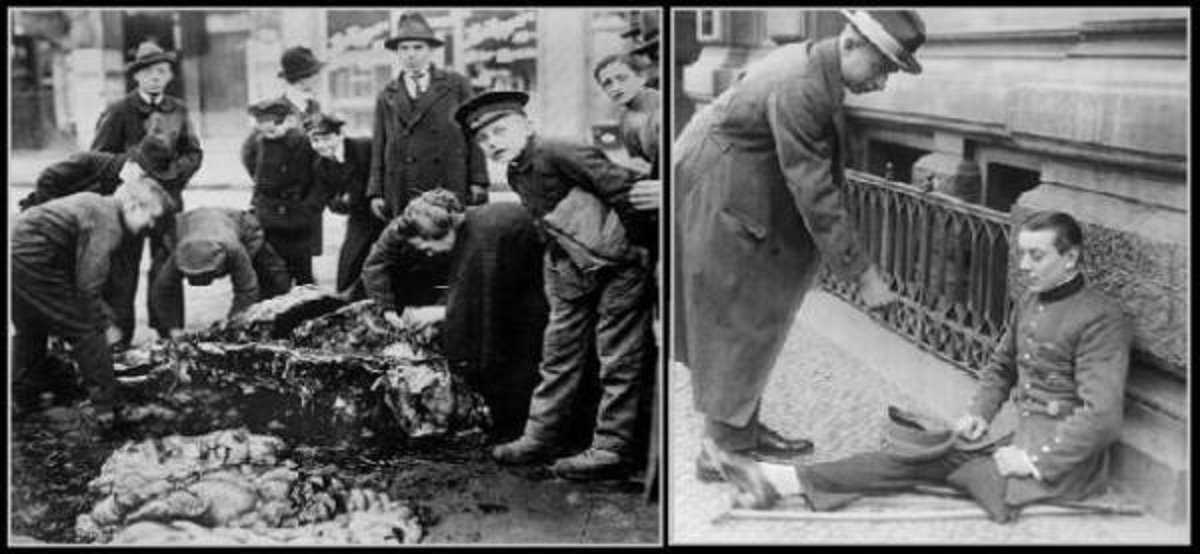
| In the aftermath of the First World War, starving German civilians carve meat from a dead horse and a crippled, decorated veteran is forced to beg (click) |
| Tears of the Fatherland by Andreas Gryphius (1616-1664) Full now, yea, more than full, behold our devastation: The frantic drum beat, and the brazen horde, The thundering siege gun, and the blood-slick sword Devour all diligence, and sweat, and careful preparation. The church is overthrown; our mighty men are slain; The town hall lies in dust; our towers burn; Virgins are raped; and everywhere we turn Are fire, plague, and death to pierce us, heart and brain. Down walls and through the town runs always fresh-spilled blood For eighteen summers now, our river's yearly flood Near-choked with corpses, has pushed slowly, slowly on But nothing will I say of one thing worse, I know, Than death, more grim than plague, or fire, or hunger's woe: Those pillaged souls from whom even hope of heaven is gone. |