| A Noble Horses of the old Kingdom |
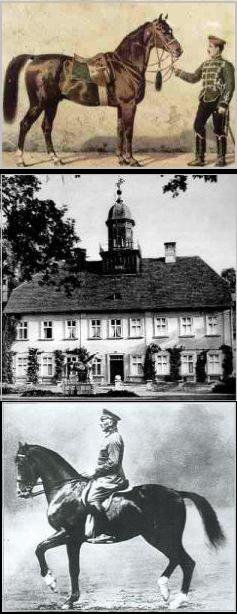
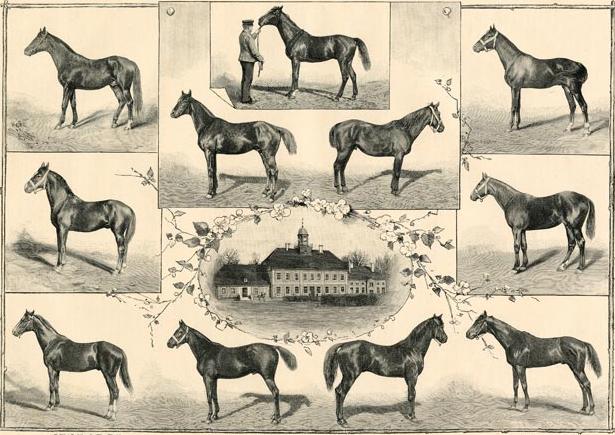
| The Trakehner is one of Germany's oldest warmblood breeds. The Teutonic Knights discovered a small, primitive horse, the Schwaikenpferd, native to the Baltic area around East Prussia in the 13th Century and used it to breed military horses. Later, farmers used the horses for light work. Friedrich Wilhelm I of Prussia, needing a faster, sounder horse, established the breed for his soldiers in 1732. War tactics had changed and a lighter horse with more endurance and speed was required rather than the heavier horses previously needed to carry armor and haul heavy equipment. He chose the best horses from seven of his royal breeding farms, and established a stud farm in East Prussian at Trakehnen and had his soldiers clear the forest between Stallupönen and Gumbinnen. In 1739, the king gave the stud farms to his son, the future Friedrich the Great. The results were very successful and the best quality, the Trakehners, were reserved for his army, and the average horses which were sometimes bred with everyday East Prussians local horses were sold as riding horses. It became state property after his death and was named the Königlich Preußisches Hauptgestüt Trakehnen. Between 1817 and 1837, Arabian, Turkish, and Thoroughbred blood was added to the Schwaike mares. The Trakehner evolved into an outstanding, beautiful and respected horse the world over. By 1918, 60,000 mares were bred to East Prussian stallions each year. After the Treaty of Versailles limited Germany's army to 100,000, the horses were again reduced to farm work and heavier reinforcement sires were used to make the horses stronger. In the 1920s and 1930s the breed was improved and it won medals in various steeplechases as well as in two Olympics. By the 1930s, there were more than 10,000 breeders and 18,000 registered mares. Alas, fate would deal as fatal a blow to the magnificent Trakehner horse breed as it did to the East Prussian people in the desperate, terrible flight out of East Prussia at the end of World War Two. The orders came at the very end of the war, as the Red Army was closing in fast, to evacuate the horses from the Trakehnen stud farm. Click to enlarge picture below |
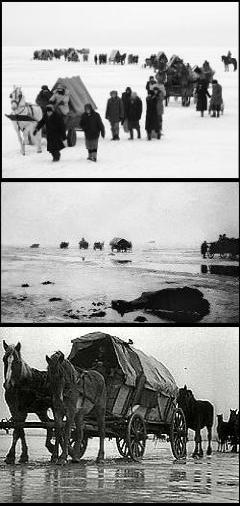
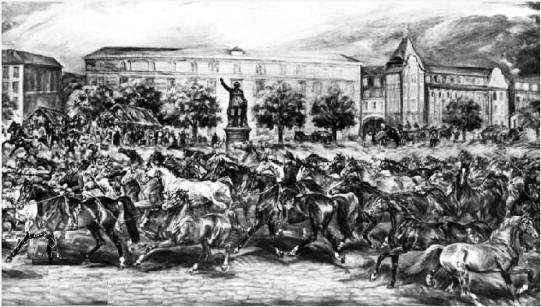
| The rescue of about 800 of the best horses was attempted, and after being hand selected by their heart-broken owners and breeders, the horses were desperately sped out of East Prussia by train and on foot. Above: The horrible sight on October 17, 1944 as Trakehners in flight from East Prussia run past the Soldier King's Monument in Gumbinnen. Photgraph from a painting by Carl Engel. Sadly, most of the horses, together with their documentation, fell into the hands of the occupation forces and were shipped to Russia, to be lost forever. The private owners and breeders, also fleeing for their lives, hitched their heavy wagons to another 800 or so of these noble horses, and headed west in the infamous "Trek'' during brutal winter weather. Others were simply set free. Many of the horses were pregnant. For two and one half months on the horrible, frantic 600 mile flight, the horses' feed ran out and many mares lost their foals, became ill or went lame. Many perished along with the refugees when they slid into a watery grave in the frozen Baltic and others were gunned down along with their owners by the Soviets circling overhead. Witnesses encountered many of the noble horses dead along the route, shot to death and flattened by Russian tanks. At the end, many beautiful horses were eaten by starving refugees, forced into heavy labor hauling rubble or put to use as taxi drivers due to the severe fuel shortages, all uses they were never intended for. By the time they reached the West, only about 100 of the Trek horses had survived and they were in horrible condition. Others had spread out all over Germany, but only a few hundred of the original 80,000 Trakehners in East Prussia survived. However, these few tough, strong surviving horses became the founders of today's hardy Trakehner horse breed. The last original Trakehner was Keith, born there in 1944 and died in November, 1976. A very dedicated Dr. Fritz Schilke of the East Prussian Stud Book Society attempted the difficult task of locating all of the East Prussian horses that had made it to the West, and in 1947, the West German "Trakehner Verband" was established with a Trakehner Stud Book that continued to document the breed. Later, unlike other German breeds, the Trakehner had no mother state and could not depend on government funding. Therefore, re-establishment of the breed originally depended on the determination of its members and the generosity of others. At the time, many Trakehnen horses could be identified only by the Ostpreußische Elchschaufel, the East-Prussian moose horn branding of a single moose antler brand on their right hip or by the double moose antlers on their left hip. Today, all Trakehner breeding stock has to undergo rigorous grading methods to maintain the high standards. |
| THE TRAKEHNER HORSE OF EAST PRUSSIA |