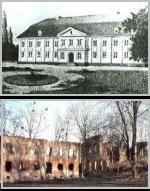
| Two years later, after finishing his swan-song, the epic "Lucius," he died. There is hardly another German poet who found so many composers for his songs. Above: Schloss Lubowitz then and now. It is difficult to fathom that there would come a day when simply singing one of his German Silesian folksongs could incur an automatic death sentence, or that lovely Schloss Lubowitz and the original Eichendorff monument would be crudely levelled. The town is Polish now, its German citizens expelled in 1945 by gunpoint, their homes and properties stolen. German inscriptions on old gravestones were defaced to further obliterate the memory of their centuries long presence. |

| "The last champion of romanticism" was a nobleman born on March 10, 1788, in the Upper-Silesian castle of Lubowitz near Ratibor. Duke Eichendorff [Joseph Freiherr von Eichendorff] matriculated at the University of Halle and became a follower of the Romantic School of poetry. His first poems were printed in Berlin, among them the famous song 'In einem kühlen Grunde'. The young baron fought against Napoleon, married and became a lawyer in Breslau. |
| In 1820, he received an educational position at Danzig and took a lively interest in the restoration of the Marienburg, a castle of the Teutonic Order and inspiration for his tragedy "Der letzte Held von Marienburg." His most popular production was "Aus dem Leben eines Taugenichts." In 1831, Catholic Eichendorff was called to Berlin as councillor in the high office of the ministry of public worship. The following years were spent mostly in Berlin, where Eichendorff devoted his genius to the history of literature, and he wrote a definitive history of the poetical literature of Germany. After the death of his wife in 1855, he lived with his family at Neisse. His ruined estate, above |
| Joseph Freiherr von Eichendorff - A Song To Die For |