| Churchill proposed the genocidal plan adopted at the 1945 Potsdam Conference for putting Poland "on wheels" and "rolling it westward" into German lands. As a result of his final solution to the "German problem", millions of Poles were displaced from territories granted to the USSR and even more millions of Germans were expelled from lands they had inhabited since the 13th century. |
| Silesian Germans, some of whom had roots in Silesia going back centuries, and who before World War II amounted to about 4 million, were collectively labelled "German partisans" and either fled or were murdered, put in camps, sent to the Gulags or expelled. Often, the men would be rounded up from the villages and camps and marched a short distance away, shot and buried in mass graves. Under the terms of the agreements at the Yalta Conference of 1944 and the Potsdam Agreement of 1945, German Silesia east of the rivers Oder and Lusatian Neisse was transferred to Poland. Poles from lands stolen by Stalin were trucked in and resettled there before the blood had even dried. The Germans were sometimes ordered to not only leave all of their possessions behind, they were ordered to leave the beds made with clean linen. It was efficient, well-planned and organized. |
| It was not just adults who were expelled from their homes. Children became adults overnight when suddenly orphaned or when separated from their parents, and they had to face the hard and dangerous treks alone, at the mercy of the elements and vicious predators. The violence used to obliterate the ethnic memory of Germans was degrading and often fatal. |
| Stolen Heritage: German Silesia |
| With German defeat in 1945, all of Silesia was suddenly occupied by the Soviet Red Army who, following their violent pattern, embarked upon another horrendous spree of rape. In one instance, 182 Catholic nuns were raped in Neisse and in the diocese of Kattowitz, they left behind 66 pregnant nuns. Even small children were not spared the horrors of violent sexual assault, and little girls were being attacked as often as their mothers. Boys who tried to protect their mothers and sisters were shot, as were many of the victims afterward. |
| Reduced to slaves by their new masters, Germans were forced to make public apologies for their "collective guilt" at social and governmental gatherings. Others were sent to camps with unbearable conditions. Of 8,064 Germans in Camp Lamsdorf in Upper Silesia, 6,488, including hundreds of children, died from starvation, disease, hard labor, and physical maltreatment including torture. This repeated itself by the thousands. Illness brought on by bad water, starvation, exposure and even poisoning was rampant and suicides epidemic. Five times as many Germans died in the first year after the War's end as died during five of the War itself. |
| “. . . In unending succession were girls, women and nuns violated. . . Not merely in secret, in hidden corners, but in the sight of everybody, even in churches, in the streets and in public places were nuns, women and even eight-year-old girls attacked again and again. Mothers were violated before the eyes of their children; girls in the presence of their brothers; nuns, in the sight of pupils, were outraged again and again to their very death and even as corpses . . . ” Mississippi Senator Eastland quoting from a letter smuggled out of Breslau September, 1945 |
| In the parts of Germany taken for Poland in 1945, the entire ethnic German population was either murdered, expelled or faced severe reprisals at war's end. As cited elsewhere, in East Prussia and Pomerania, from Danzig to Stettin to Elbing and to all of the old Baltic German cities, catastrophic Allied bombing was followed by Red Terror. The few surviving Germans in these areas were placed before violent Communist led "verification" committees who decided their fate. Their language and civil rights were immediately suspended. Thousands died trying to flee. Slave labor camps in Poland included, among those run by the infamously sadistic Salomon Morel and Czesław Gęborski, the Central Labour Camp Jaworzno, Central Labour Camp Potulice, Łambinowice, Zgoda labour camp and others. Aside from being thrown into one of these 1,255 "labor" camps under Polish administration in early 1945, it was estimated that about 165,000 Germans were deported to slave labor in the Soviet Union from the German territories annexed de-facto by Poland. |
| It is interesting to note that not all Germans were expelled: in the Opole/Oppeln region in Upper Silesia. Some German miners and their families were "allowed" to stay, but their culture was repressed and they were virtual slaves. German language remained forbidden for the next forty years.Forced out at gunpoint, old and young, rich and poor had to leave their family homes behind furnished and unlocked for the new inhabitants. The Oder-Neisse as the border of a new postwar Germany was deceptively described as "tentative" until a final peace settlement with Germany. The issue was not laid to rest by Germany until it was forced to sign it as the high price for German reunification: some or nothing at all. |
1.On July 14, 1945 from 6 to 9 oclock resettlement of the German population will take place.
2.The German population will be resettled to an area west of the river Neisse.
3.Each German is allowed to take 20kg of luggage with him at the most.
4.No means of transportation (wagons, oxen, horses, cows etc) is permitted.
5.The total of the living and dead inventory in an undamaged state remains the property of Poland.
6.The last resettlement deadline will terminate on the 14th of July at 10 o’clock.
7.Noncompliance with this order will be punished severely, including the use of weapons.
8.Sabotage and looting will also be prevented by the use of weapons.
9.Assembly point on the street station Bad Salzbrunn Adelsbacher Weg in a four person
marching column. The head of the column is to be 20 meters before the village of Adelsbach.
10.Those Germans who have a certified none evacuation order, are not permitted to leave their
dwelling with their family members from 5 o’clock to 14:00.
11.All dwellings in the city must remain open; all apartment and house keys must be left outside.
2.The German population will be resettled to an area west of the river Neisse.
3.Each German is allowed to take 20kg of luggage with him at the most.
4.No means of transportation (wagons, oxen, horses, cows etc) is permitted.
5.The total of the living and dead inventory in an undamaged state remains the property of Poland.
6.The last resettlement deadline will terminate on the 14th of July at 10 o’clock.
7.Noncompliance with this order will be punished severely, including the use of weapons.
8.Sabotage and looting will also be prevented by the use of weapons.
9.Assembly point on the street station Bad Salzbrunn Adelsbacher Weg in a four person
marching column. The head of the column is to be 20 meters before the village of Adelsbach.
10.Those Germans who have a certified none evacuation order, are not permitted to leave their
dwelling with their family members from 5 o’clock to 14:00.
11.All dwellings in the city must remain open; all apartment and house keys must be left outside.
| Although the city was only bombed once, massive destruction took place in the aftermath. Breslau was largely destroyed. The medieval parts of the city and almost all historical landmarks were gutted. The buildings that escaped bomb damage were burned and looted by the Soviets. It was said there was a murdered, disfigured or disemboweled German hung on every lamp post in the city. |
| The 40,000 survivors of the German garrison who surrendered were executed, thrown into mass graves or taken to the Gulag, from which few returned. Over 30,000 more civilians would die, most from homicide, but there were also about 3,000 suicides. The Red Army went house to house and block to block embarking on vicious rape and slaughter. For 77 days, the carnage and mayhem lasted, the Soviets murdering and burning people alive. Thousands of Breslauers lay dead in the ruins, and the city was almost 70% destroyed. Like most of Silesia, Breslau was placed under Polish administration. Most surviving German inhabitants were expelled and all German property was taken. By the 1950s, Breslau had been cleansed of most of its dried blood as well as remaining Germans and the real history of the city. Renamed "Wrocław", it was resettled with Poles. |
| The entire youth of Germany, boys of 14 to 17 years, and the Volkstrum, consisting of old men, were all the defense that was left during these last days of war. These pitiful troops were all that stood between Germany and Armageddon. Over a thousand of these boys arrived to defend Breslau where they awaited the Russian onslaught. Many of the youngest boys killed themselves out of sheer terror while others fought on desperately for days until the city finally fell on May 6, 1945. |
| Thousands of Breslau civilians had waited to evacuate the city when they heard news of the Soviet advance on January 14, 1945.They could not evacuate until 6 days later because of rail damage and battles. In panic and desperation, 50,000 to 60,000 left on foot, mostly women and children, in bitter winter weather. In the process, some 18,000 frozen bodies were recovered along their trails and 70 children were crushed to death under wagon wheels. 90,000 Breslauers are thought to have died in the trek. Partly because they realized the hopelessness of evacuating, another 200,000 or so civilians remained in the inner city, and by February 15, the Soviet noose tightened around them. Breslau was the last major city in eastern Germany to fall on May 7, 1945. |
| Gerhart Hauptmann's birthplace was a resort town in Silesia named Bad Salzbrunn. Fortunately for him, he died long before 1945 when he would have joined the millions of other Germans cast from their homes forever. An order of expulsion was placed upon the expellees by Communist Section Commander Major Zinkowski: |
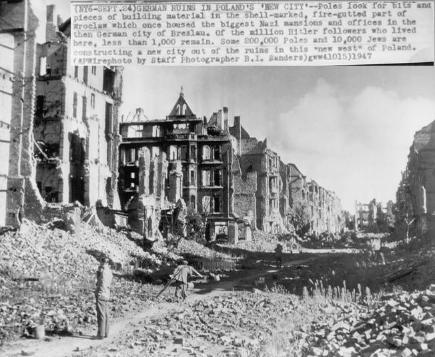
| The US media in the wire photo, right, describes the murdered and displaced German civilians collectively as "nazi followers". |