| Down in the Valley: Silesian Castles in Hirschberger Tal |
| German Silesia was full of enchanting castles, but one area had an especially rich abundance. The Hirschberger Tal (valley) in formerly German Silesia was cleared of forests by German colonists beginning in the late 13th century, and several villages and towns were established. During that time, the family of Schaffgotsch, who later owned the entire valley until their expulsion in 1945, also appeared for the first time in the region. In the middle of the 15th century, Silesian ruler Matthias Corvinus destroyed all Silesian castles, but from the Renaissance and Baroque era, the landscape of Hirschberger Tal in Silesia attracted the Prussian high nobility who built magnificent palaces, manors, parks and splendid estates. The stately homes turned the valley into an important garden landscapes in Middle Europe. At the end of the 18th century, artists and travellers discovered the valley. At Bad Warmbrunn (now "Cieplice Śląskie-Zdrój") there was the first touristic center. By the late eighteenth and early nineteenth century, better roads invited more tourists and several stately inns turned the area into an ideal and beautiful retreat. |
| At the end of World War II, Silesia was taken by the communist Red Army and this magnificent valley with all of its treasures was given away to communist Poland. The German cultural heritage of the area was thrown out and its local history was rewritten to exclude mention of the centuries old German presence and ownership. Important churches, castles, palaces and manors were neglected and vandalized, their art and antique collections either looted, destroyed or spread all over Poland. |
| Today many private and governmental initiatives as well as German expellee organisations and family members of former owners work together to revitalize the area. Probably this is one of the most exquisite natural landscapes on earth, and German families in the valley had been present for 700 or more centuries. |
| Erdmannsdorf palace (now "Mysłakowice") was mentioned for the first time in 1305. Until the 16th century it was owned by the families of Zedlitz, Stange and Reibnitz. The core of todays building issueed from the 18th century when Maximilian Leopold von Reibnitz expanded it to a Baroque palace. Later it was owned by the family von Richthofen and military genius August Neidhardt von Gneisenau who expanded it in neo-classical style. After his death Friedrich Wilhelm III of Prussia bought the palace and appointed Schinkel and Lenné to remodel palace and the park, which became one of the most beautiful landscape gardens in Silesia. In 1837, Frederick William III left large parts of his estate to religious refugees from Tyrol, who built picturesque Alpine styled houses. |
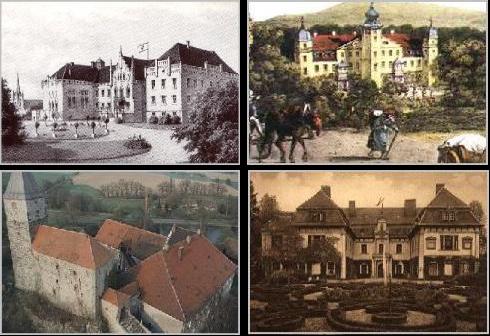
| In 1822, Wilhelm, brother of the Prussian king, was actually the first Hohenzollern prince who took his summer residence in the Hirschberg valley at Fischbach (now "Karpniki). Schloss Fischbach is one of the best known palaces in the valley. It was first mentioned in 1364 as a moated castle and was expanded in the 15th century. Initially owned by the families Predel and Reichenbach, it was bought by Hans I. Schoff in 1476, who enlarged the castle with a two story mansion. After a fire in 1593, the building was again expanded with two new wings in Renaissance style. Beginning from 1844, it was reconstructed in neo-Gothic style according to plans in part by the prince himself. Wilhelm and his successors also equipped the palace with a remarkable art collection of medieval glass paintings and far eastern objects of art. At the end of World War II, it was used as a depository for important Silesian art treasures and German national library. |
| Buchwald (now "Bukowiec" palace) was formerly owned by Countess von Reden, is now an academy with a park. "Buchwald is what in England is commonly called an ornamented farm, and the grounds are out altogether in the English taste. Nature is indeed here so extremely beautiful of herself that she will condescend to receive very little decoration from human ingenuity. Here are lawns and grottoes and cascades and running streams and parks which scarcely require anything more than enclosure to make English gardens." John Quincy Adams |
| Berthelsdorf (now "Barcinek" palace), the home of the historic Count Nicolaus Ludwig Zinsendorf, has also been neglected. The castle and the near-by church became the spiritual center of the Moravian Pietists. It was also from Berthelsdorf that many instructions were issued to missionaries world-wide from members of the Moravian mission board. This religious site, so closely associated with a faith which is globally recognized, and very historically important, has gone to ruin. |
| Schloss Plagwitz ("Plakowice") Schloss Lähn am Bober ("Wleń") Schloss Lehnhaus ("Wleński Gródek") Schloss Waltersdorf am Bober ("Nielestno") Schloss Langenau ("Czernica") Schloss Matzdorf ("Maciejowiec" ) Schloss Paulinum in Hirschberg Schloss Schwarzbach ("Czarne") Schloss Lomnitz ("Łomnica") Schloss Arnsdorf ("Milków") |
| Schloss Jannowitz /("Janowice") Schloss Kammerswaldau ("Komarno") (Wasserschloss) Schloss Neuhof ("Kowary") Schloss Ruhberg (") (Palais Radziwill) Schloss Stonsdorf "Staniszów" Schloss Hermsdorf ("Sobieszów") (Schloss von Schaffgotsch) Schloss Wernersdorf ("Pakoszów") Bad Warmbrunn Palais Schaffgotsch |
| Bad Warmbrunn (now "Cieplice Sląski Zdrój" palace) was the palace of the Count of Schaffgotsch. Kynast (Polish: Chojnik), built ca. 292, Schaffgotsch family seat after 1360 |
| After Friedrich Wilhelm's death, his successor, Friedrich Wilhelm IV of Prussia, reconvert the palace to plans by Friedrich August Stüler in neo-Gothic style. Until 1909, the stately home continued to be the summer residence of the Prussians kings and German emperors. After Word War II, all Germans were either murdered or expelled by the Red Army, who looted and occupied the palace. Since 1951, the communist Polish state used it as a school and largely destroyed the interior. Today parts of the exterior are renovated and most of the park is preserved, even though some important viewshafts are overgrown. |
| After the war, Russian and Polish soldiers plundered the castle, which was given to communist Poland. In the following years the palace was used as a school and a mental hospital. Over time it fell into disrepair and in the following years it was willfully destroyed. After the fall of the Iron Curtain several initiatives tried to preserve what is left, so far without success. The large park of the estate was created after 1822. A bench of marble showed medallions of the prince and his family and there was a neo-Gothic monument. The Waldemarsturm housed a weapons collection of prince Waldemar. Cottages, a greenhouse, a cross on the summit by Christian Daniel Rauch and many other buildings and structures were built. Today the park is barely visible and most of its buildings are destroyed. There were an enormous number of grand estates and palaces in the Hirschberger Valley and many have gone to ruin while others are still forlorn and decayed or have been turned into hotels, hospitals or government buildings. |
| Schloss Schildau (now "Wojanów" palace) was one of three former royal Prussian summer residences in the valley.Since 1299, it was owned by family von Zedlitz. In 1839, Friedrich Wilhelm III of Prussia bought the building as a gift for his daughter Louise. In the following years the park was redesigned by Peter Joseph Lenné. After World War II the palace was looted and the furniture removed. The new Polish owners used it as a administrative building and holiday home. Later it was abandoned and fell into ruin. Now the building is being restored to house a luxurious hotel in the future. The park is still decayed and overgrown. |
| Schloss Rohrlach (demolished) Schloss Kupferberg (demolished) Schloss Maiwaldau (demolished) Schloss Boberstein (ruins) Schloss Eichberg am Bober (ruins) |
| Other nearby castles and palaces: |
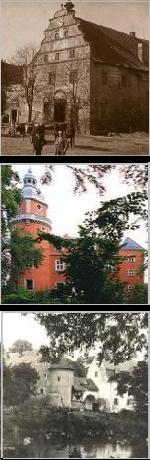
Matzdorf
Paulinum
Jannowitz
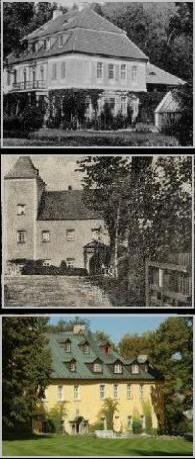
Ruhberg
Schwarzbach
Stonsdorf

Lomnitz
Langenau
Kammerswaldau
Hermsdorf
Arnsdorf
| Erdmannsdorf, Fischbach, Schloss Schildau, Buchwald |
| Hirschberg Ruin, Berthelsdorf, Kynast, Berthelzin |

