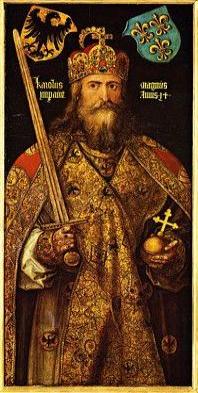
| Karl der Große: Charlemagne |
| Karl der Große was born of German blood and German language at a place unknown. He could speak ancient Teuton, Latin and Greek and he became king at age twenty-nine. Karl, the second son of Pepin the Short and Bertrada, was born in 751. In 754, Pepin convinced Pope Stephen II to crown him in exchange for defending Italy against the Germanic Lombards, a tribe occupying central and northern Italy. Karl saw war as a child riding with his father's army, and he would continue to personally lead men into battle throughout 53 campaigns. The Moslem governor of Barcelona asked for his help in defeating the caliph of Cordova, another Moslem, and in the year 777, Karl led the army across the Pyrenees until he realized he had been deceived. As he led his army back through the mountains, the Basques attacked his rear guard and killed nearly every man in the squad led by Karl's nephew Roland, a battle which became immortalized in song and story. In 795, Karl returned and conquered part of northeast Spain before again assaulting the persistent Lombards in Italy, a feat for which Pope Leo III crowned him Emperor of the Romans on Christmas Day in 800 AD. The concept of feudalism was a combination of German and Roman practices developed and practiced most widely by the Franks, a large confederation of Germanic tribes who, wanting freedom from both other Germans and the Romans, united in the 3rd century AD and adopted the common name "Frank" (derived either from the word "Free" or "Spear"). They were the most successful of the German tribes and by the 4th century, many of them were living in the area of Belgium and the Rhineland as allies of Rome, while other Franks were living in adjacent German territory. The Franks maintained independence and later helped defeat the Huns who were terrorizing Europe. Since they lived close to the Romans in Gaul for so long, the Franks developed and modeled their own kingdoms in a similar manner to Roman civilization and once Roman authority was gone in the 5th century, many of these Frankish kingdoms united under Merovich (reigned 448-458) whose grandson, Clovis (reigned 481-511) converted to Christianity. The Franks conquered southern France and large parts of Germany. The Franks were so efficient and successful that all Germanic peoples grew to be considered "Franks". The Christian Frankish kingdom continued to develop throughout the 6th century. Unlike the Romans, where officials were selected more for their ability, the ancient German tribes believed that their clan's ruling dynasties were descended from the gods. The Franks incorporated their pagan belief into their new Christianity by having their leaders "anointed" by a bishop. This adaptation to an old German concept allowed the Church to develop the idea of the "Divine Right of Kings", a leader chosen by God. The Franks turned the Roman estate practices into what is known as the Manor System. By the 8th century, the Frankish warrior on horseback was superior to any European infantry force, and from the 700s to the 1200s, they ran the battlefield. Maintaining the lifestyle of these knights was expensive, with their costly equipment and families to support, so the Frankish kings decided to introduce a system that would provide trained soldiers for the crown and also put reliable men in local positions of authority throughout the kingdom by combining the manor system with all their knights. The German noble was therefore surrounded by loyal lesser nobles and commoners in a fellowship bound together for mutual protection, and although they farmed and hunted, war was, by the nature of the times, a central element in their lives. The Frankish kingdom culminated in one man: Charlemagne. Charlemagne led his armies and sent his armies far. He subdued the unruly Saxon heathens, giving them a choice between baptism or death, resulting in the beheading of 4,500 of them in one day. He drove back the advancing Slavs, defeated the Avars, and by the thirty-fourth year of his reign, he could resign himself to peace until his death in 814. He bestowed a governmental structure and unifying faith upon Western Europe which had been torn by religious and political strife for years, and he managed to bring all of the people between the Vistula and the Atlantic, the Baltic and the Pyrenees, nearly all of Italy and much of the Balkans under his rule. Charlemagne made military service a condition of owning land and created a system of knighthood and noblemen, along with a whole code of moral behavior in order to build a strong military. Building upon the Roman system of feudalism, Charlemagne enabled this new noble military class to ensure the well-being of serfs who would in turn provide and supply the needs of the nobleman and his militarily. In this well planned society, Charlemagne can be considered the Father of Feudalism. He formed a structured society based on public participation in the government with assemblies of armed property owners, and he respectfully delegated various individual responsibilities to all. It was Charlemagne who first attempted to organize his kingdom by dividing his power with various levels of government: an aristocrat appointed as Count controlled the lords and nobles who in turn controlled the serfs or peasants on the fief of each knight. The counts took care of administrative tasks and supervised Church business and an appointed Bishop headed a diocese within certain borders. In those areas where there were potentially volatile situations, Charlemagne appointed a Margrave. By his formulation of the Chapters of Legislation, once a year they all traveled to the king's court at Aachen to convene and to discuss governmental business. Here they presented items for oral vote (out of the jurata, a custom in ninth century Frankish lands where a sworn group of inquirers was used to decide many local issues from land ownership to criminal guilt, came the jury system of modern times). In between these meetings, Charlemagne traveled to the various capitals of the region, and held assemblies of the nobles where they would hash things out and come to agreement on various issues. They also shared a good time with much joking and talking. To fill in the gap between meetings, he created a group of emissaries called the missi dominici who travelled throughout the kingdom hearing complaints, making sure that things were running smoothly and collecting taxes. Through the Capitulare missorum, the people of Francia had their own guarantee of equality, justice and freedom from tyranny four centuries before England’s Magna Carta was established. Under Charlemgane's enlightened rule, conscientious effort was made to transform barbarism into civilization through legislation pertaining to most aspects of civilized living from religion to government. A great bridge was built across the Rhine at Mainz to produce active trade and a stable currency was maintained. He even established a system of relief for the poor with taxation on the nobles and the clergy to pay its costs. An ancient Saxon poem begs the Gods for deliverance from Charlemagne: "Great and Holy Wotan, help us and our field general Wittekind and the captains to defeat Karl the Butcher. I give you an aurochs, two sheep and a beehive. I slaughter all your prisoners in your holy mountain realm." He called in foreign scholars to restore the schools of France and then organized the royal palace at Aachen as a teaching facility by sending for teachers from England and elsewhere, turning the palace school into an active center of study and the birthplace of educational reform that spread throughout the realm. Even Charlemagne himself was an eager pupil, as well as his family. While he studied Latin, he continued to speak German, and he compiled a German grammar and collected specimens of early German poetry. Out of his schools came the university system of Europe. Charlemagne was profusely generous to the Church, but also made himself its master, yet he also had open negotiations with Moslem rulers suggesting fair treatment of their respective minority populations. What we know as the Holy Roman Empire was born of a noble vision of world peace, order and civilization. German rulers of the nineteenth-century were enamored of the memory of Charlemagne. In 1843, Prussian king Friedrich Wilhelm IV had Charlemagne's tomb opened. His bones were still intact, except for part of the right arm, and his living height was calculated just over 6 feet. In 1861, 1874, and finally 1906 it was opened again. Einhard's "The Life of Charlemagne"1880: "Charles was large and strong, and of lofty stature, though not disproportionately tall (his height is well known to have been seven times the length of his foot); the upper part of his head was round, his eyes very large and animated, nose a little long, hair fair, and face laughing and merry. Thus his appearance was always stately and dignified, whether he was standing or sitting; although his neck was thick and somewhat short, and his belly rather prominent; but the symmetry of the rest of his body concealed these defects. His gait was firm, his whole carriage manly, and his voice clear, but not so strong as his size led one to expect. His health was excellent, except during the four years preceding his death, when he was subject to frequent fevers; at the last he even limped a little with one foot. Even in those years he consulted rather his own inclinations than the advice of physicians, who were almost hateful to him, because they wanted him to give up roasts, to which he was accustomed, and to eat boiled meat instead. In accordance with the national custom, he took frequent exercise on horseback and in the chase, accomplishments in which scarcely any people in the world can equal the Franks. He enjoyed the exhalations from natural warm springs, and often practised swimming, in which he was such an adept that none could surpass him; and hence it was that he built his palace at Aixla-Chapelle, and lived there constantly during his latter years until his death. He used not only to invite his sons to his bath, but his nobles and friends, and now and then a troop of his retinue or body guard, so that a hundred or more persons sometimes bathed with him." He was so fond of his six daughters that he talked them out of marriage, and they consequently consoled themselves with a variety of love affairs and bore many illegitimate children, which Charlemagne accepted with affection, since he himself had four successive wives and five mistresses who bore him eighteen children, of whom only eight were legitimate. He was said to be moderate in his eating and drinking and maintained good health . He rarely entertained, and instead greatly enjoyed music and a good book. He had almost a clairvoyant intelligence, extreme vitality, unbridled enthusiasm for science, law, literature, and theology; he mocked superstition yet employed soothsayers. He spoke directly and honestly, and was kind, charitable and emotional, yet he could be ruthless when required, especially in regard to spreading Christianity. His empire became far greater than the Byzantine, surpassed in scope only by the realm of the Abbasid caliphate, but suddenly Germany had to protect itself against the Norse, who raided the Frisian coast, and against the Slavs on their murderous rampages. Because of this danger, he divided his empire in 806 among his three sons: Pepin, Louis, and Karl. Pepin died in 810, Karl in 811,and only Louis remained. In 813, Louis was elevated from the rank of king to that of emperor, and his father, by then age 72 and in the 47th year of his reign, said: “Blessed be Thou, O Lord God, Who hast granted me the grace to see with my own eyes my son seated on my throne!” Four months later, Karl der Grosse died and was buried under the dome of Aachen cathedral dressed in his imperial robes. Carolus Magnus, Karl der Grosse, Charlemagne. |