| The Lusitania: The Ship that helped launch Millions of Deaths |
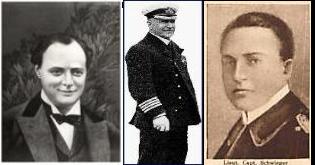
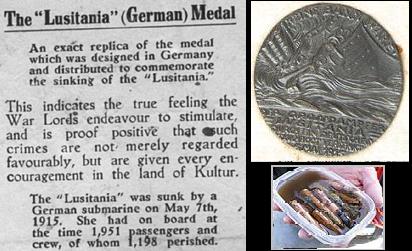
| When the wreck was investigated in modern salvage operations in the summer of 1993, indeed, it showed that it had been struck by only one torpedo and that it had been tampered with extensively. The wreck lies in just 295 feet of water, making it relatively easy to visit. Reports of "blasting and salvaging" operations, some apparently conducted by or for the Royal Navy, date from 1946 to the 1980s. Divers have reported that the wreck is full of holes and "is littered with unexploded hedgehog mines". Royal Navy officials have claimed they had merely been "practicing" on the wreck, but others have suggested that in fact they were deliberately trying to destroy evidence. Germany's claim that Lusitania was carrying munitions for the killing of German soldiers was proven correct in examination of a portion of her manifest, kept from the public until the 1950s. She had originally said that she would take platinum, bullion, diamonds and various other precious stones along with her passengers, but these items were never found and port records do not list them either. A licensed Irish dive team made the first known discovery of munitions aboard the ship in 2006 and these included 15,000 rounds of 0.303 (7.7×56mmR) caliber rifle ammunition in boxes in the bow section of the ship, munitions used by the British in all of their battlefield rifles and machine guns. Indeed, Lusitania carried at least 2,400 cases of Remington rifle cartridges, 1,248 cases of three foot shrapnel shell cases, 18 cases of non-explosive fuses and 4,927 boxes of cartridges with 1,000 rounds in each box, all under the guise of bales of fur and cheese boxes. More ammunition made in the USA (and intended for the British to kill Germans with) were found on a recent dive to the wreck in 2008. For decades, British and American officials denied that Lusitania was carrying so many munitions, and although her manifest did list millions of rounds of rifle cartridges, the cartridges were not officially classed as ammunition by the Cunard Line. There are an estimated four million rounds of American-made Remington .303 bullets still nestled in the Lusitania's hold (pictured below). There was also evidence of tons of additional materials stored in unrefrigerated cargo that probably included significant high explosives in the holds: shells, powder, gun cotton, that may have sunk the ship. The Lusitania's sinking was a huge propaganda bonus for the British. Pro-war newspapers distorted the sinking, and after a storm of protest the Kaiser called a halt to unrestricted submarine warfare and even made reparations. By 1917, the pro-war camp in the US was distributing more than 6,000 press releases and 20,000 newspaper columns, with hundreds of them using the Lusitania as a rallying cry for "freedom" from the blood-thirsty Hun. Walther von Schwieger, dubbed the “Baby Killer” by the British press, appeared along with other successful U-boat commanders on the Admiralty's 'most wanted list' of possible war criminals. He was the sixth most successful submarine commander of World War One and sank 49 ships with 3 submarines on 34 missions, for which he was awarded the "Blue Max"on July 30, 1917, becoming only the 8th U-boat commander to have receive it. He sank a total of 190,000 tons of Allied shipping before he met his own grisly death just short of turning 33 years on September 5th, 1917. Captain Turner, who remained on the bridge of his ship until the water washed him overboard, managed to cling to the ship's logbook and charts. He found a chair floating in the water which he clung to and survived. He was pulled unconscious from the water after three hours. He lived out his life until 1933, but died a bitter man, unable to bear the public scorn for the loss of his ship. He never forgave the Admiralty, and particularly Winston Churchill, for their thorough attempts to exonerate themselves at his expense, even going so far as to suggest that he was a German sympathizer. Karl Goetz, a Munich-based medalist, created an unofficial medallion of the event which portrays the irresponsibility of the British Government and the Cunard in allowing the return of the liner from New York to Liverpool despite warnings and at a time of intense U-boat activity. Unfortunately, he got the date of the sinking from an incorrect newspaper account which gave May 5th as the date and this went on the first few medallions. Although later corrected, this mistake gave British Intelligence the base for an ugly propaganda campaign "proving" pre-planning of the event on Germany's part: 300,000 British copies of Goetz's original medallion were made in England on the orders of Director of Naval Intelligence Captain Reginald Hall and sold in a nice case with a bogus description of events which said: "This medal has been struck in Germany with the object of keeping alive in German Hearts the recollection of the glorious achievement of the German Navy in deliberately destroying an unarmed passenger ship, together with 1,198 non combatant men, women and children." Lord Newton, in charge of propaganda at the British Foreign Office in 1916 told the Evening Standard in 1926: "I asked a West End store if they could undertake the reproduction of it for propaganda purposes. They agreed to do so, and the medals were sold all over the world in neutral countries, especially in America and South America. After some initial difficulty a great success was achieved. I believe it to have been one of the best pieces of propaganda." War-mongering former US ambassador to Germany, James W. Gerard, recounted in his 1918 memoirs his fabricated story that in Germany, schoolchildren had been given a school holiday to celebrate the sinking of the Lusitania. This was a complete falsehood. Very few people in Germany ever saw the medallion. Some claim that the release of the fake medal had a duel purpose. Sir Roger Casement was an Irish nationalist leader hanged for high treason in 1916 after returning to Ireland from Germany where he had been soliciting aid. This and the bloody suppression of the Easter Rising, an Irish attempt to wrest independence from Britain, along with repressive British actions in India, had turned much US opinion against the British and also acted to unite Irish-American groups. The production of the British medal was timed with the release of "excerpts of Casement’s diary" which indicated that he was a homosexual, a revelation intended to divert, distract and confuse the public. After Lusitania's sinking and the barrage of British pro-war propaganda, President Wilson, who was already caving in to consistent pressure to enter the war from the financially motivated domestic “preparedness” movement, stuck to the popular policy of absolute neutrality just long enough to win re-election. By 1917, however, Wilson came out of his closet. One notable exception to the prevailing view on the sinking of the Lusitania was Secretary of State William Jennings Bryan who urged compromise and restraint. He believed that the US should try to persuade the British to abandon their food blockade and limit their mine-laying operations at the same time the Germans be persuaded to curtail their submarine campaign. He also suggested that the US government issue an explicit warning against US citizens travelling on any belligerent ships. Bryan resigned as Secretary of State rather than sign what he considered to be an overly stern and one- sided diplomatic note to Germany and this left Wilson with key foreign policy advisers who were all pro-Ally. Secretary of State Robert Lansing, Bryan’s successor, was an avowed interventionist. Then, in the midst of all of this, there was the convenient issue of the Zimmermann Telegram. While the Lusitania was instrumental as propaganda, the sinking of another ship provided the final excuse Wilson eventually used to bring the US to war against Germany. Wilson informed Congress that a German submarine violated international law and sank the French steamer Sussex in the English channel when, on a crossing to Dieppe in March 1916, the ship was mistaken for a minelayer and torpedoed, killing US citizens aboard the ship. This was not true. The Sussex did not sink, but managed to limp into a French port. 50 persons were killed but no Americans lost their lives, although some were injured. Wilson issued caustic remarks to congress on March 24, 1916 accusing the Imperial German Government of "relentless and indiscriminate warfare against vessels of commerce by the use of submarines" and violating international law. He had no comments regarding British violations. |
| Germany responded to Wilson's demands on May 4, 1916 with what is called the "Sussex Pledge" and promised to alter their naval and submarine policy of unrestricted submarine warfare and stop the indiscriminate sinking of non-military ships. Instead, Merchant Ships would be searched and sunk only if they contained contraband, and then only after safe passage had been provided for the crew and passengers. The German guarantees were honored for a year until they found their position militarily untenable since the USA was obviously not neutral. The public announcement of their resumption of unrestricted submarine warfare was on February 1, 1917, and On April 2, Wilson addressed Congress and begged them to declare war against Germany, which it did on April 6. From 1914 to 1918, more than half of the people on earth would break off their previously pleasant relationship with Germany and many, such as China, Japan, Brazil, Belgium, Green, Bolivia, Peru, Ecuador, Guatemala, Honduras, Cuba, Nicaragua, Panama, Uruguay, Haiti and Liberia would soon declare war against Germany without any valid basis other than from being bullied, bribed or otherwise intimidated into declaring their loyalties elsewhere. |
| When the Lusitania was launched, she was intended to be the largest, fastest ship ever built, doing better than 25 knots at top speed. Britain had enjoyed naval superiority since 1815, but was gravely impacted by the popularity and financial success of the German luxury liners of Hamburg-Amerika and Norddeutscher Lloyd, and she hoped that Lusitania would restore her sagging reputation. Her maiden voyage was on September 7, 1907 and for the next nine years, the Lusitania crossed the Atlantic 100 times. Her 101st voyage on May 7, 1915 would be her last. In 1903, British Prime Minister Balfour had authorized the 20-year loan for £2.6 million at 2.5% interest for Cunard to construct both Lusitania and Mauretania. When they were completed, Cunard was given a subsidy of £150 000 for maintaining both ships in a state of war readiness. Under the command of Captain William Thomas Turner, Lusitania sank within an astonishing 18 minutes of being hit by a German U-boat. Over 1,000 people aboard died because of the quickness of the sinking, including 124 out of 159 Americans on board. There were greater maritime tragedies, but none provided such a perfect opportunity for pro-war propaganda, and probably never before had the innocent dead been as quickly and blatantly exploited. Sir Gilbert Parker, the member of the British propaganda bureau in charge of information and propaganda aimed at the USA, used the occasion to rush the infamously dishonest "Bryce Report of German Atrocities" into print within five days after the sinking, with the sole aim of bringing the USA into the war on Britain's side. The American media parroted British reports that the Germans had fired two torpedoes at the ship without any prior warnings. There had been clear, repeated warnings beforehand, however, and even on April 24, 1915, German officials had published notices in forty US newspapers that a state of war existed between Germany and Britain and that passengers would be travelling at their own risk. The public had no idea that British passenger ships would also be carrying implements of war intended for use against Germany, thus making them targets. From the onset of war in 1914, Britain's horrendous blockade on Germany under First Lord of the Admiralty Winston Churchill prevented even food from being imported into Germany and brought death, starvation and malnutrition to thousands of people. The British blockade violated the tenets of generally accepted international law which had been codified by several international agreements of the previous two centuries and is believed to have caused up to a million German civilian deaths. U.S. Senator Robert LaFollette pointed out, in vain, that food blockades violated international law and struck at America’s rights as a neutral power. LaFollette even cited an admission by Lord Salisbury, one of England’s prominent statesmen, that "food for the civilian population was never contraband...a principle that the English were callously ignoring in their blockade of Germany." Not only were the British employing the blockade to stop, destroy or confiscate ships carrying cargo to Germany, they also disguised warships as merchant ships, used neutral flags as cover (Q-ships), and armed merchant ships, giving them orders to ram German U-boats. This turned every British merchant ship into a warship in the opinion of Germany, who had objected to this policy in vain. The Royal Navy showed its own disregard of civilians by loading passenger ships with weapons. As early as March of 1915, Germany was so deprived of money, energy and food because of the British blockade that she was ready for peace. On September 2, 1916, the German Ambassador asked if Wilson would be willing to help negotiate an end to the war in return for German withdrawal from Belgium, but Wilson refused to do anything until after fall elections. But something saved the day for a continued conflict: a source of credit for the Germans arranged through the American M. M. Warburg & Company. Taking advantage of the war, the Warburg and the Schroder banking families opened banking institutions in Hamburg after being approved by the Accepting Houses Committee which was associated with the Bank of England, which was in turned controlled by the House of Rothschild. Both sides of the conflict were financed at times by the same sources. Early on, Lusitania had been withdrawn from passenger service for conversion to war before being returned to civilian status. The ship was also captained by a Royal Naval officer. Both the 1914 "Jane's Fighting Ships" plus the "British Naval Packet Book" listed Lusitania and Mauritania, among others, as "armed merchantmen". It is reasonable to conclude that she might no longer be considered a harmless passenger ship to the enemy and would be suspected of carrying war materials. On May 6, Schwieger sank two other ships. In the morning he hit the Candidate and allowed the crew to escape, and in the afternoon he torpedoed the Centurion. The Lusitania was not warned by the Admiralty of either of those ships or the other victim that day in the area where she would travel. Nor had Captain Turner followed proper procedure to avoid confrontation. Schwieger's U-boat was built for service in the Kaiserliche Marine, launched on December 18, 1912 and commissioned on August 5, 1913. Schwieger had only three torpedoes left when he hit the ship, and he needed two kept in reserve for the return transit. He said he did not know the ship he was sinking was the Lusitania and that he torpedoed her before he identified her. She was just was a target of opportunity for a tired captain who was reputed to "shoot first and identify later". He was even more surprised when the ship sank so rapidly after being hit by only one torpedo. In Schwieger's words: "When the steamer was two miles away it changed its course. I had no hope now, even if we hurried at our best speed, of getting near enough to attack her.... I saw the steamer change her course again. She was coming directly at us. She could not have steered a more perfect course if she had deliberately tried to give us a dead shot....I had already shot away my best torpedoes and had left only two bronze ones...not so good. The steamer was four hundred yards away when I gave an order to fire. The torpedo hit, and there was a rather small detonation an,d then after, instantly a much heavier one. The pilot was beside me. I told him to have a look at close range. He put his eye to the periscope and after a brief scrutiny yelled: "My God, it's the Lusitania." U-boat captain Walther Schwieger had never before been accused of atrocities such as deliberately drowning, bombing or machine-gunning survivors. The huge loss of life was caused not by the one torpedo, but because the ship sank so quickly. Schwieger had fired torpedoes into ships five times smaller than the Lusitania which had not sunk at all, or sank only after many hours. Yet US newspaper headlines echoed the British charges which insisted that the Lusitania had been sunk by two torpedoes. One torpedo probably would not have sunk an unarmed ship that large, but certainly could have ignited a ship carrying explosives and munitions, so the two torpedo story was a ruse. The ship's manifest appeared in the American press shortly after the sinking but in several different versions, all of which were inaccurate, and all different from a "supplementary manifest" which was filed after the Lusitania left New York, one never made public. Lusitania was in effect being used as a big, high-speed munitions carrier, and on this trip she carried shrapnel rounds and fuse mechanisms intended for the Royal Artillery and supplied by the US firm Bethlehem Steel, plus an unusually large consignment of live artillery shells. Two odd consignments of (unrefrigerated, hence inedible) "butter and cheese" listed on the public manifest weighed nearly 90 tons and were destined for the Royal Navy Weapons Testing Establishment in Essex! Recent theories suggests that items such as gun-cotton, probably not properly packed, were not listed on the public manifest but were carried all the same. At the time, feisty Wisconsin Senator Robert La Follette faced expulsion from the Senate because he had stated that the Lusitania carried munitions. However, Mr. Dudley Field Malone, collector at the port of New York, confirmed this as true and revealed that the Lusitania carried large quantities of ammunition consigned to the British Government. The Wilson administration refused to permit the publication of this fact. One of the principal charges in the move to expel La Follette from the Senate was that he had falsely declared that the Lusitania carried ammunition, but the prosecution was dropped when Malone offered to testify. |
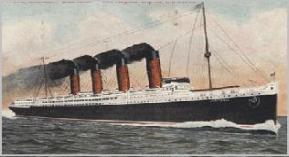
SM U-20 that sunk Lusitania (click); Churchill, Turner, Schwieger; Faked Lusitania Medal (click)
| 4/4/17: As to "Making the World Safe for Democracy", Senator Robert LaFolette quipped: "Let us look at the company we will keep in performing this benevolent function. We will be marching side by side with the King of Serbia; the King of Italy is our boon companion; the King of Belgium is there; so also the King of Roumania; the Emperor of India and the King of England, our stalwart brother; not to mention the King of Montenegro and various other principalities and rulers, as well as chaotic Russia - only France is a Republic - and last but not least we are to be brothers in blood with our dear friend the Emperor of Japan. And this our Chief Executive proposes as our 'league of honor'. The forefront of this alliance to make the world safe for democracy is England - a hereditary monarchy, with a hereditary ruler, with a hereditary House of Lords, with a hereditary landed system, with a limited and restricted suffrage for one class and a multiple suffrage power for another, and with grinding industrial conditions for all the wage earners." |
