| To avoid revealing their activities in obtaining it, which not only absolutely violated previous agreements with the USA but could have undermined America's own national security, they could only reveal the telegram's contents, and not the actual telegram itself. |
| On the first of February, we intend to begin unrestricted submarine warfare. In spite of this, it is our intention to endeavour to keep the United States of America neutral. In the event of this not succeeding, we propose an alliance on the following basis with Mexico: That we shall make war together and make peace together. We shall give generous financial support, and an understanding on our part that Mexico is to reconquer the lost territory in New Mexico, Texas, and Arizona. The details of settlement are left to you. You are instructed to inform the President [of Mexico] of the above in the greatest confidence as soon as it is certain that there will be an outbreak of war with the United States and suggest that the President, on his own initiative, invite Japan to immediate adherence with this plan; at the same time, offer to mediate between Japan and ourselves. Please call to the attention of the President that the ruthless employment of our submarines now offers the prospect of compelling England to make peace in a few months. |
| From that point, it made another circuitous round of intentionally confusing and obscure travels until it was delivered from British Codebreaker Admiral Hall to the British Foreign Minister by a beaming Arthur James Balfour who in turn delivered it to Walter Page, U.S. Ambassador in Britain, on February 23, who in turn relayed it to President Woodrow Wilson 2 days later. The Americans would have to rely solely on the British interpretation of the telegram. The sensational manner in which the media "exposed" the telegram immediately resulted in an outpouring of fear and anti-German sentiment and, a few days later, Wilson asked Congress to declare war on Germany. On April 6, 1917, Congress complied, bringing the United States into World War I. ...and exactly one month later, the famous Balfour Declaration was signed. |
| The idea of such a telegram was at first believed to be forged by British intelligence designed to bring America into the war on their side, and this was echoed by some in the American media. However, on March 29, 1917, Zimmermann, who would remain a rather elusive and shadowy figure to this day, gave a speech confirming the basic text of the telegram, while protesting the interpretation of the message. Zimmermann said that he had not written a letter to Carranza but had given the instructions to the German ambassador via a "route that had appeared to him to be a safe one". |
| There is no real proof that the British were able to decipher the Telegram! All that is known of the unenciphered text of the Zimmermann Note is what the British told the USA. The actual note was never before made public and was believed to have been destroyed along with many of the secret documents in this incident. |
| Britain had for some time a batch of eager helpers mongering for American involvement in the war and aiding in code breaking efforts. Charles Jastrow Mendelsohn joined the censorship division of the Post Office Department when the United States entered the war and was put in charge of solving German codes in diplomatic messages. Mendelsohn's team included Victor Weiskopf, a former Department of Justice agent, and Edith Rickert, a university professor. William Friedman and Charles Mendelsohn later issued a classified bulletin entitled 'The Zimmermann Telegram of January 16, 1917 and its Cryptographic Background'. |
| The Zimmermann Telegram |
| He also said that his instructions to the Mexican government were only to be carried out if and when the US declared war, and he believed his intent displayed absolute loyalty in regards to the US. He blamed President Wilson for refusing to discuss the matter and instead immediately breaking off relations with Germany, as he stated, "with extraordinary roughness" after the telegram surfaced.Zimmermann was a lawyer and was the first non-aristocrat to serve as German foreign secretary. Nobody really knows if he was inept or simply had duplicitous designs. |
| It was immediately recognized as a propaganda bonanza for the British as it came at a time when anti- German feeling in the United States was beginning to cement and while Mexican-American relations were poor. However, although most of the message was quickly deciphered, they had major problems: They had to convince the Americans that it was authentic since American code-breakers would not be able to verify the telegram as they could not crack the ciphers, and also the enemy would know that their codes had been broken if they published it. But a bigger problem was that the telegram had been sent via the American cables which were supposed to be off limits to the British, and it might anger Washington when they realized that they had been tapped and how seriously Britain’s code breaking activities extended to neutrals. |
| As soon as war was declared, the first thing the British had done was cut Germany's transatlantic cable. All telegrams or telephone calls to North America had to travel over Britain's cable, and they intercepted every telegram out of Germany. On January 16, 1917, British Naval Intelligence code breakers on night duty illicitly intercepted a coded telegram from the German foreign minister Arthur Zimmermann dispatched to Heinrich von Eckardt, the German ambassador in Mexico. The message had been sent from Berlin to Johann von Bernstorff, the German ambassador in Washington, then forwarded again to von Eckardt by three separate routes before it suddenly appeared in British hands. |
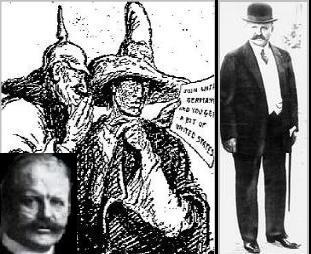
| After the war, both Arthur Zimmermann, and Count Johann Von Bernstorff, the German Ambassador to Washington in 1914, were active in Zionist Pro-Palestine and became the Chairman of Kurt Blumenfeld's Zionist Committee. Bernhard Dernburg, a former banker on Bernstorff's staff was sympathetic as well. |