| The Expulsion and Extermination of Eastern European Germans: An Overview |
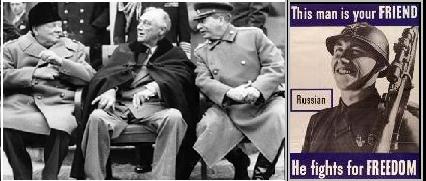
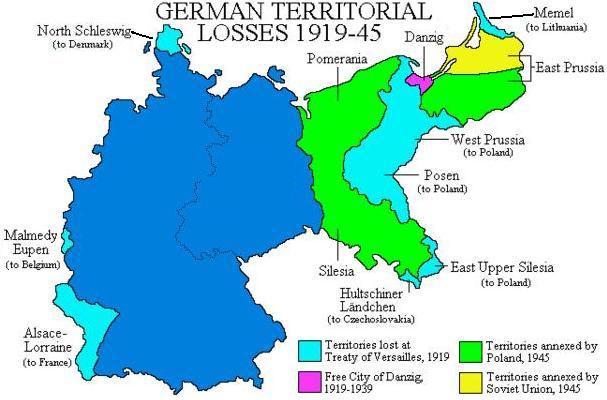
| The expulsion of Eastern European Germans resulted in the largest exchange of population in European history. It ended close to 1,000 years of German presence in areas now considered to be parts of Poland, the Czech Republic, Russia and other Eastern European states, forever changing the ethnic face of Europe. Alone, the expulsion of millions of Prussian Germans from their native land between 1944 and 1947 was accomplished in an immensely sinister manner, yet it is an event that has been ignored, minimized or rationalized by the mainstream media. At the peak of the expulsions in July of 1946, 14,400 people a day were still being dumped over the devastated and famished frontier into an equally devastated and famished Germany which had been reduced to a smaller size than it was in the 11th century. Most countries which once had a substantial ethnic German presence no longer do. Entire ethnic German cities and regions vanished in the aftermath of the war. When Stalin promised a "modest reduction in the German Population" to Churchill and Roosevelt, his homicidal plans were greeted with a wink and a nod, and that goal was accomplished with lethal zeal. Agreeing to Stalin's murderous plans to uproot both Poles and Germans, Churchill said in the House of Commons in 1944: "Expulsion is the method which, in so far as we have been able to see, will be the most satisfactory and lasting. There will be no mixture of populations to cause endless trouble. A clean sweep will be made. I am not alarmed by these transferences." In November 1944, Roosevelt agreed, and chief advisors to both Roosevelt and Churchill argued for a solution to the "German problem" as calculated and as chilling as Stalin's. In December, 1945, The New York Times noted that the number of people the Allies proposed to transfer in just a few months equalled the total of all the immigrants admitted to the USA since the beginning of the 20th century! Aside from countless German civilians who fled in advance of the Red Army and were bombed, drowned or shot at, since the British and Americans agreed at Yalta to redraw historic German borders, they abetted, authorized and encouraged the deportation of millions of ethnic German civilians and gave to vengeance-fueled communist governments the power for who, where and how these citizens would be deported, a power which would inevitably be greatly abused. Among the Allies, who insisted that they nobly fought the war to uphold the dignity and value of all humanity, were thousands of officials, servicemen and politicians who took active roles in carrying out a program that was contrary to all principles of humanity, a program which, had it been perpetrated by their wartime enemies, would have been considered a criminal violation of human rights. Chaos, kidnapping, rape, thievery and mass murder were the order of the day in the regions where Germans were expelled. Poles, Czechs and others, with the assistance of the Red Army, sometimes gave the populations of whole German villages only minutes to vacate their homes. The Germans were either collected by force or ordered to gather at a central location where selected individuals were ripped from the group and beaten, executed, or dragged off for slave labor in a ruthless process which even tore children from their mothers' arms. The evicted Germans were methodically stripped of their most personal and dearest possessions before being taken to train stations where they were indecently prodded for hidden valuables, shoved aboard cars without adequate food, water or sanitation facilities, and speedily shipped to occupation zones in Germany where they were simply dumped. Others were forced to walk hundreds of miles to destinations which were often in rubble, and few of them reached these destinations with even a handbag left in their possession. Many died on the roadside from disease, exposure or starvation. Forbidden to ever return home, all of their worldly goods were confiscated. Many taken for slave labor were deported to the USSR after Secret Order 7161 of 1944 issued by USSR State Defense Committee made possible the internment of all adult Germans from Romania, Yugoslavia, Czechoslovakia, Hungary and Bulgaria. About ten per cent of the victims died just in the course of transportation to Russia as a result of hunger, murder and cold. Half of the remaining 'repatriated displaced persons' died in camps, one of the worst being the Kolyma Camp. The numbers of deaths and expulsions sky-rocketed at war's end. In the USSR, over 75% of German civilian slaves worked the mines in Ukraine and 11% worked in the Urals. By 1946, out of the German "arrested internees", 39% died, and of 875,000 other German civilians who were abducted and transported to the camps, over 50% perished. Labor camps for Germans existed not only in the Soviet Union, but in almost all the regions from which Germans were displaced, the last ones not being closed until 1950. In Poland and areas under Polish administration, there were 1,255 camps: 6,048 out of about 8,000 people died in Lamsdorf camp alone. In Czechoslovakia, 2,061 camps existed: in the Mährisch-Ostrau camp around 350 people were tortured to death by early July 1945. In Yugoslavia, the Red Cross found 1,562 gruesome camps and prisons. By May of 1945, practically all of the Yugoslav Germans who did not flee in time were living and dying in camps. The standard estimates which stood unrevised for sixty years stated that between 1945 and 1950, from 11,730,000 to 15,000,000 German civilians fled and/or were expelled from the eastern territories of Germany proper and from the Eastern European countries and other estimates were much higher. Although, as in the case with mortality figures from Allied bombing, the number of victims is relentlessly downsized, that these violent expulsions displaced and murdered millions of innocents is undeniable. "Population transfers", from highest to lowest, were from former eastern Germany, then Czechoslovakia next, then Poland, Danzig, Yugoslavia, Romania, Hungary, the Baltic states and, lastly, the USSR. And besides the forced expulsion and murder of millions of these people, at least another 3.1 million simply "disappeared" during the expulsion/liquidation process. Even after a murderous bombing campaign eliminated a large part of their population, five times as many Germans, both civilians and soldiers, perished in the first year after World War Two than died during the course of the entire war, and they died at the hands of others directly as a result of revenge policies inflicted upon a thoroughly dehumanized enemy. 15 to 20 million homeless people, many half insane from shock and grief, wandered amid rotting human bodies dotting the bleak roadsides and paper thin orphans aimlessly navigating through the charred and broken remnants of mercilessly bombed cities. The Allied Control Council had worked out procedures in advance for taking into the occupied territory 6,650,000 "racial Germans" who were among those they expected to be expelled from Poland, Hungary, Austria and Czechoslovakia under their plans. The US zone's share was to be 1,750,000 from the Sudetenland and 500,000 from Hungary. They were scheduled to come at a rate of a quarter million a month in December, January, and February of 1945 and even larger numbers in the spring. But they came at greater rates, and the Allies were in no way prepared or eager to deal with the situation humanely. In a British camp at Kleve, for instance, thousands of civilians died from hunger, disease and starvation. 25 percent of former German farmland had been given to Poland making food scarce in Germany after the war and there was already a disastrous famine in the many urban areas where refugees were dumped since the Allies were not yet letting food through. Health and medical services could not possibly handle the additional millions of starving, homeless and ill German refugees. Half of the children under a year old died during the first months in cities like Berlin. By the summer of 1945, 20,000 weak, starving, homeless people were dying every day, their bodies piling up on roadsides, by train tracks and in empty fields. When winter arrived, the Allies relented and finally allowed some private international relief agencies to provide food and clothing, but it was far too late for many. In communist-occupied Koburg, 3/4 of the people were dead by starvation by the spring of 1947. The children died like flies of diseases such as Diphtheria which ran rampant. The greatest deaths were reported in the Neumark area in Eastern Brandenburg. Out of a 644,834 pre-war population, by 1945 there were 257,000 dead. Out of sheer desperation, people all over Germany shot, hanged, drowned and poisoned themselves and sometimes their entire families. Within the Eastern German regions which were hacked up and turned over to communist rule, "liberation" led to enslavement for decades. Subjected to brutal policies calculated to break their will, thousands upon thousands of innocent people were murdered, oppressed or tortured. "Crimes" such as singing an old regional folk song could be punishable by prison, and the brutality used to obliterate German "nationalism" extended to executions, prison or life in the far away gulag. Many people simply disappeared. Those who didn't comply with the degrading re-education process inflicted by their new communist masters were enemies of the state. Refugees in the Eastern Cities after the War: One City's Story The refugee problem was of a momentous proportion and what took place in Leipzig is typical of many eastern cities. Families having lost their homes and farms were split up and scattered into unfamiliar areas, children torn from their mother's arms and fathers and sons missing or dead. Refugees with friends or relatives to rely upon were lucky if they had the capacity to make the journey and if their contacts were still alive and in surviving houses themselves. Others faced long stays in crowded, harsh refugee camps. The plight of the desperate refugees began first with a severe shortage of housing. From 1943, thousands of Leipzig houses had been destroyed by bombing. Of 221,178 dwellings, 28,178 were completely destroyed and 93,000 were damaged, thus 20 per cent of the native Leipzig inhabitants had become homeless themselves and had to be accommodated in the dwellings of others or in emergency shelters and camps. Sizable buildings still standing, such as the university, were seized, and the evacuation of a large number of dwellings was demanded, but it was not enough. The old Leipzig mansions were also seized, but proved impractical for conversion. There was not only a housing crisis, but an absence of urgently needed clothing, food, furnishings as well as a lack of furnaces, fuel and cooking stoves. The first refugee camps in Leipzig developed in January, 1945 when Central Germany was affected for the first time by the escape waves of people fleeing East Prussia. Later, exiled Silesian and Sudeten Germans flocked to cities for help. They were put up in private homes, zoos, high schools, auditoriums and restaurants. Americans were greeted in Leipzig on April 18, 1945 with white flags. Nobody realized at the time that they had been "sold out" to the Red Army. The Allies immediately issued regulations that, among other things, imposed curfews and closing hours and forbade the publication of newspapers and the use of cameras, which were confiscated. Under the Americans, bread rations for the population was only 200 grams for young people, 170 grams for adults and 100 grams for children As the Americans prepared to end their occupation and leave July 2, 1945, the corralled refugees, created by Allied bombing and Allied policies set at Yalta, were stunned to hear that Russian troops were about to arrive in the city the next day. Because of the two zones of occupation, traditional supply lines to Leipzig had been cut off and the infrastructure was destroyed per day. There was no escape from a future of brutal communism. Conditions worsened in the entire Soviet zone of occupation until a uniform food map system was inserted much later, which consisted of categories. The assignment of the food maps was graduated mainly by work status, so non-laboring housewives and pensioners had a diet containing neither fat nor meat. Among the refugees, there were many old people and women who, because they had to supply small children, were exempted from the forced work details and therefore had very little to eat. A “dwelling law” put forth by the temporary Allied occupation forces had decreed that "victims of fascism" and immigrant workers were to be given first preference to housing and the needy second preference, while the refugees did not even rank among the groups privileged by the law! Average floor space was calculated for eight square meters per person, with children under fourteen years old ranked as "half a human" by the Americans, who were given strict orders to destroy or otherwise render inedible their own leftover surplus so as to ensure it could not be eaten by German civilians, a policy in US zones throughout all of Germany. Within the Soviet zone of occupation, some refugees were sent over the borders, resulting in strong objection from adjacent provinces who were battling their own refugee crisis. Usually the neighboring authorities sent the refugees back to Saxony, some numerous times, ostensibly to prevent the spread of epidemic disease. This resulted in even more trauma for the exhausted refugees. When the surrounding frontier was closed, certain cities such as Leipzig were subjected to the in-pouring of thousands of frightened and weary human beings who had accumulated in the area. Where they would they live and how they would they eat was a horrible problem. A decree was issued on August 2, 1945 prohibiting the further influx of refugees, and on August 7th, the Leipzig welfare office suggested that any future refugees should receive accommodation of only one night in the Leipzig transit camp. The Red Cross tried to supply these people with at least with one warm meal and bread and jam for their forthcoming travels. Some refugees walked aimlessly for months in hunger, pain and confusion. Typhus broke out and there was a malaria epidemic in the damp Leipzig camps from 1945-49 where some refugees languished in old, swampy prison camps. The forlorn refugees were afflicted with scourges such as lice, ringworm, bedbugs and transmittable diseases, while the formerly rich and the once poor struggled together for survival. The whole social order had broken down with nothing of substance to replace it and lift the sagging spirits and weary bodies. Stress, grief, illness and pain took a devastating toll, especially in the very young and aged. One of the linguistic rulings of the Communist regime turned the refugees into "re-settlers," and after the establishment of a central administration for "re-settlers" at the end of September, 1945, efforts were undertaken to end the chaotic situation in Saxony and to settle thousands of refugees in a more orderly manner. To enforce this, a halt was called to refugee movements from October 1, 1945. At the same time, the naturalization of all refugees in Saxony was arranged. For the city of Leipzig this meant naturalization of almost 28,000 additional people during a time of incredible hardship for everyone. Worse was to come. The “arranged evacuation” of the remaining Germans who were forced out of their homes in Poland and Czechoslovakia began in summer, 1946, and turned a crisis into a calamity. Saxony alone was assigned 400,000 more refugees. Since most refugees came in the last months of the year, winter was already upon them and many wanted to remain in the camps where, despite disadvantages, at least there was heat and meagre food. Churchill's final solution to the German problem was proving deadly. After 1947, another 25,000 people gained admission to Leipzig, and then another 38,000. Leipzig's standard of 8.8 square meters of floor space had to be lowered. The catastrophic housing conditions caused already traumatized people to become more ill. Strangers shared housing, and often five or more persons had to live in one or two rooms without a kitchen and with a continuing shortage of food, heat, sanitation and private sleeping places. Most refugees had no money. Despite the emergency housing dilemma, in July, 1947 the Soviet military administration demanded the evacuation of approximately one thousand dwellings north of the city to be handed for use by Soviet commercial enterprises. Only in 1948 was a slow improvement in the living conditions of the refugees finally discerned. Until the stop of all refugee movements in Leipzig, 71,324 “re-settlers” had gone through the Leipzig camp. In 1950, more than half of the Leipzigers were still not in their own home, but in officially assigned dwellings, and 78,000 out of 93,707 refugees still lived in the city. The situation did not begin to remedy itself until the early 1960s. Information from the State Ministry, Saxony |
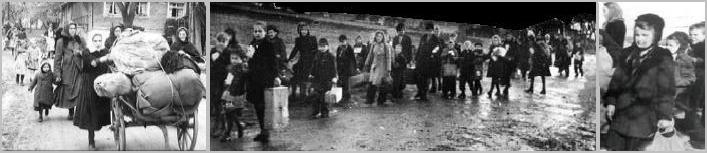
| "Since the end of the war about 3,000,000 people, mostly women and children and overaged men, have been killed in eastern Germany and south-eastern Europe; about 15,000,000 people have been deported or had to flee from their homesteads and are on the road. About 25 per cent of these people, over 3,000,000 have died. About 4,000,000 men and women have been deported to eastern Europe and Russia as slaves. It seems that the elimination of the German population of eastern Europe - at least 15,000,000 people - was planned in accordance with decisions made at Yalta." Senator Homer Capehart in a speech before U.S. Senate, Feb. 5, 1946. *more |