| Destruction Of German Monuments~ Monumental Destruction |
| Little would Friedrich have guessed that the name "Prussia" would be formally expunged from international language by order Number 46 of the Allied Control Commission on February 23,1945 because, as it incorrectly stated: "Since time immemorial it has been the pillar of militarism and reaction in Germany". The state of Prussia still legally existed for a time after war's end but proved to be an obstacle to the Allied division of Germany into four easily controlled zones of occupation structured to "stabilize political structures" in their concept of a new Germany since it was a large state with its various regions included in all four zones. Calling Friedrich the Great a "forerunner to Hitler", in February of 1947, in an act of remarkable arrogance and stupidity, and in total disregard of historical fact, the Allied powers issued a formal decree abolishing the ancient German State of Prussia. There was a spectacular monuments to Friedrich which once graced Marienburg, site of the old Teutonic Knights castle and revered symbol of German cultural history and national consciousness which was torn away and given to communist Poland. The monument was destroyed. A mass grave holding the remains of thousands of German Prussian civilians murdered in cold blood by the Red Army has recently been discovered nearby. |
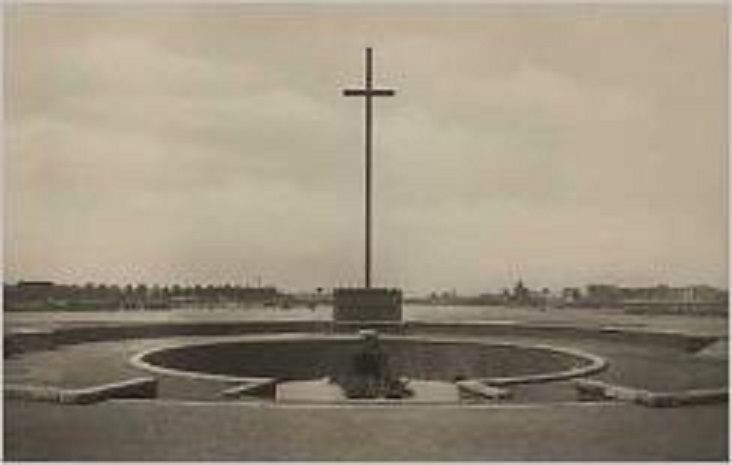
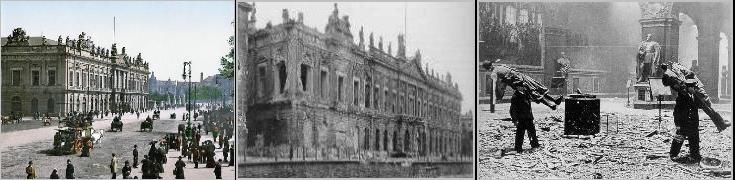
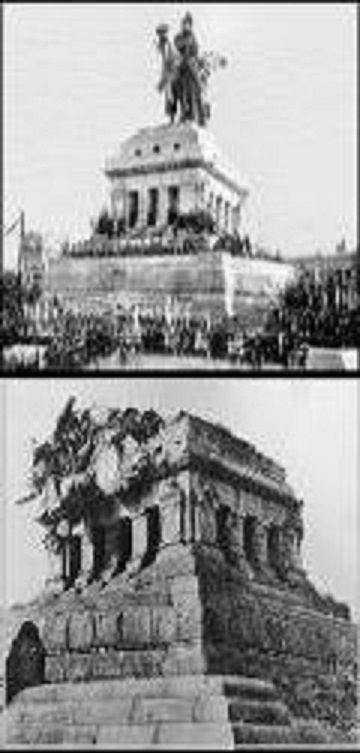
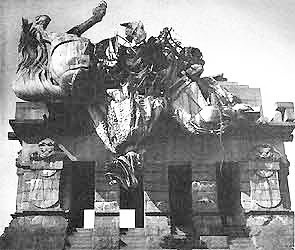
| The Zeughaus (old arsenal) of Berlin, above bottom, is the oldest structure on the Unter den Linden. Built by Elector Friedrich III between 1695 and 1730, it was used as an artillery arsenal. From 1877 to 1880, it was converted into a Hall of Fame to honor the Brandenburg-Prussian army at a cost of 4.33 million marks and was modelled after the famous old Vienna Armory. After grave bomb damage by the peace-loving Allies, the Armory War Museum was dissolved per orders of the Berlin Allied Command on October 18, 1945 who carted off and dispersed of much of its collections of valuable antique swords, armor, maps and other German historical treasures. Brandenburg Gate Russia certainly retained memorials and monuments to its own warlike past and plunked several on German soil. While Germany is still not allowed to honor its own war dead without engendering animosity or illegality, the massive Soviet memorial built in Berlin from 1946-1949 commemorates the Soviet soldiers that fell in the battle of Berlin and juts up from the landscape in the heart of the calm gardens of Treptower Park in a city outrageously plundered by the Soviets and where well over two million German girls (as young as 6), women and elderly, suffered violent Red Army rape. Likewise, at ancient Torgau on the Elbe, there is a large monument honoring the linking up of American and Soviet troops in April, 1945, at an event that hastened German defeat. There is no monument to the Red Army's looting of local treasures and the Hohner accordion and harmonica factory, nor one commemorating the decades of slavery and decay Torgau was sentenced to after the Americans handed the town over to the communists. From 1945 to 1948 the NKVD operated the hellish Special Camps Numbers 8 and 10 here for political prisoners considered a "potential threat to the socialist system". In those three years, over 1,500 prisoners are known to have perished here. But the Germans today don't seem to mind. They host regular events commemorating "liberation". The Zoo grounds in Berlin were dotted with figures such as the one of Goethe. Almost all were destroyed by Allied bombing which levelled Berlin. The victory column, Die Siegessäule am Großen Stern was built from 1864 to 1873 at the Zoo to honor the German-Danish war and the Franco-Prussian war. Amazingly, it survived the bombing, but the communist and socialist municipal authorities put in charge of German cities after war's end by the Allies, in this case Berlin, vociferously requested the destruction of all "nationalistic" monuments. The French occupying the ruins of Berlin in 1945 also demanded that this monument be blown up. The British and Americans rejected the idea because the monument was built before the "legitimate" date from which German monuments should be levelled. To appease the French, however, they were allowed to remove the bronze sections of the monument and take them to Paris. On the 750th anniversary of Berlin, France returned the Bronze sections, but in pieces. Even thus, the monument was finally renovated, giving back to Berlin one small remnant of its cultural history. France also retained monuments and memorials to its own warlike past and plunked a few on German soil, the same soil which they repeatedly invaded in centuries past. French General Vicomte de Turenne dutifully served French kings Louis XIII. and Louis XIV. Although his men called him the "Father of the soldiers", Germans understandably connected Turenne to the bloodshed and devastation the French inflicted upon the Palatine, especially in 1674. A battle took place near the church of Sasbach in 1675 and soon the whole village erupted into sorrow and flames. A German gunner fired at Turenne and killed him. The French consequently retreated across the Rhine. However, when they were successfully entrenched on German land in 1782, they built a monument to Turenne's honor in Sasbach. The monument was destroyed by a fierce storm in 1786, only to be partially rebuilt in 1796. Under King Charles X. of France, a third monument was ordered built and inscribed "La France à Turenne" and it became a bitter symbol of French aggression to many Germans, and although it survived World War I, after the German victory over France in 1940, it was destroyed in 1940. On October 1945, a few months after the end of the war, French Occupation Forces pompously inaugurated the fourth Turenne monument in Sasbach accompanied by a huge celebration to rub salt in the wound of the Germans. It still exists today, with a new museum. It is heralded as "a place where Germans and French meet in friendship"and sponsor typical EU global youth peace projects. The 1897 monument to German Emperor William I was inaugurated on a spit of land on the Rhine known since the days of the Teutonic Knights as Deutsches Eck. During World War II, the statue was blown up by US artillery (it was rumored that this was on Eisenhower's personal order) and the horse was mostly destroyed and its valuable copper plates stolen. Finally, the remaining statue was removed and melted down, although fragments of figures, including the head of the Emperor, reappeared later and now rest in a Koblenz Museum. The French military occupational government intended to dismantle the base and replace it with a new monument to "peace and international understanding", but this plan failed due to lack of money. Against all obstacles, in 1953, what was left of the monument was re-dedicated to German unification, the once proud horse replaced by a German flag and its base graced with the emblems of the western federal German states as well as those of the lost areas in the East. The French-occupied Saarland was added four years later after its population voted to rejoin Germany. On October 3, 1990, when communist East Germany fell, those former states also joined in, and their emblems were added to the monument. All that remained were the names of the lost German areas which had been stolen by Russia, ceded to Poland and lost to France. That would not happen. Since it was demanded that Germany give up any hopes and claims for these areas as a price for re-unification, all that was later added were three concrete pieces of the demolished Berlin Wall which were installed next to the monument and dedicated to the victims of the separation. On September 25th, 1993, despite the usual frenzied left wing protests, a new statue created with private funds and was inaugurated to replace the flag. Kaiser Wilhelm Monuments After the outbreak of World War One, young Albert Leo Schlageter signed up as a voluntary emergency worker and took part in several battles, earning the Iron Cross both first and second class. After the war, Schlageter joined the Freikorps and took part in various battles between military and communist factions that were hemorrhaging Germany. During the bitterly resented and often brutal French occupation of the Ruhr in 1923, he led a combat patrol that tried to resist the occupying forces by means of sabotage. A number of trains were derailed in order to disrupt supplies to the occupiers, and this was blamed on his group. On April 7, 1923, Schlageter was arrested by the French, court-martialed within a month and condemned to death. On the morning of May 26, he was executed on Golzheimer heath near Düsseldorf. Young Schlageter became a hero to much of the oppressed German population, and a Schlageter Memorial Society was formed. In 1931, they succeeded in getting a monument erected near the site of his execution. This was a giant cross placed amid sunken stone rings. The Schlageter Monument was blown up after WW2 by order of the British occupation authorities as part of "denazification". |
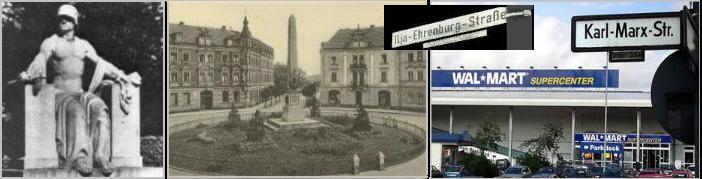
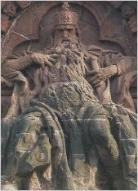
| Germany was a land of grand monuments dating from well before the Middle Ages. The US led MFA&A reported that in Germany alone, over 90 percent of the monuments had been hit by Allied bombings, and 60 percent had been destroyed. The rest were at the mercy of the occupying forces or new governments in lands taken from Germany. Allied directives issued in 1945, as part of the "re- education" process, demanded the destruction all German monuments and museums deemed "patriotic, nationalistic or idealizing German culture". The reasoning behind this process was based in theories propounded by World War One propagandists which concluded that Germans were genetically more violent than other ethnic groups and had to be "de-militarized" in such a manner that they would lose the "German Will to Wage Future War". Rampant cultural devastation then ensued by the occupying Allied forces all over Germany, and few objects were exempted from this crusade. To provide a facade of legitimacy for the vandalism, German monuments condemned for Allied destruction applied formally to those built before August 1,1914, the beginning of Britian's hostilities with Germany in World War One. In reality the decisions were left to company commanders or even factors such as what amount of valuable scrap might be gleaned. Monuments were razed and blown up without regard to age, artistic merit, rarity, history or beauty in all occupied western zones, while in the communist controlled eastern regions, ancient statues of German kings, musicians and writers were replaced by those of communist thugs, erasing centuries of German history and culture. Barbarossa's death caused great anguish and gave birth to the legend that he was not really dead, but sleeping upon his throne inside of a Kyffhäuser mountain cave surrounded by his loyal knights, ready to be summoned at Germany's moment of peril. For many years it was said: “When the ravens cease to fly round the mountain, Barbarossa shall awake and restore Germany to its ancient greatness." Various German associations during the late German Empire financed the construction of a grand memorial to Barbarossa here, and in January, 1900 they conglomerated into the "Kyffhäuser Federation of the Landwarrior Union" dedicated to the care and repair of the monument. All "patriotic or nationalistic" organizations were banned by the Allies, the Kyffhäuser federation being one of them. Apparently afraid that old Barb might actually wake up and restore Germany,this monument was slated for destruction. Oddly enough, it was the Russians who, for some unknown reason and unlike their usual custom, saved it. The Kyffhäuser Association has recently reformed. The occupying US military government replaced the First World War monument in Erlangen, below left, with a flower bowl. The monument, center, was built in 1897 in honor of Wilhelm l, and graced an Erlangen square. The Allies tore it down in 1946 as part of an effort to "de-militarize" the occupied Germans by destroying their "negative" and "warlike" culture. Not content to destroy only monuments, old streets with names such as "Kaiser Wilhelm Platz" were all renamed under the guidelines of the Psychological Warfare Division of the Supreme Headquarters Allied Expeditionary Force who was in charge of re-educating the Germans. In their place, Germany today has several Karl Marx streets and even an Ilya Ehrenburg Street in Rostock commemorating a communist thug who prodded the Red Army to rape and kill German civilians. |
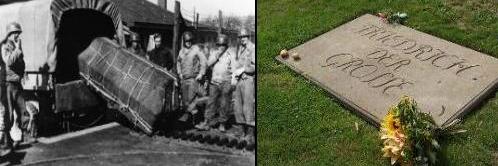
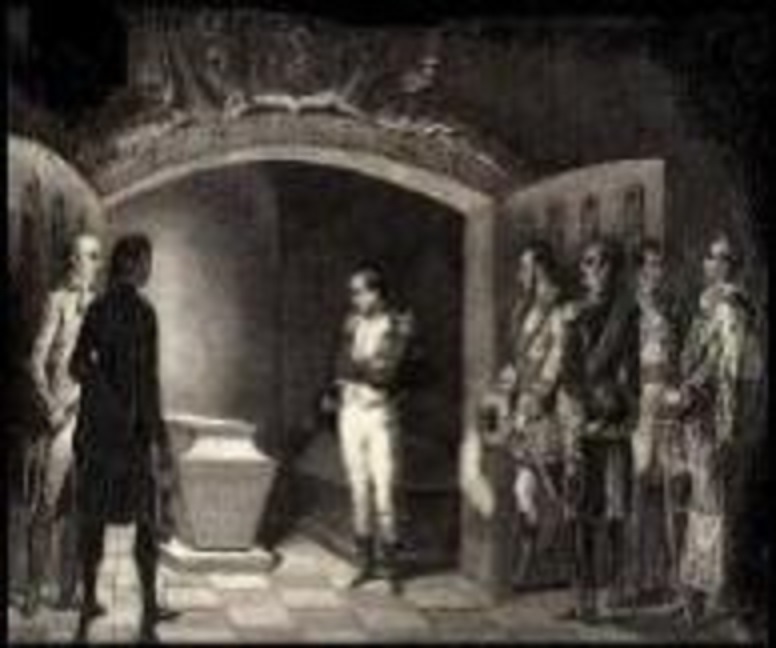
| Many monuments, unlike the lovely old memorials in Düsseldorf and Hamburg, below left, actually survived the cultural carnage of bombing and looting under occupation only to fall later. Magdeburg had a beautiful monument to Prussian Queen Luise, the most beloved queen in German history, below center, who was a symbolic figure for the release of Germany from Napoleon's tyranny. This old monument survived the monument desecration of the post war era until 1963 when a communist professor insisted that the statue be razed for "ideological reasons." Other monuments have been repeatedly vandalized recently by communists and encouraged by the political left, above right. The historical monument above, second from right, to the fallen soldiers in what was once German East Afrika has recently been smashed and stripped of its ornaments by groups opposed to the "appalling genocide". Something also stunk in Denmark Famous homes of German historical figures were not safe, either. The birthhouse of Bismarck, Schoenhausen, was a stately manor house established by his ancestors between 1695 and 1700. It was used by the family until 1944 when it was used as a military hospital, after which it housed refugees, then the elderly. On August 2,1958, the place was blown up by the communist East German government for "ideological" reasons. The gate house is all that remains of yet another missing piece of German cultural history. In Leipzig, the construction of the Bach's workplace, the Paulinerkirche, began in 1228 and the church stood for over 700 years, a model of Gothic church architecture with the University of Leipzig. It contained many historic and artistic artifacts, including a favorite organ of Bach. On May 30, 1968 at 11AM, the church, which had survived the vicious Allied bombings of Leipzig, was destroyed because the communist leadership of Paul Fröhlich and Walter Ulbricht had made the decision on "ideological" grounds. They left only seven days to prepare for the demolition and rescue of artifacts from the church. A weeping crowd of Leipzigers gathered to watch one of their most precious monuments be blown up off of the avenue which had been renamed "Karl Marx Platz". The rubble was cleared and piled at the edge of the city where it is now covered by a small hill with a small wooden cross which reads, "Paulinerkirche 1968." At the same time that the parks and squares of other European cites are full of old and new monuments to warlike, controversial figures from their own histories (i.e. that of Arthur Harris in London), Germans gaze at military monuments to the Soviets, the French and other former foes on their own soil and do so quite submissively, their inherent "will to wage future wars" now absent. Germans were unsafe at any state of decomposition. The occupying Americans in bombed out Aachen, home of Charlemagne (AKA Karl der Große in the more warlike German), ordered a G.I. to go ferret out the remains of the great emperer (which had been hidden for safe keeping by Germans who fessed up the location after a bit of "difficult questioning" on the part of the peace-loving Allies) and bring the bones back. When the soldier reappeared with the sack of bones, he asked with a dumb look on his face, "So, where do I dump this?" Napoleon visited the tomb of Friedrich the Great during the French occupation of Germany. “He was a great man, especially in critical situations. It’s the highest praise one can give of his character” was his homage to the great Prussian King, as he stood at his coffin. "We would not be here if he were alive." An inveterate looter, he then went into Friedrich's personal library, rifled through his belongings and took Friedrich's sword. It went back to Paris where it was later destroyed. The great and enlightened Prussian king Friedrich the Great was not allowed much peace, even in death. Friedrich left clear instructions for his funeral in his will. He wanted to be buried at home next to his favorite dogs. Friedrich's successor instead ordered him buried in the Potsdam garrison church. In World War Two, German soldiers had moved the coffin of Friedrich the Great for safekeeping to an underground bunker in Potsdam-Eiche in 1943 and then, in March of 1945, to a salt mine in Thuringia. After the war's end, the bones were carried off by Allied soldiers to be stashed at Marburg- in-Hesse's Elizabeth Church to prevent a "resurgence of nationalism". There was some talk among the Allies of destroying the mortal remains of the king as a symbol of their new authority over Germany, but the Bones were instead transferred to Burg Hohenzollern at Hechtigen in 1952. However, the wishes of Friedrich the Great were at last fulfilled, despite shrill left wing protests. On August 17, 1991, on the 295th anniversary of his death, the sarcophagus with the mortal remains of the King was laid out in the forecourt of Sanssouci palace, escorted by an honour guard. The burial took place that night in the tomb Friedrich had planned for the purpose since 1744: "Once I am there, I shall be carefree". |
| American G.I.s move the coffin while picking their noses |
| The Schlageter Monument, above, and the Deutsches Eck Monument. right (click on images) |