| Nürnberg Opens its Doors |
| In 1685, Nürnberg was already a very old city. Many Salzburgers arrived here with broken hearts, some with a small circle of friends and fellow exiles. They faced a major culture shock having left their lifelong homes in the mountains for a busy city where they were immediately forced to find lodging, a new occupation and new friends. Some, like Joseph Schaitberger, arrived penniless and had to come to grips with the loss of their children as well. From its beginning, Nürnberg was a civilized city conducive to creative thinking, with an atmosphere in which great minds flourished. Barbarossa himself built an imperial castle here adjoining an old castle of the once mighty Burgraves, wealthy imperial officials who for a very long time had exercised jurisdiction in all civil, judicial and military matters. Their power began to wane after 1062 when Heinrich IV gave the city the right to hold a fair and coin money, but the Burgraves were not easily budged. The emperors of the twelfth century then took over the administration of the imperial possessions and installed a castellan, or overseer, in the imperial castle who not only administered the imperial lands surrounding Nürnberg, but levied taxes and constituted the highest judicial court in matters relating to poaching and forestry. The strained relations between the old burgraves and the castellan evolved into hostility. Friedrich II presented a charter freeing the city from all authority excepting that of the emperor himself in 1219, and Nürnberg became a free imperial city. Since the middle of the thirteenth century, its administration was entrusted to a council which became more and more independent, and in 1320, it was invested by Ludwig the Bavarian with supreme jurisdiction. This accumulation of rights and privileges made the power of the council equal to that of the sovereign or territorial lords and, with their acquisition of the imperial forest near Nürnberg, a basis for future development was laid. The members of the council were chosen by the people, usually from the wealthier class; this custom led to a circle of "favorites," which artisan class resented. With the increasing importance of handicraft, the artisians became determined to have a voice in the city government. In 1349, the members of the trade unions unsuccessfully rebelled against the patricians. Their unions were then dissolved, and the oligarchic element remained in power. Nürnberg had become wonderfully developed at the beginning of the 14th century. Karl IV conferred upon it the right to conclude alliances independently, thereby placing it upon a politically equal footing with the princes of the empire. The city protected itself from hostile attacks by a wall. After the old castle was destroyed by fire in 1420 during a feud with the Burgraves, the ruins and the castle's forest ands properties were ceded to the city by Emperor Sigismund in 1422 and then purchased by the city. Nürnberg became master of all within her walls with this and other purchases, and the city accumulated considerable territory.In 1431, the population of about 22,800 was reduced to 20,800 in 1450 due to wars and plague. The war of succession in Landshut at the beginning of the 16th century brought new possessions to Nürnberg until it owned more than any imperial free city and, along with its political importance, its industrial power and superior culture, it became known as the "Empire's Treasure Box." By the middle of the sixteenth century, the city was almost completely Protestant. The Diet of Nürnberg, 1532, gave religious freedom to all and remained neutral in foreign affairs. A Meistersinger was a German lyric poet of the 14th, 15th and 16th centuries, who carried on and developed the traditions of the medieval Minnesingers. Hans Sachs of Nürnberg was the most famous of all. The Meistersinger school had spread all over south and central Germany. Each guild numbered various classes of members, ranging from beginners to a master, being a poet who was not merely able to write new verses to existing melodies but had himself invented a new melody. The poem was known as a Bar or Gesetz, the melody as a Ton or Weis. The songs were sung in schools without accompaniment. The rules of the art were set down in the Tabulatur, the law-book of the guild. Meetings took place either in the Rathaus, or on Sunday in the church, and at Easter, Pentecost and Christmas. Special festivals and competitions were instituted. The Meister singers played a huge role in the life of 15th and 16th century German towns The forthright Meistersinger poetry reflected the values of the German burger, his good sense and honesty. In this respect, it was an important factor in the rise of that middle class literature. The Meistergesang reached its highest point in the 16th century, and it lingered in south German towns even as late as the 19th century. The art of the Meistersingers has beer immortalized by Hans Sachs, a shoemaker of Nürnberg and Sach's work was immortalized by Wagner. The city also contributed much to the science of astronomy. In 1471, Johannes Mueller built an astronomical observatory in Nürnberg and published many important astronomical charts. In 1515, artist Albrecht Durer, a native of Nürnberg, mapped the stars of the northern and southern hemispheres, producing the first printed star charts. Durer also published the Stabiussche 'Weltkarte', the first perspective reproduction of the terrestrial globe. The main part of Copernicus' work was published in Nürnberg in 1543. Hans Tucher invented the compass. Great masters thrived in Nürnberg's creative environment. Adam Krafft, sculptor, Viet Stoss with his intricate wood carving, and Peter Vischer, master of bronze, were among the best artisans in the world and they left an indelible imprint on the city. A city of music and song, even the musical instruments were superior in detail. Nürnberg was known for its beautiful workmanship and objects of fine quality. |
| Printers and publishers have a long history in Nürnberg. Many of these publishers worked with well-known artists of the day to produce books that are considered works of art. Others furthered geographical knowledge and travel by map making. Navigator and geographer Martin Behaim made the first world globe, and Hartmann Schedel wrote his World Chronicles (Schedelsche Weltchronik) in the local dialect. Nürnberg was always known for its highly sophisticated and impeccable craftsmanship. In a register from 1363, fifty different crafts are mentioned along with the names of over twelve hundred masters. During the revolution of the princes against Karl V in 1552, Nürnberg struggled to purchase its neutrality but Margrave Albert Alcibiades, one of the leaders of the revolt, attacked the city and forced it to conclude a disadvantageous peace. At the Religious Peace of Augsburg, the possessions of the Protestants were confirmed by the emperor and their religious privileges extended. By in the first half of the 16th century, the revolution in commerce and trade due together with the difficulties caused by bickering sovereigns helped the city declined in wealth and influence. During the Thirty Years' War it did not always succeed in preserving its policy of neutrality. Frequent quartering of Imperial, Swedish and League soldiers, war-contributions, demands for arms, semi-compulsory presents to commanders of the warring armies and the cessation of trade all caused irreparable damage to the city. The population, which in 1620 had been over 45,000, sank to 25,000. |
| Because it was an "ideological center", Nürnberg was destroyed in the Allied bombing of World War II. In just one 53 minute raid, over 6000 “blockbuster” high explosive bombs and over a million firebombs were dropped on Nürnberg, destroying over six centuries of history in less than an hour. |
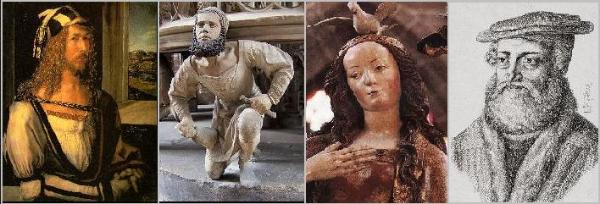
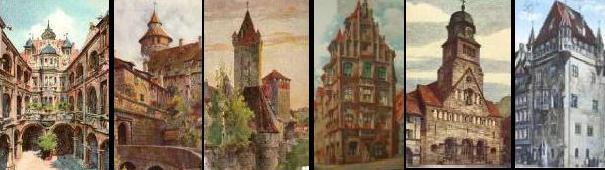
| Nürnberg contained several interesting churches, the finest of which were St Lorenz, St Sebald and of Frauenkirche, all three enshrining valuable treasures of art. St Lorenz was built in. the 13th and 14th centuries and it held the masterpiece of the sculptor Adam Krafft, consisting of a ciborium in the form of an exquisitely minute and delicate 65 foot high Gothic spire. The west front had a magnificent rose-window, and some of the stained glass dated from the 15th and 16th centuries. In front of the altar hung a wood-carving by Veit Stoss. St Sebald contained a bronze sarcophagus and canopy in rich Gothic, adorned with numerous statues and reliefs by Peter Vischer and was considered one of the greatest achievements of German art. The Frauenkirche possessed fine old stained-glass windows, paintings by Michael Wohlgemuth and the Tuchersche altar, one of the finest works of the Nuremberg school about the middle of the 15th century. The church was restored in 1878-1881. Other churches were those of St Jacob, founded about 1,200 and of St Aegidius. The old castle (Kaiserschloss) set high upon a rock on the north side of the town and received its modern form mainly during the reign of the emperor Friedrich I. It was carefully restored to its original appearance in 1854-1856, and part of the interior was fitted up as a royal residence with apartments for the families of the German emperor and of the king of Bavaria. It contained two Romanesque chapels. The castle was a favorite residence of German sovereigns in the late middle ages, and the imperial regalia were kept here from 1424 to 1796. Near it are the ruins of the burg of the Hohenzollerns, the principal existing part of which was the chapel of St Walpurgis. Not far away stood the Luginsland, a stronghold with four corner turrets, said to have been built in 1367 as a watch-tower . The Germanic national museum was established in an old Carthusian monastery and included a gallery which mainly housed German works of the 15th and 16th centuries, including masterpieces by Holbein, Wohlgemuth, Dürer and others. The municipal library contained about 2000 manuscripts and 80,000 books, some of great rarity. The town Rathaus was erected in 1616-1619 but incorporated parts of a 14th century building. It contained frescoes by Durer and other ancient treasures. The fascinating buildings in town included the houses of the old patrician families as well as the dwellings of Albert Durer, Hans Sachs, the cobbler-poet, and Johann Palm, the patriotic bookseller who was shot by order of Napoleon in 1806. There were statues of Durer, Sachs, Melanchthon, founder of the grammar- school, navigator Martin Behaim, and Peter Henlein, the inventor of the watch; The streets were enriched with several fountains, including the famous Schone Brunnen from 1385 and the Gansemenenchen or goose-mannikin, a bronze figure by Pankratz Labenwolf. On the way to the St John cemetery, which contains the graves of Durer, Sachs, Behaim and other Nürnbergers, were the famous Krafft's Stations, seven pillars bearing stone reliefs of the Passion which ranked among his finest works. Nürnberg remained aloof from the quarrels and affairs of the world at large until contributions were demanded for the Austrian War of Succession and the Seven Years' War. Restrictions of imports and exports deprived the city of many markets for its manufactures, especially in Austria, Prussia and Bavaria, and the eastern and northern countries of Europe. The Bavarian elector, Karl Theodore, appropriated part of the land and Prussia also claimed part of the territory of Nürnberg. Nürnberg was handed over to Bavaria in 1808. Its population was then 25,200 and its public debt twelve and a half million guldens. Nürnberg made a brief comeback after the fall of Napoleon. Its trade and commerce revived, its public debt had been acknowledged as a part of the Bavarian national debt, and the establishment of railways joining of Bavaria to the German Customs Union (Zollverein) opened the way to great prosperity. In 1852, there were 53,638 inhabitants. However, it never regained its ancient importance and stature. All the same, it was a historical mecca, full of charm and antiquities, a time capsule of past glories and great minds, full of sublime art treasures, superb craftsmanship and a showcase of a marvelous old culture. |