| East Prussia's share of material war damages amounted to 1,5 billion Marks, and she had also suffered catastrophic loss of life. Even more indignities were forced upon her when she was vindictively ripped away from her ethnic and cultural roots with Germany by the harsh terms set by the Allies at Versailles. East Prussia, now separated from the Fatherland by the new "Polish passage", was all but an island, cut off from substantial and traditional channels of distribution with her neighbouring markets. The majority of road connections and railway lines through former German lands which had been given away to the new Poland at Versailles were now either closed or redesigned to add punitive taxes and outrageous tariffs to the price of German transport. |
| East Prussia and the Aftermath of World War One |
| Wilhelm I did, however, accept the title of Emperor and ruled from 1861 to 1888. Under Otto von Bismarck's guidance, the German Empire was born. A reconstitution of the ancient German Reich brought back the Reichstag as a parliament with Bismarck himself as the first imperial chancellor. He would shape the fortunes of Germany for nearly three decades. His German empire, like its medieval prototype, consisted of separate constituent states: 4 kingdoms, 5 grand duchies, 13 duchies and principalities, and the free cities of Hamburg, Lübeck and Bremen. Germany prospered and grew into a major world power. In 1888, Wilhelm I died and his son Friedrich III became Emperor, only to die of throat cancer after 99 days, at which time his son Wilhelm II took over the throne. Hence, 1888 was known as the Year of Three Emperors. The Hohenzollerns, who had lent their power to the state in the Unification of Germany and in the creation of the German Empire in 1871, ruled until they abdicated the German throne in 1918. |
| The two most powerful Confederation members were Austria and Prussia. The Austrian emperor Franz I lived until 1835 and Friedrich Wilhelm III of Prussia died in 1840; Metternich remained chancellor of Austria until 1848.With Prussia's extensive new lands, Prussian King Friedrich Wilhelm had turned all of his territories into a single customs-free zone in 1818 to bind together his somewhat disjointed extended kingdom and to benefit trade between neighbouring regions. By 1834, his Zollverein (customs union) covered almost the whole of Germany. |
| The revolutions which sweep through Europe in 1848 sparked riots and unrest, prompting the king of Prussia Friedrich Wilhelm IV to propose a national assembly which considered a German constitution. This resulted in elections in the various German states, while in March of 1849 Austria introduced a new constitution treating her entire empire, including Hungary and north Italy, as a single unitary state. Fearful, the German delegates at Frankfurt elected the Prussian king Friedrich Wilhelm IV as emperor of the Germans, but he turned it down. |
| Then came the French aggression under Napoleon. Prussia attempted to remain neutral, and under the Treaty of Tilsit in 1807, Russia and Prussia briefly cooperated with Napoleon, but Napoleon was less than gracious with Prussia. Parts of Poland under Prussian control were shaved off to provide for the grand duchy of Warsaw ( to be ruled by the king of Saxony ), and Prussian territory in the west was taken to make room for the kingdom of Westphalia. French troops remained in Prussia until a huge financial indemnity was paid and Prussia was forced to close her ports to Britain. |
| A revised version of the Confederation of the Rhine and the German states now consisted of thirty-five monarchies and four free cities: Hamburg, Bremen, Lübeck and Frankfurt. From 1815, a German Confederation (Deutscher Bund) was formed as a body with no legislative powers, but a diplomatic assembly of rulers or their representatives in which the British king even had a place as the King of Hanover, as did the Danish Duke of Holstein. The Bundestag, an assembly in succession to the Reichstag of the defunct Holy Roman empire met in Frankfurt. |
| After Napoleon's defeat at Waterloo with the indispensable help of 30,000 Prussians under Friedrich Wilhelm Von Bülow, the countries of Prussia, Austria, Britain and Russia emerged as the four strong world powers and Prussia had proper status in the Congress of Vienna, where Prussian king Friedrich Wilhelm III was represented by Chancellor Prince von Hardenberg. A compromise was reached which brought Prussia new land in the west up to and beyond the Rhine, and Prussia became the greatest power of northern Germany. |
| Beethoven composed Symphony No. 9 in d minor, opus 125, commonly known as the Ode to Joy, and gratefully dedicated it to König Friedrich Wilhelm III. von Preußen. It is the current EU anthem. |
| The capital was moved from the town of Brandenburg to Potsdam as the Hohenzollern dukes and electors became Kings of Prussia, and they steadily attained even greater prestige and power, beginning with the reforms of the administration and the army undertaken by Friedrich Wilhelm, the Great Elector of Brandenburg, and continued by his son and grandson, the first two Prussian kings. With connections to Frankish Nurnberg, Ansbach and the South German Hohenzollerns, and to eastern Europe, the Hohenzollerns were one of the oldest, most important European royal families. |
| The new Habsburg ruler, 23 year old Maria Theresa, was strong but her Habsburg armies proved no match for the Prussians. After Friedrich's first victory over the Austrians in April of 1741, he convinced the French and Bavarians to join him against Maria Theresa. A series of three victories in 1745 won him the title of "the Great". By the treaty of Dresden in 1745, Maria Theresa ceded the greater part of Silesia to Prussia adding about 50% more people to Prussia. On August 29, 1756, 70,000 Prussian soldiers under Friedrich marched into Saxony and launched the Seven Years War in order to keep it. |
| By the end of his reign, barely 5% of the kingdom's revenue was dedicated to upkeep of the royal family and state functions, while in France, for example, the royal family spent up to 50% of the country’s revenue on their upkeep. Friedrich Wilhelm I was therefore able to bequeath a strong economy with a cash surplus and Europe's best-trained army to his son, the future Friedrich the Great. During his reign, Friedrich Wilhelm kept his loyalty to the Holy Roman Empire and its emperor, Karl VI. He supported the Habsburgs against France in the War of Polish Succession. He also supported the Pragmatic Sanction, an agreement that all of the Electors in the Empire would support the succession of Karl VI's daughter, Maria Theresa, to the throne of Austria, should he have no male heir. Friedrich Wilhelm I died in 1740, the same year that Karl VI died. |
| Half of the army was made up of foreign mercenaries, and half were drafted from peasants throughout Prussia and Brandenburg. After training, they could return to their homes and regular jobs for ten months a year. Nobles served as well, but merchants were exempt. East Prussia had been destroyed by plague and famine when he took the throne, and he continued Prussia's tradition of giving refuge to countless religious and political refugees from other regions of Europe and thereby repopulated the devastated land. 20,000 Salzburg Protestant exiles and 8,000 French Huguenots who had arrived in 1685 and 1732 mingled with immigrants from French Switzerland, Nassau, the Pfalz, Magdeburg and Halberstädt, and the total population in East Prussia between 1713 and 1740 rose from 400,000 to 600,000 inhabitants. |
| When Friedrich took the throne, Prussia had 2,400,000 people, 600,000 of them religious or political refugees and/or their descendants. In his reign, he introduced another 300,000 more. By 1786, one third of Prussia's population was of foreign (non Prussian) birth or foreign descent. Friedrich disassociated Prussia from what he considered the corrupt judicial systems of the greater German Reich. He reorganized a system of indirect taxes which provided the state with greater revenue and completely revised the civil service code. Prussia became the first country in continental Europe to abolish torture, give people total equality and fairness under the law and enjoy complete religious tolerance. He allowed freedom of speech and print. Prussia had the reputation of having the best educational system and the finest administration and legal system in Europe. Between 1772 and 1796, Poland was partitioned between Russia, Prussia and Austria. |
| Since 1618, both Brandenburg and Prussia were ruled by the Hohenzollerns, and beginning with the "Great Elector" Friedrich Wilhelm I. after the devastation of the Thirty Years War, its brilliant leaders managed to take backwater Brandenburg to a pinnacle of power and prosperity in Europe. Since there was a sparsely populated Polish region sandwiched between two German regions. Brandenburg acquired another stretch of Baltic coast in eastern Pomerania in 1648 so as to bridge the territorial gap between Brandenburg and ducal Prussia. In the year 1657, Elector Friedrich Wilhelm finally succeeded, through minor warfare and diplomacy, in severing the feudal link between his duchy and the Polish kingdom, and Poland conceded its loss of ducal Prussia in the treaty of Wehlau in 1657. With the peace of Oliva in 1660, the international community recognized Prussia as an independent duchy belonging to Brandenburg. |
| By the time Germany became an Empire, her fortunes were the fortunes of Prussia. To understand how this came about, one must begin with a brief background of the Kingdom of Prussia. |
| Brandenburg was one of seven Electorships of the Holy Roman Empire from the late medieval period, and controlled by the Bavarian royal family of Wittelsbach from 1323 until 1415, when Emperor Sigismund granted it to the House of Hohenzollern who made Berlin their residence from the year 1442. The Hohenzollerns embraced Lutheranism and acquired Ducal Prussia in 1525 and Albrecht of Brandenburg-Anspach secularized the Prussian holdings of the Teutonic Order. In 1618, Brandenburg then expanded its lands to include, among other territories, the Duchy of Prussia. |
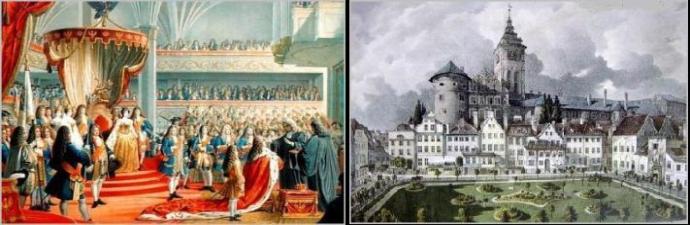
| Under the direction of Friedrich Wilhelm, Brandenburg’s small, but professional army also defeated their former allies/occupiers, the Swedes, in 1675 at Fehrbellin. These achievements enabled Friedrich Wilhelm's son, Friedrich III of Brandenburg, to achieve prominence in 1700 when the Austrian emperor Leopold I needed his help in the War of the Spanish Succession. Since there were no German kings within the Holy Roman empire apart from the Habsburg kingdom of Bohemia, Leopold allowed Friedrich to become the King of Prussia. Thus, Friedrich III was crowned King Friedrich I of Prussia in Königsberg, East Prussia in 1701, below |
| This crippled East Prussian commercial interests. East Prussia was being "starved out" of the markets.By 1939, East Prussia had 2.49 million people, 85% of them still German and all of them in dire peril. They had lived there for centuries and built up the land with their blood, sweat and tears, and by World War Two their culture was on the verge of extinction. Her population was left isolated and at risk and scores of East Prussians had by now fled in wagons and on foot, many never to return to their devastated homes and farms. Those who remained were increasingly harassed. |
| Jumping forward in time, past the invasion and occupation by Napoleon and the era of great kings and philosophers, East Prussia became part of the German Empire in 1871 along with the rest of the Kingdom of Prussia. In 1875, the ethnic make-up of East Prussia was 73.48% German-speaking, with an 18.39% Polish-speaking minority mostly concentrated in the southern Masurian and Warmia part of the province, and an 8.11% Lithuanian speaking minority concentrated in the north east. After 1890, the population started to drop in East Prussia because of emigration and economics, but the population of the province in 1900 was still overwhelmingly German and predominantly Protestant. |
| Prussia, and especially East Prussia as the first threshold of foreign armies, suffered greatly from World War One in physical and material damage. At Versailles, large chunks of Prussia were given away to the newly endowed and reinvented Poland. In 1920, plebiscites in eastern West Prussia and southern East Prussia were held to determine if the areas should join Poland or remain in Prussia within Germany; 96.7% voted for Germany. |
| East Prussia, along the southeastern coast of the Baltic Sea, enclosed the bulk of lands of the now-extinct old Prussians. In prehistory, the east of the area was inhabited by the Eastern Balts. In time, the Western Balts consolidated into the Old Prussian nation, while the Eastern Balts, including the "Curonians", consolidated into part of Latvia and Lithuania. Parts of the Baltic region remained wilderness for longer than anywhere else in Europe. About 350 BC Pytheas called the territory Mentenomon and the inhabitants Guttones, neighbors of the Teutones. The territory was called "Brus" ("Prus") in an 8th century German map. Vikings penetrated into the area in the 7th and 8th centuries and many were absorbed into the local population, especially in the bigger trade areas such as Truso and Kaup where they were said to travel nack and forth across the Baltic Sea. In expeditions launched by the Vikings and Danes later, many areas in Prussia including Truso and Kaup were destroyed. |
| The old Prussian language belonged to the Western branch of the Baltic language group, but old Prussians spoke a variety of tongues, including German, and some related to modern Latvian and Lithuanian languages. Eastern Prussia from the 13th century on was almost entirely German as a result of German settlers. In 1457, Königsberg became the center of the Teutonic Order or Knights. |
| In the 13th century, more German emigrants arrived to settle the Prussian lands, and the Order was now an independently formed, noble political entity, and in 1243 and in 1263, the Pope allowed the knights to monopolize the grain trade. The Grand Master went to Venice after the fall of Acre in 1291, and then, after conquering Pomerelia in 1309, to Marienburg in Prussia, absorbing the Sword-Brethren in Livonia whose expansion had taken place further east. The knights administered their lands from Marienburg and granted considerable freedom to the cities, many of which joined the Hanseatic League. The Order was defeated in 1410 at Tannenberg by Poland and Lithuania, and after a revolt in its own territories it became a vassal of Poland. |
| All across East Prussia, the landscape was dotted by old castles of the Teutonic Knights. During the siege of Acre in 1190, the Teutonic Order began as a hospital brotherhood to care for the many sick German crusaders who were denied medical care from others. It was turned into a military-monastic order in 1198, reflecting the involvement of the Hohenstaufen dynasty in the Holy Land. The order conquered territory in the Holy Land, and then, under grandmaster Hermann von Salza, Eastern Europe, where they rose to prominence. They were in Hungary by 1211-25. After 50 years of war, the knights had subdued the pagan Prussians, who had risen in revolt repeatedly and were now reduced to serfdom. The order allied themselves with the Polish dukes of Masovia and Silesia to both subjugate the Prussians and fight against Novgorod. |
| The main feature of Friedrich Wilhelm's internal policy was the establishment of a system of permanent taxation, the revenue from which funded a strong, standing army. By the time the Great Elector's grandson Friedrich Wilhelm I took power, the Prussian army amounted to 80,000 men, a whole 4% of the population, in a system which kept many armed men as a highly trained citizen army without damage to the economy. It had a highly effective officer corps and the first effective light cavalry. He also established a native arms industry. Aptly called the Soldier King, he achieved considerable success in his endeavors and managed to acquire Pomerania from Sweden. |
| Friedrich II inherited the Prussian throne at age 28. Cultured and intelligent, Friedrich not only read poetry, established a court orchestra and provided Berlin with an opera house, he jumped to attention when Emperor Karl VI of Austria died on October 20, 1740. Despite the Pragmatic sanction, Elector Carl Albert of Bavaria, King Philip V of Spain, and Augustus III of Saxony all contested Maria Theresa’s succession. Friedrich II offered to adhere to the Pragmatic Sanction and support Maria Theresa in return for Prussia occupying Silesia. Maria Theresa refused. So, taking advantage of the turmoil caused by the disputed succession, in December of 1740, Friedrich the Great ordered his army to invade the rich Habsburg province of Silesia, astonishing Europe. |
| German farmers, war widows, children and old folks were victimized by marauding gangs of communists, nationalists, hoodlums and people who just wanted to steal their property. Violent acts against these vulnerable and unprotected Germans were rampant. Over 154 complaints lodged on behalf of the oppressed and victimized citizens had been submitted to the League of Nations by 1933, and all were ignored. The situation grew more violent and even in 1939, in the wake of bloody massacres, the British and American media still downplayed or scoffed at the plight of these ordinary human beings forced to flee their homes. |
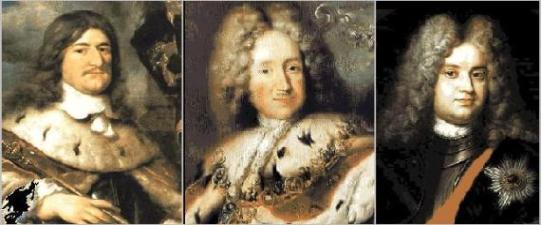
| Der Große Kurfürst Friedrich Wilhelm; Friedrich I. König in Preußen; Friedrich Wilhelm I |
| Friedrich II. von Preußen "Friedrich der Große"; Friedrich Wilhelm II; Friedrich Wilhelm III. |
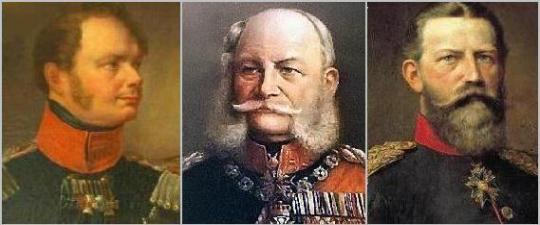
| Friedrich Wilhelm IV von Preußen; Wilhelm I von Preußen; Friedrich III |
| Prussia: A Brief Background ~ Prussia Glorious |