| The Flying Machine |
| Friedrichshafen before and after WW Two British bombing |
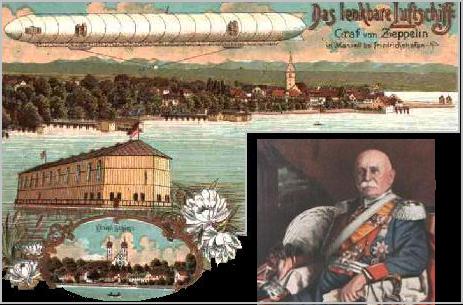
| Germans were also improving air travel. Aviation pioneer Ferdinand Adolf August Heinrich Graf von Zeppelin (1838–1917) was the energetic founder of the Zeppelin Airship company. After receiving an education at Ludwigsburg Military Academy, the University of Tübingen and the Stuttgart polytechnic from 1853, he entered the Prussian army in 1858 and went to the United States in 1863 to work as a military observer for the Union army during the American Civil War. Here, Zeppelin visited Thaddeus Lowe's balloon camp and then a balloon camp where the German aeronaut John Steiner helped him. Zeppelin actually made his first balloon flight in the state of Minnesota before returning to Germany where he served in the Franco-German War of 1870-1871; he was retired from the military in 1890 at age 52 with the rank of brigadier general. This gave him the free time to work on his airship ideas. The Zeppelin airship company made its home in Friedrichshafen, a town in the proximity of Ludwigshafen on the northern side of Bodensee in southern Germany near the borders with Switzerland and Austria. Zeppelin, who was born in Konstanz, originally had his airships built in a floating airship hangar on the lake which could be aligned with the wind to support the difficult starting procedure. He began constructing his first rigid airship in 1899 following a design he had patented in 1895, with a tubular aluminum frame which, instead of using sheets of metal as a cover, used a fabric cover not intended to be gas-tight. The gas was enclosed in bags in compartments of the hull separated by transverse aluminium girders. Zeppelin made three flights with the "LZ 1" over the Bodensee. The public was excited by the idea and the second version of his airship was entirely financed through donations and a lottery, followed later by a campaign which raised 6.5 million German marks to create the 'Luftschiffbau-Zeppelin GmbH' and a Zeppelin foundation. From this point on, development proceeded rapidly, and by 1900, Zeppelin had spent nearly a decade working on his dirigible. Zeppelin’s success moved steeply upward from the year 1906, with continued support from various lotteries and gifts from an ecstatically enthused public. The military administration was soon buying airships, and in 1909, Zeppelins also were used in civilian aviation. Large production plants and workshops were soon developed, and several cities took part in the building of airship hangars and a network to connect the large German cities on the airway. Additionally, training centers for Airship pilots and crews were created and Zeppelin established the Zeppelin Foundation, an institution which promoted social projects such as housing developments and sports arenas. Up until 1914, the German Aviation Association (Deutsche Luftschiffahrts- gesellschaft or DELAG) transported 37,250 people on over 1,600 flights without an incident. Apart from the building of airships, aircraft construction also strongly interested Zeppelin, and in the year 1907, he supervised the construction of an airplane and later a hydroplane. As World War I began, Zeppelin advanced his ideas of enormous airplanes which could be used for bomber purposes. The Zeppelin was too slow and explosive a target, and about 40 were shot down over London. In June 1915, an enormous airplane of the "Gotha" type was built, a prototype of a long-range bomber which was used with some strategic success. The Germans had seven operational dirigibles at the onset of war, but they quickly lost three to anti- aircraft fire. Influenced by Korvettenkapitan Peter Strasser, the navy bought more airships which were used for reconnaissance patrols through 1914. Bombers of the Royal Navy Air Service attacked Zeppelin production lines and their sheds at Cologne and Düsseldorf in September of 1914. In late 1915, the order was given for attacks on German industrial targets, and the British began strategic bombing to support infantry actions of the Western Front, to attack the German submarines in their moorings and to bomb steelworks. The Kaiser was very reluctant to attack Britain, but finally granted such permission conditional on the order that no attacks were to be undertaken against civilian targets. The Germans bombed military targets in Great Yarmouth (home to a submarine squadron which was attacking German ships in the Bight), Kings Lynn (iron works), and Sheringham on January 19th 1915. In all, four people were killed and the British press reported the incidents as civilian attacks. They continued about two raids month raids alongside of continuing reconnaissance. However, there was no policy of bombing civilian targets until after June 15, 1915, when French aircraft attacked Karlsruhe and Baden, killing 29 civilians and wounding 58 in a purely civilian attack. Up until this time, the Kaiser had forbidden any attacks against civilian targets in Britain, and the civilian deaths which occurred were a result of collateral damage. After a series of devastating civilian raids by French bombers on German cities, the Kaiser, still reluctant, authorized bombing London and on May 31, 1915 the first raid was carried out, killing seven. Throughout the remainder of the year, Zeppelins raided London frequently. They flew too high for most planes to stop, and the small aircraft ammunition of the time had little effect on them. |
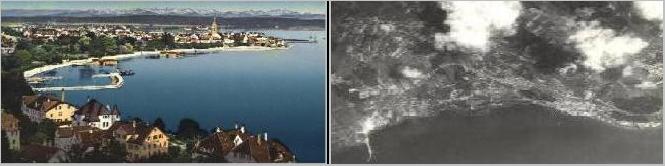
| While they also bombed Paris slightly, the Germans concentrated their efforts on Britian. Raids continued in 1916. Since navigation was primitive, it is estimated that only 10% of the bombs dropped from Zeppelins actually hit their target. In fact, London was bombed accidentally in May. In a revenge raid on the afternoon of June 22, 1916, French pilots again bombed Karlsruhe, Germany, this time a circus tent, killing 120 persons, most of them children. Things escalated and in July, the Kaiser allowed raids against urban centers. There were 23 airship raids in 1916. After the loss of several airships, the Zeppelin factory began producing larger, more powerful airships with more engines, but the British planes were armed with a mixture of explosive and incendiary bullets which could penetrate the Zeppelins and set them on fire. The German military was becoming disillusioned with the Zeppelins, and began using the new Gotha and Giant bombers to attack Britain, but they needed to fly higher against improved anti-aircraft fire, and the third generation of Zeppelins, the "Height Climbers", were born. These airships were capable of reaching an altitude of 20,000 feet. But British air defenses were also improving and they began to have success with night interception and even more perfected anti-aircraft fire. The last raid of the war was carried out on the night of October 19-20, 1918. Of the 115 Zeppelins used by the Germans, 53 were destroyed and 24 were gravely damaged. Their crews suffered a 40% loss rate. The Germans were ordered, under the treaty of Versailles, to hand over all their airships, but their crews managed to destroy as many of them as they could first. At the age of 79, Ferdinand Graf von Zeppelin died in Berlin in 1917, before the end of World War One. He fortunately did not live to watch his hard work and immense contributions to aviation be shattered and stolen with German defeat. Although the Allies shut down the Zeppelin project after World War One per the demands of the Treaty of Versailles, and despite France having greedily seized Zeppelin's prize dirigibles, airship construction rebounded against all obstacles, and the Zeppelin company worked hard to resume civilian flights quickly. Faced with considerable difficulties, they completed two small Zeppelins put into use by August 1919, and in the following two years actually transported some 4,000 passengers; However, in 1921, the Allied Powers decided to demand that these two Zeppelins should be delivered as "war reparations", albeit a bit late. Further Zeppelin projects could not be realized at the time because of the punitive Allied interdiction, and this temporarily halted German Zeppelin aviation. In the later first third of the 20th century, the industry did manage to rebound, however, and once again contributed significantly to Friedrichshafen's prosperity, but the Zeppelin's era of glory ended with the explosion of the Hindenburg in 1937. It's history and industry made the town a target for Allied air strikes, notably in "Operation Bellicose", in the latter part of World War II which was supposed to target outlaying industry. In a moonlight raid on June 20/21,1943, 60 Lancasters attacked the Zeppelin works at Friedrichshafen using a feature later known as 'the Master Bomber' technique. 10 per cent of the bombs actually hit factories. The rest fell squarely on the pretty old town's historical center, almost completely flattening it. At the end of war, French Occupation Troops stole most of the Zeppelin Museum's valuable exhibits and sent them back to France, just as they had done with actual Zeppelin airships after World War One. Some have been returned. |
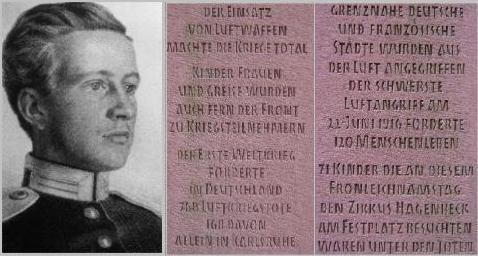
| Above: Young Zeppelin during the American Civil war; Monument to victims of the June 15, 1915 French attack Side One: "The use of air forces made the war total. Children, women and the elderly became participants in the war even far behind the front lines. 768 people died in air attacks on Germany, 168 of them in Karlsruhe". Side Two: "German and French cities near the border were attacked from the air. The heaviest attack on 22 June, 1916, claimed 120 lives 71 children who were visiting the Hagenbeck circus on the festival square on that Corpus Christi holiday were among dead" |