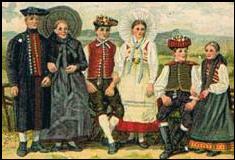
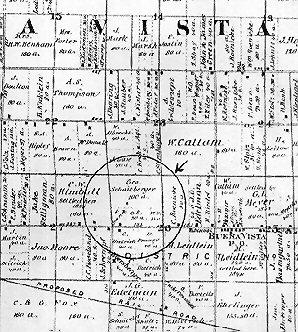
| Shortly before Georg's departure, Rev.Wilhelm Loehe, a charismatic country pastor in the village of Neuendettelsau, had been moved by missionary Friederich Wyneken's call for help in Christianizing the Indians of North America, and Loehe organized a mission society for training lay preachers for this work. From his tiny German village, he eventually organized four colonies in the Saginaw, Michigan area: Frankenmuth, then Frankentrost, Frankenlust and Frankenhilf. His fledglings pledged to remain loyal to the church, Germany and to the German language. See in greater depth elsewhere The Missionary movement was in full swing, and nowhere was the image of "natives" beheld with such curiosity as it was in Germany. The romantic fascination with "heathens" led to an urgency to introduce them to God's Word, and missions were established from Asia to North America. Upon landing in America after a long, perilous voyage, the early settlers made their way toward the Saginaw valley, which was at the time only a dismal, bug-infested swamp where bear and wolves still prowled. They cleared the land, built log houses and a church and forged primitive roads. The settlers, still in their Franconian dress, found themselves to be a strange sight indeed to English and French settlers, and assuredly to the Indians! Their dialect was even difficult for other Germans to understand. Worse, the colonists had arrived knowing nothing of Indian culture! The Indians were already relocating in search of better hunting grounds and only a handful were "Lutheran material." But the brave, determined settlers soon turned the wilderness into fertile farmland. While Germany was moving ahead with the industrial revolution and modernization, these colonists had reverted back into an almost primeval past in the forests and untamed areas of a new world. Other settlers soon joined them, and Loehe, hearing of the success of Frankenmuth, encouraged the settling of Frankentrost. In 1847, Georg Schaitberger's older sister and her husband migrated there among the first settlers. After Georg Schaitberger arrived in America, he too made his way to Saginaw after a sojourn in western Pennsylvania. He was remarried around 1850 to Elizabeth Leidel, who was from his old neighborhood in Franconia. When Georg arrived in Michigan, he brought a team of horses with him and began to operate a stage route. He and Elizabeth bought a 150 wilderness acres in Buena Vista township adjoining Frankentrost and the family "camped out" long enough to build a house. In time, they created a fertile, successful farm. Here, he found himself among a tight knit group of friends and families that were associated in the old world as well as the new. He and the others were active in their own little church, and soon, the Frankenmuth and Frankentrost area established hotels and flour mills, saw mills and woolen mills. The industrious settlers produced sausage, cheese and... beer. |
| An Odd little Settlement in the Wilds |
| A German-American Family |
| Georg and Elizabeth had 8 children, one of them being Johann Simon Schaitberger, born May 20, 1856. Georg was active in his church and community, and busy with his farm and family. In 1859, Georg is listed as a Justice of the Peace for Buena Vista Township, formerly part of East Saginaw. After Elizabeth died in 1869, Georg remained a widower until 1878, when at age 59 he married a widow with whom he had one more son. He died October 11,1888. The baby girl George fled Germany with grew up, married and enjoyed a long life. Georg is listed in the 1880 census as a farmer as is his son, Johann Simon, who by now had married and had a baby son. Farming at this time was losing its appeal as more factory jobs, lumbering and railroad work arrived in the area. More diverse immigrants were arriving and the Frankonians were no longer isolated. Germany, meanwhile, had become a strong, wealthy and well-respected empire under Bismarck's leadership, and although many of the issues which caused the settlers to leave their German homeland were now resolved, most had no desire to return to the old country. They were now German-Americans. |
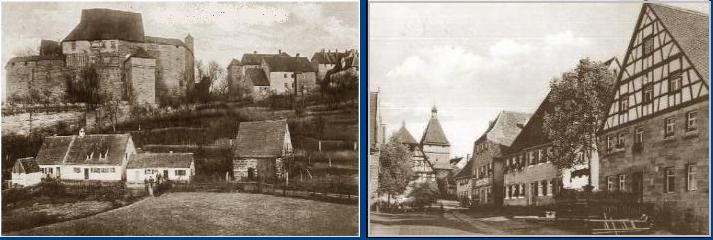
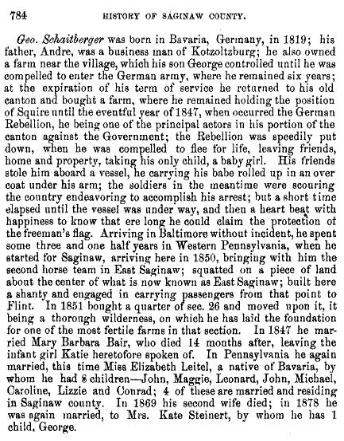
| Dissatisfaction was in the air when Johann Georg Tobias Schaitberger was born in Cadolzburg, Mittelfranken in 1819 into a family of chimney sweep masters not even a decade after mostly Protestant Frankonia was attached to Catholic Bavaria and given a back seat in political matters. Georg was 16 when the first railroad line opened in Germany on December 7, 1835. Named the “Ludwigbahn”, it connected Nürnberg and Fürth. The locomotive imported from England was named the “Eagle” and cost 850 pounds of sterling. Delivered by ship to Rotterdam, then put on a Rhine ship to Cologne, it was then sent by cart to Nürnberg. Georg soon began his compulsory six year military service for a Bavarian king he felt no duty to. Around this time, in 1838, when an edict came down from the King requiring the soldiers to genuflect in certain parades, the mostly Protestant draftees from Upper and Middle Frankonia refused, and although the order was withdrawn it had created even harsher feelings. After the army, Georg purchased a farm with his military discharge pay and started a chimney business in the village of Wachendorf, where he married in 1847. Alas, his wife died shortly after giving birth to their baby daughter. Meanwhile, as the story goes, Georg actively led a local rebellion and soon became a wanted man. In grave danger, he was suddenly forced to leave his home, friends, family and all he owned behind and flee with his child. With the baby smuggled in an overcoat under his arm and "soldiers in hot pursuit", he evaded capture and his friends were able to whisk him away to Bremen and a ship bound for America. |
| Franken to Frankentrost 19th Century Immigration |
| Excerpts from September 1856 to August 1862, Birth, Baptism, Marriage and Death Register of St.John's Lutheran Church, East Saginaw, Michigan, page 3 Birth and Baptism Records |
| page 4 and 5 #1 HAMILBACKER (Hammerbacker): George Leonhard, son of Andreas HAMILBACKER and wife Kunigunde of Zilwaukee, Michigan. Born August 23, 1850. Bapt. September 26, 1856. Sponsors: Georg Leonhard WALKENDOERFER and wife Anna Eva. #2 HOCHDANNER: Friedrich #3 Twins: Eva Margaretha, son and daughter of Georg Adam HOCHDANNER and wife Magdalena of Middle Franken. Saginaw County, Michigan. Born June 8, 1856. Baptized (no date). Sponsors: Friedrich BINDER and wife. #4 LEIDLEIN: Johanna Friederika, daughter of Michael Leidlein and wife, Dorothea of Frankentrost, Michigan. Born: May 3, 1856. Bapt. May 12, 1856. Sponsors: John LEIDLEIN and wife. #5 KOLB, Justus, son of Stephen KOLB and wife Marie Agnes of Saginaw, Michigan. Born. April 15, 1856. Baptized June 1, 1856. Sponsors: Justus Schmidt and A. M. Schmidt. #6 SCHAITBERGER: Johann Simon, son of Georg SCHAITBERGER and wife, Elizabeth of Frankentrost. Born: May 20, 1856. Baptized: June 1, 1856. Sponsors: Simon DIETRICH and wife. #7 REIS: Andreas Herrman, son of Nicholas REIS and wife Katherine of Saginaw, Michigan. Born April 18, 1856. Bapt. July 29, 1856. Sponsor: Andreas RITTER. #8 DIETRICH: Anna Elizabeth, daughter of Johann (Simon?) DIETRICH and wife Kunigunde, Frankentrost. Born: June 21, 1856. Baptized June 29, 1856. Sponsors: G. SCHAITBERGER #9 MAIER: Anna Katharine, daughter of Georg MAIER and wife Rosina of Saginaw. Born: December 3, 1853 Baptized December 17, 1853. Sponsor: (no name) #10 MAIER: Christina Caroline, daughter of Georg MAIER and wife, Rosina, Saginaw, Michigan. Born: September 23, 1855. Bapt. April 20, 1856. Witnessed by Parents. #11 HOEPFER: Johannes, son of Jacob HOEPFER and wife Barbara of Saginaw, East Side, Michigan. Born: August 19, 1855. Bapt: April 20, 1865. Witnessed by Parents. #12 VOGT + : Adam Johann, son of Mr. VOGT. Saginaw, East Side, Michigan. Born: March 27, 1856. Bapt: April 20, 1856. Sponsor: Phillip LOEFFLER and Chr. RITTER: Johannes Friedrich, son of Fritz RITTER and wife Dorothea nee BUETTO (BUETOW?) of Saginaw, Michigan, East Side. Born: March 7, 1856. Baptized, 8th Sunday after Trinity. Sponsor: Friedrich MU___?__ and John PALM. page 6 and 7 #13 HAEGENAUER (HAGENAUER): Johan, son of Johan Chr. HAEGENAUER and wife Barbara, East Saginaw, Michigan. Born: April 20, 1856. Baptized May 6, 1856. Sponsor: Marda WERN or KERN. #14 SUHR (SAHR?): Carl, son of Friedrich Suhr and wife Marie. Born in Mecklenberg. Now in Saginaw, East Side, Michigan. Born: February 8, 1856. Baptized May 18, 1856. Sponsors: Carl SIMON, Fritz LANDON, Christoph |
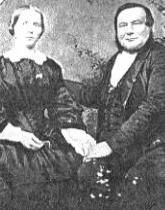
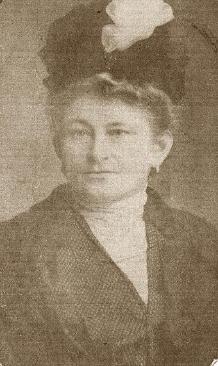
| From left: Cousin Veit Schaitberger and wife Augusta. He was a minister in Roßtal from 1850-1863; Georg's farm in Buena Vista Township Michigan Article about Georg from: The History of Saginaw County, Michigan; by Leeson, Michael 1881 Katharine Schaitberger Schlukbier (she was the baby Georg left Germany with) |
| P38/39: #48 Schaitberger, Johann Leonhard Michael, son of Georg Schaitberger and wife Elisabetha, Frankentrost. Born, 5 June 1858, baptized 4 July 1858, sponsors Johann Leonhard Haenlein [Heinlein] and wife. P46/47: #11 Heinlein, Elisabeth Margaretha, daughter of Johann Leonard Haenlein [Heinlein] and wife Margaretha nee Leidlein, Frankentrost. Born 24 September 1858, baptized 17 October 1858, sponsors Schaitberger and wife. John Baumgaertner. p72/73: #69 Schaitberger, Kunigunde, daughter of Georg Schaitberger and wife Elisabeth nee Leitel [Leidel], Frankentrost. Born 24 March 1860, baptized 22 April 1860, sponsors Johann and Kunigunde Lantrich p94/95: #5 Schaitberger, Elisabetha Margaretha, daughter of Johann Georg Schaitberger and wife Elisabetha nee Leidel, Frankentrost. Born 30 December 1861, baptized 10 March 1862, sponsor Leonhardt Haenlein [Heinlein]. P104/105: Confirmation Class, Sunday, 18 April 1858 #4 Schaitberger, Johann, born 5 November 1845 (Other classmembers: Conrad Brechtelsbauer, J. Jakob Scherrer [Scharrer], J. Michael Funk, Kunigunde Moser, Friedrika Dorothea Christina Sahr, Kunigunda Bayer, J. Joachim Friedrich Falkenhagen, J. Jakob Heinrich Oland, Georg Andreas Hegenauer, Anna Maria Cordelia Huebner, Hermina Theresa Henrietta Thieme, Maria Elisabeth Eichinger, Ernestine Carolina Faeks, Margaretha Huebner). Confirmations, Sunday after Easter, 1861 #7 SCHAITBERGER, Katharine, (no birthday). |
Click on images