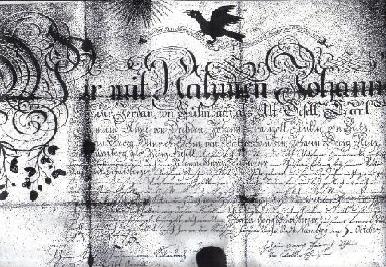
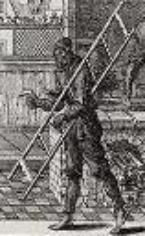
| Philippus Schaitberger, Joseph Schaitberger's first born and only surviving son with Catharina Brochenberger, was born in Mittelfranken in 1692. Lovely, young Catharina, typical of women of the time, had children in rapid succession, and she died after only six years of marriage and the deaths of three other infant boys. Joseph never again remarried. Philip's life is probably similar to many first generation immigrants in Franconia. Children at the time didn't have much of a childhood and often had to go to work at an early age. The literacy rate of the general public was only about 20 percent and education was infrequent. Mining was no longer an option as a hereditary occupation, and Philip learned a new trade from an uncle, hence ushering in a long family line of chimney sweep masters in Mittelfranken. Philippus is recorded as being a sweep master in Zirndorf, Pappenheim, Weissenburg, Bad Windsheim, Erlangen and Ansbach in the Margraveship of Ansbach. In 1712, at twenty years old, he married Margaretha Beckert in Erlangen, daughter of soldier Christoph Beckert and wife Dorothea. He and Margaretha had eight children. The first born, Leonard, was born around Zirndorf in 1712, the same year that Friedrich the Great was born. Philipp lived in Ansbach from 1736 to his death in 1759, during the reign of Karl Wilhelm Friederich, the "Wild Margrave," who was also born in 1712. The Wild Margrave's exploits were legendary. One story relates that because one of the Margrave's mistresses wanted to see a chimney sweep fall from a roof, Wild Wilhelm shot one who was working nearby. The story was a bit vague, but a sweep's brush could be seen protruding from an old chimney at a nearby home for decades until a nearby Allied bomb blast jarred it loose in World War Two. The Schaitbergera were the royal chimney sweeps in Ansbach during this time, and although there is no record of any of them having been shot, Leonhardt Schaitberger, who carried the title of "Hochfürstlich Onolzbachischer Hoff Caminfeger- meister", lost one of his sons to a "chimney fall" in the late 1750's. Philip, the first in his family to be born on foreign soil, would have been forty and his son Leonhardt twenty years old when the long lines of Salzburg exiles passed through Franken on their trek toward East Prussia. Even in Mittelfranken, in the company of many other "Salzburgers", the old dialect and customs quickly gave way to the those of their new Franconian friends and neighbors. Before long, they would think of themselves not as Salzburgers, but as Franconians. The Schaitberger family dispersed throughout the region. First born son Leonhard would become a sweep in Ansbach, then a sweep master in Erlangen. One line remained in Ansbach and would be last mentioned in 1887. Another went to Coberg where the name was last mentioned in the 18th century. |
| The Exiled Schaitberger Family Begins Anew |
| Philippus the Chimney Sweep |
| The Chimney Sweep |
| The castles and monasteries in Germany were the first high-rise buildings created of stone. Fire areas were eventually moved from the middle of the room to a corner of two exterior walls where channels were constructed over the open fire for the smoke to escape to the outside. From this began the development of chimney construction and when the history of the chimney sweep began in Germany, and it was initially a service pioneered for use in the imperial cities by royalty and the wealthy burghers in the 16th century. For the common citizen, the cleaning of chimneys was unregulated and fell to the occupants of the house. The dangers of the old open fireplaces were largely limited to external spark fires and not chimney fires. With the advent of the popular tiled stove in the 16th century, more danger came from soot formation and the accompanying chimney fires. Since these stoves came to Germany from Northern Italy, most of the sweeps at this time were initially Italian, but the occupation soon spread. In the 16th and 17th centuries, a master chimney sweep could apply for work at a Royal Office and be reviewed for suitability as a Privileged Royal Chimney Sweep. The formation of guilds began in the 17th century: The first order of the Viennese Rauchfangkehrer dates from 1664, in Basle from 1661 and in Berlin from 1697. In 1703, a guild was formed in Nürnberg, where sweeping was ranked among the free occupations. By 1729, the craft spread over Europe and guilds were formed in Copenhagen, Denmark, Sweden, Norway and Russia. By now, the chimney sweep, known in Germany as a Schorsteinfeger, Schlotfeger, Kaminfeger, Kaminkehrer or Rauchfangkehrer, not only cleaned chimneys, they supervised their construction. German fire protection laws strengthened in the 18th century and the sweep occupation adapted along with new chimney and furnace construction and improved fire fighting methods. A high master might have two to ten workers, and each Master would have a territory, with a foreman, an under journeyman, a journeyman and sweeps, the youngest being 13 to 14 years old. The foreman and others often lodged with their Master who usually had a large home and yard where the soot, which was valued as fertilizer, could be stored and sold. The sacks which one sees in old drawings of sweeps held the soot which was used on many farms until the early 20th century. Children did not do roof work, but rather the bending and climbing inside the chimneys with their knees. This aspect of mounting and cleaning was still part of Berlin's Sweep Examination until 1972. In the 18th and 19th century, a four to six-year training was usually required and the apprentices still lived in their master's houses into the early 20th century. The sweep as "Glücksbringer" (luck bringer) goes back to an old tradition where the chimney sweep went from house to house and wished a good year to all, and having a sweep present at a wedding was thought to guarantee marital bliss. The sweep's cylinder hat came about around 1830. Duties of sweeps also included putting out chimney fires, which often entailed climbing into a burning chimney from one end or the other. Being a sweep was risky for one's health in other ways: Some of the risks that faced the chimney sweep were carbon monoxide poisoning from blocked flues, carcinogenic chemical exposure by both contact and inhalation, poisoning from various metals, exposure to diseased birds, and, as illustrated in many old prints, seemingly endless encounters with lusty parlor maids. Sweeps also risked lightening strikes, bee stings, spider bites, cuts from rusty nails and fatal or serious falls. There were cases of sweeps choking to death by inhaling soot. Today, there is a new risk. The old German laws which have shielded chimney sweeps from competition since the Middle Ages have been attacked by E.U. who demands diversity by allowing foreign chimney sweeps to have equal employment in Germany so that they too can break their necks. |
| Philippus Schaitberger "Hochfürstlich Bayreuthischer Unterländischer Caminfegermeister." Das erste Kind aus dieser Ehe war der Leonhard, getauft 29. März 1712 in Zirndorf |
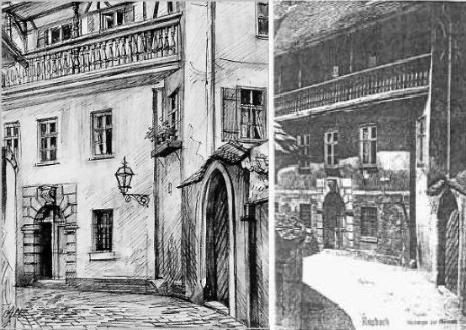
| Philipp Schaitberger acquired a huge baroque compound in the old city of Ansbach from where five generations of family sweep masters sprang forth. Many acquired other territories. The Margrave's physician, Dr. Lälius (Laurentius Loelius/Laelius), lived in the Schaitberger house in Ansbach until the end of the 17th century and created a portal in the year 1681 with his coat of arms. The Schaitberger chimney sweep dynasty then acquired the complex. The northeast front of the house is contains a piece of the town wall originating from the 15th Century, which the Margrave Albrecht Achilles established around 1450. The house is later referred to as the Herberge zur Heimat from its later use. In the 19th century, a movement sprang up across Germany similar to the Salvation Army, and many large rooming houses were used for working men in transit. They were usually large, clean and free or inexpensive for two nights or more. Eventually the Schaitberger compound was willed to the city by the widow of Philipp's great grandson at the end of the 19th century. There is also a Schaitberger Strasse in Ansbach, this one named not for Joseph but for chimney sweep Phillip Schaitberger |
| Schaitberger Haus Ansbach |
| The drawing of the Herberge und Heimat, above left, is by German painter Theodor Friedrich Zacharias Alt (1846-1937). Center: Schaitberger Haus as shown in Geschichte der Stadt Ansbach, 1927. Sweeping was generally a family occupation. The document shown above is a sweep document with Philip's son Leonhardt's and one of his son's names with the Hohenzollern royal seal. |
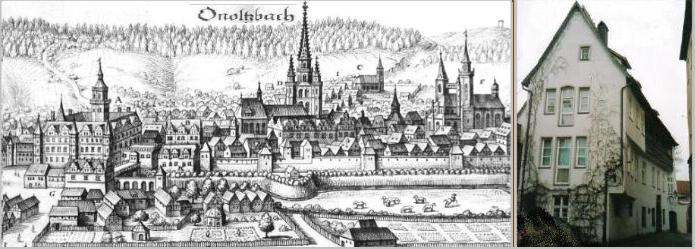
| Schaitberger Haus Ansbach |